AI Voice Agent for Small Business: Answer Every Call
AI voice agent for small business: how it works, what it costs, where it fails, and how to launch one in 14 days without annoying your callers.
Your phone rings while you are under a sink, on a ladder, or with a paying customer in front of you. The caller waits four rings, hangs up, and dials the next business on the list. That quiet leak is why an AI voice agent for small business has become one of the most practical tools a five-person company can buy.
Here is what these agents are, how a call flows through one, what they cost, where they break, and what you now have to tell callers. We also read what owners say in public forums after six months of living with one.
Key takeaways
An AI voice agent answers, understands, acts and hands off. It is not a phone menu with a nicer voice.
Adoption moved fast: 66% of customer service organisations now use AI agents, up from 39% a year earlier.
The cheapest early win is after-hours and overflow cover, not replacing your front desk.
Owners who stay happy with theirs share one habit: they read call transcripts every week.
In the EU you must tell callers they are speaking with an AI system, and that duty has applied since 2 August 2026.
What an AI voice agent for small business actually is
An AI voice agent is software that picks up a phone call and holds a real conversation. It turns speech into text, works out what the caller wants, takes an action in one of your systems, and replies out loud in a synthetic voice.
The important part is the action. A voice agent that only talks is a demo. One that writes a booking into your calendar, logs the caller in your CRM and sends a confirmation text is a member of staff who happens to be software.
Three things get blended together, so it is worth separating them. Voicemail records. An IVR routes you through a numbered menu. An AI voice agent listens to an unscripted sentence and does something about it.
Menus fail in a specific way: if the caller's question matches no option, the menu has no answer and the caller leaves. We unpacked that in our piece on conversational IVR. If the labels confuse you, our explainers on the AI receptionist and the AI phone agent describe the same category with different marketing emphasis.
How a call flows through an AI voice agent
A single call passes through six stages, and each one is where quality is won or lost.
Transcription. Speech becomes text in real time, usually within a few hundred milliseconds.
Intent. A language model reads the text plus your instructions and decides what the caller wants.
Action. The agent calls a tool: check availability, look up an order, create a ticket, send an SMS.
System write. The result lands in your calendar, CRM or helpdesk while the caller is still on the line.
Speech. The reply is spoken back with text to speech.
Handoff. Anything outside the agent's remit transfers to a person, with the transcript attached.
Handoff is where cheap setups give themselves away. Transferring a call is easy. Transferring the context, so your colleague does not ask the caller to repeat everything, takes real integration work.

Figure 1: the six stages of an AI-handled call, with the latency budget that keeps a conversation feeling natural. Source: Callin.io.
Latency deserves its own note. Conversation tolerates roughly 200 to 300 milliseconds of silence before a pause feels wrong. Push the round trip past a second and callers start talking over the agent.
Why small businesses are adopting voice AI now
Voice automation used to be an enterprise project: a telephony integrator, a speech vendor, months of calendar time and someone in-house to own it. No-code platforms removed all four, which is why a two-van plumbing firm can go live in an afternoon.
The adoption data backs that up. In Salesforce's State of Service research, published in May 2026 from 3,075 responses collected that March and April, the share of service organisations using AI agents rose from 39% to 66% in twelve months, and 70% saw measurable value within 60 days. The figures are in the Salesforce research summary.
There is peer-reviewed evidence too. In NBER working paper 31161, Erik Brynjolfsson, Danielle Li and Lindsey Raymond studied customer support agents and found productivity rose 14% on average, and 34% for novice and low-skilled workers, with little change for the most experienced staff. The paper is public.
Read that finding carefully, because it tells you where to point an agent first. The technology lifts the floor far more than the ceiling. Your best salesperson will not get better. Your unstaffed Tuesday evening will.
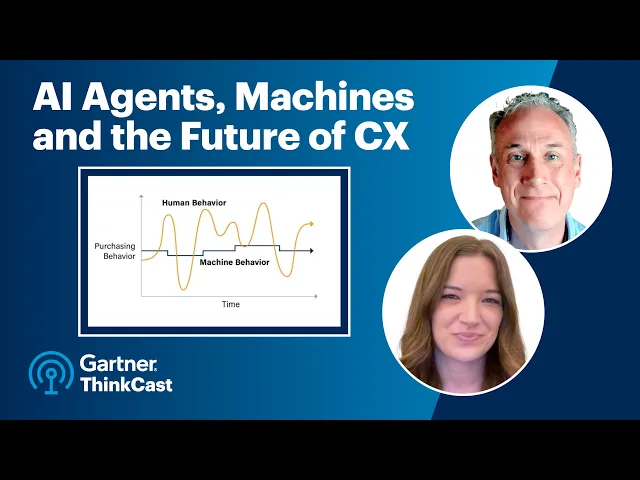
Video: Gartner analysts on AI agents, machine customers and the direction of customer experience. Source: Gartner's official YouTube channel.
The analyst view points the same way. Gartner expects agentic AI to resolve 80% of common customer service issues without human intervention by 2029, with a 30% cut in operating costs, per its March 2025 press release.
Five use cases that pay for themselves first
Nobody should switch their whole line over on day one. These five jobs return value quickly, roughly in order of how easy they are to get right.
After-hours and weekend cover. The agent answers at 21:40, captures the enquiry, books what it can, queues the rest. Lowest risk, clearest value.
Overflow during spikes. When three lines ring at once, calls four and five reach an agent instead of a dead tone.
Booking and rescheduling. The agent reads live availability and writes the slot. Our guide to AI appointment scheduling covers the calendar mechanics and no-shows.
Tier-one questions. Opening hours, order status, where to park, what to bring. Repetitive and well-bounded, as we set out in voice AI for customer service.
Outbound follow-ups. Reminders, renewals, waitlist calls. Higher reward and higher compliance risk, which is why AI outbound calling got its own guide.
Your trade changes the order. A property manager cares most about repair triage, the shape we built for in property management. A service desk cares about tickets and password flows, covered in IT support.

A desk phone is still the first touchpoint for most local businesses. Photo by Berkeley Communications on Unsplash.
What owners actually say after six months
Public forums beat case studies here, because nobody is quoted with a logo attached. Across the larger threads, four themes repeat.
First, these agents are not set-and-forget. One practitioner on r/VoiceAutomationAI who said they had built agents for dozens of businesses put it plainly: somebody has to check accuracy, review call logs, update scripts and catch edge cases. The owners who skipped that upkeep were the ones who churned.
Second, callers resent being surprised. In a 230-comment thread on r/Entrepreneur, started by an owner whose front desk was stretched thin, the top reply was blunt about people getting frustrated with AI when they expect a human. The fix is not a better voice. It is saying what the caller is speaking to, and offering a fast route to a person.
Third, the after-hours case wins the argument on its own. Several sceptics said they kept the agent purely for evenings and weekends, where the comparison is voicemail rather than a receptionist.
Fourth, the community spec is sharper than most vendor feature grids: sub-second latency, genuine interruption handling, writing straight into the scheduling system, and SMS recovery when a call drops.
One caution on numbers from these threads. Claims like "most small businesses miss 62% of calls" get repeated confidently with no primary source behind them. Treat them as folklore and pull your own missed-call count from your phone system, since that takes ten minutes and it is the only figure your budget should answer to.
On LinkedIn the framing is subtler and worth borrowing. One operator noted the real opportunity is not answering more calls but helping more callers reach the right outcome. Another pointed at auditability across multiple agents as the thing that prevents expensive mistakes.
What to look for when you choose a platform
Demos are built to succeed. Buy on the items below instead, and ask to see each one on a live call with your own data.
Setup without engineers. You should change a greeting or a booking rule yourself, in minutes.
Latency you can hear. Call the demo number and interrupt mid-sentence. If it keeps talking, walk away.
Real integrations. Native links to your calendar, CRM and helpdesk, not a webhook you have to build around.
Warm transfer with context. Your colleague sees the transcript before they say hello.
Transparent pricing. Per-minute rates, included minutes, and the overage rule. Our pricing page shows the per-minute model in the open.
Transcripts and analytics. Searchable logs, containment rate, transfer rate, booking rate.
Guardrails. The agent should refuse to invent an answer and say it will check instead.
Compliance controls. Recording disclosure, data residency, deletion on request.
Agencies need one thing more: their own brand on the product. That is a different buying motion, covered in our guides to the white-label AI voice platform and the white label AI voice agent.
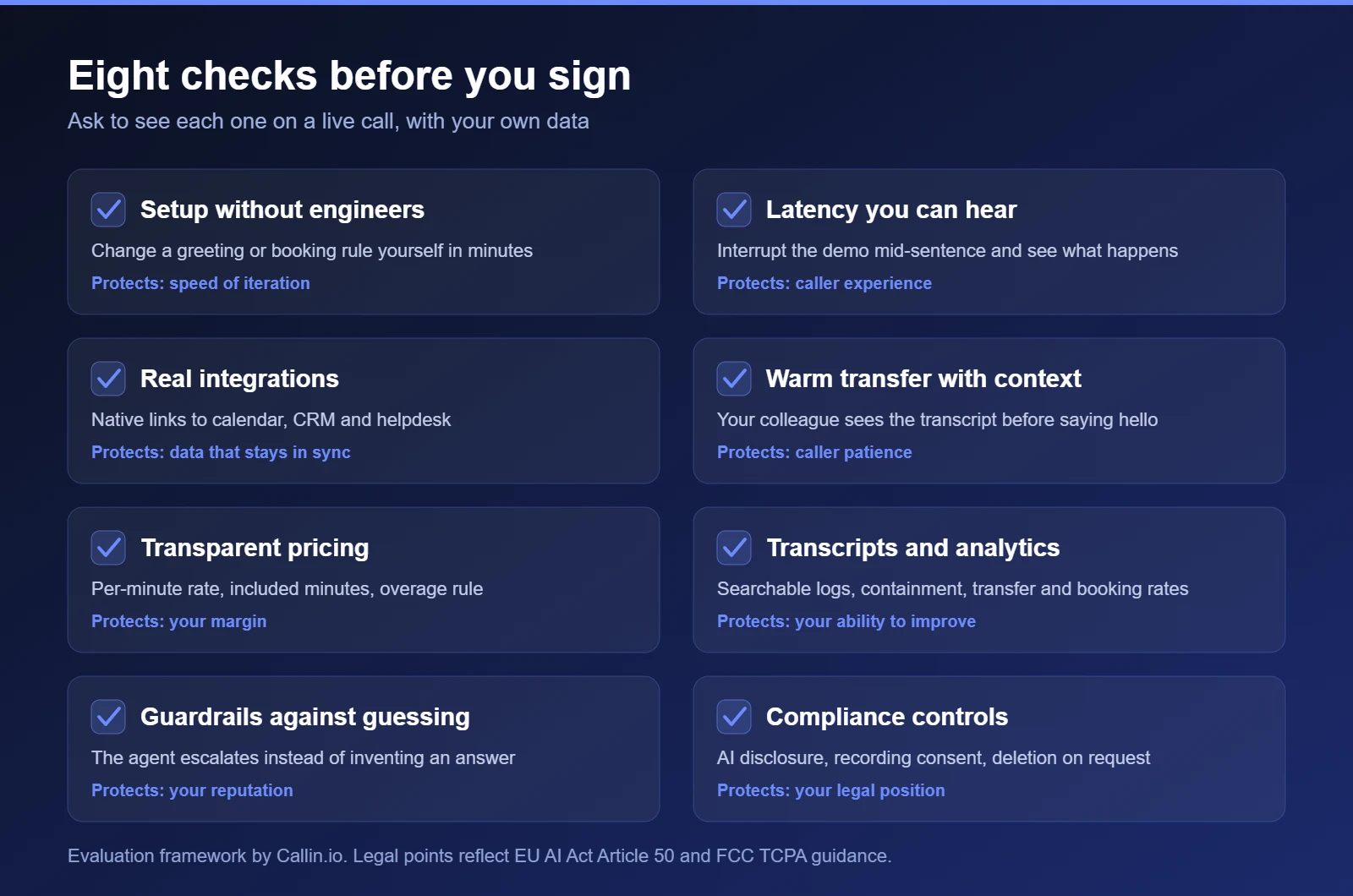
Figure 3: an eight-point evaluation checklist for an AI voice agent, grouped by what each point protects. Source: Callin.io.
What it costs, and the only ROI maths you need
Most platforms charge per minute of conversation, sometimes with a monthly fee on top. At the small business end the usual range runs from a few cents to a few tens of cents a minute, so 300 calls a month at three minutes each means buying 900 minutes.
Compare that against what you would otherwise do, not against zero. Voicemail costs nothing and converts almost nothing. A human answering service or a part-time hire costs considerably more per answered call. Then price one booked job: if a dental practice adds one hygiene appointment a week from evening calls, the agent pays for itself immediately. If your product carries a twelve euro margin, pilot before you commit.
One caveat that cuts against the usual pitch. Gartner predicted in January 2026 that by 2030 the generative AI cost per resolution will exceed three US dollars, above many offshore human agents, in its press release on cost per resolution. Cheap minutes today are not a permanent advantage, so buy for the outcome.

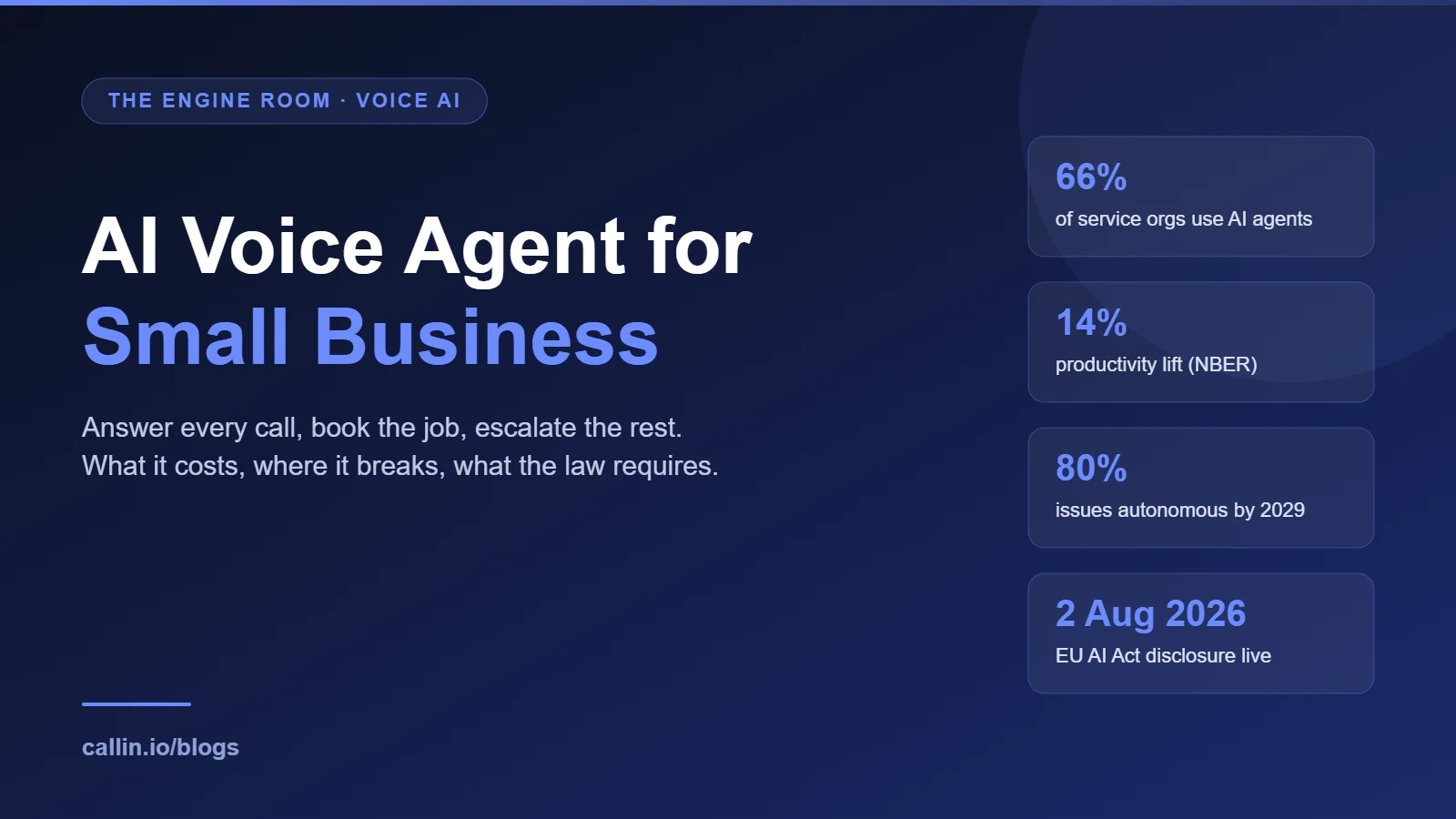
Figure 2: four verified numbers worth keeping in front of you when you build the business case. Sources: Salesforce, Gartner, NBER, EUR-Lex.
Where AI voice agents fail
Confident wrong answers. Asked something outside its knowledge, a model will sometimes produce a plausible sentence anyway. The control is a tight knowledge base plus an explicit instruction to escalate rather than guess, audited weekly against real transcripts.
Edge-case calls. An angry customer, a safeguarding issue, a legal threat or a medical emergency should never sit inside an automated flow. Write the escalation rules before go-live and test them deliberately.
Accents, noise and bad lines. Transcription quality is not uniform. Test with the voices you actually serve, from a car and a building site, not from a quiet office.
Caller trust. Salesforce found 65% of service professionals believe their customers fully trust AI, while the Metrigy Consumer CX Index it cites puts consumer trust in AI for service at 44%. That gap warns against assuming your callers feel the way your team does.
Disclosure, recording and consent
This is not legal advice and the rules differ by country, but three obligations apply widely enough that every small business should know them.
In the European Union, Article 50 of the AI Act requires providers to design AI systems intended to interact directly with people so that those people are informed they are dealing with an AI system, unless it is obvious. The regulation applies from 2 August 2026, so this is current law, not a future deadline. The text sits on EUR-Lex.
In the United States, the FCC issued a declaratory ruling confirming that calls using AI-generated voices count as artificial under the Telephone Consumer Protection Act, which pulls them inside existing robocall consent rules. The FCC document is short and worth reading before any outbound campaign.
Recording consent varies by state and country, and in much of Europe it falls under data protection law rather than telecoms law. Confirm your platform plays the disclosure and that you can delete a recording on request. Gartner also expects AI regulation to raise assisted service volume 30% by 2028 as more customers opt out and ask for a person, so staff for that.
A 14-day rollout that does not scare your callers
Days 1 and 2. Pull your call data: how many calls, when, how many unanswered, and the top five reasons people ring.
Days 3 to 5. Write the agent for one job only, usually after-hours enquiry capture. Script the greeting, the AI disclosure and the transfer phrase.
Days 6 and 7. Connect calendar and CRM. Make the agent write a record on every call, abandoned ones included.
Days 8 to 10. Test with twenty real calls from colleagues, including one angry caller, one heavy accent, and one request it cannot possibly handle.
Days 11 and 12. Go live for evenings and weekends only, and read every transcript.
Days 13 and 14. Fix the three most common failures, then decide whether to extend into daytime overflow.
Frequently asked questions
Which AI voice agent is best for a small business?
There is no single best. Pick on three things: native integration with the calendar and CRM you already use, latency you can tolerate on a live test call, and transparent pricing at your real volume. A platform that wins a feature grid but cannot write to your calendar is the wrong choice.
How much does an AI voice agent cost?
Usually per minute of conversation, often with a platform fee. Model total minutes per month rather than cost per agent, and compare it against what you pay today for voicemail, an answering service or a part-time receptionist. Our AI answering service guide breaks the cost structures down line by line.
Can an AI voice agent replace a human receptionist?
For routine, well-bounded calls, yes. For judgement, negotiation, upset customers and anything with legal or medical weight, no. Most small businesses end up hybrid: the agent takes first contact and after-hours, people take whatever it escalates.
How quickly can a small business go live?
A single-purpose after-hours agent can be configured in a day on a no-code platform. Doing it properly, with integrations tested and escalation rules written, takes about two weeks of part-time attention.
Do I have to tell callers they are talking to an AI?
In the European Union, yes, under Article 50 of the AI Act, applicable since 2 August 2026. Elsewhere rules vary, but disclosure is good practice anyway: callers react badly to discovering it late, far less so to being told upfront.
What happens when the agent cannot answer?
It should say so and transfer, passing the transcript and any details collected to whoever picks up. If a platform cannot demonstrate a warm transfer with context, keep shopping. Scaling that pattern across a team is what our guide to AI call center software covers.
Start with one call type
The businesses that get value from voice AI are not the ones that automated the most. They picked a single call type nobody was answering, measured it honestly, and read the transcripts every Friday.
Pick your evenings, your overflow, or the repeat question your team is tired of answering. Build the agent for that one job and widen only when the transcripts say it is safe. To hear what it sounds like on your own number, set one up and place a test call at callin.io.