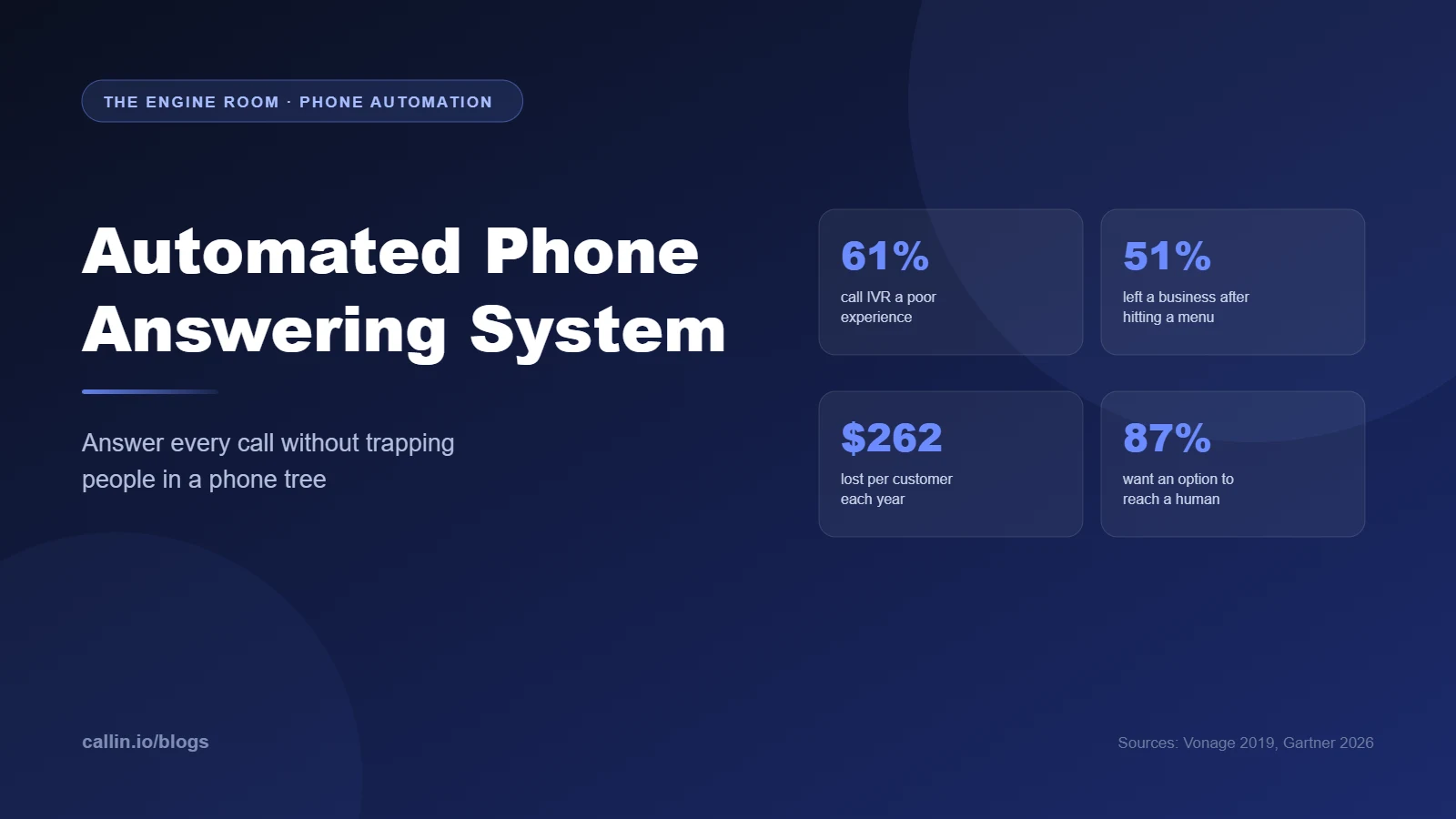
Missed Call Text Back: Turn Lost Calls Into Booked Jobs
Missed call text back turns ignored voicemail into booked work. How to wire it, what it costs, the SMS rules to follow, and when a voice agent wins.
A phone rings in a van, on a ladder, in the middle of a job. Nobody picks up. Thirty years ago that call became a voicemail. Today it becomes a competitor's booked appointment.
Missed call text back is the automation that sits in that gap: the call goes unanswered, the system notices, and an SMS leaves your business number before the caller has dialled the next listing. It is one of the cheapest fixes in local marketing and one of the most badly implemented.
Key takeaways
A working setup needs five things: miss detection, number normalisation, one lead record, the message, and a named human with a deadline.
The text is an acknowledgement, not an answer. It buys about fifteen minutes of attention.
In the US, business SMS at scale needs registered traffic, and quiet hours are set by federal rule.
Measure one number above all others: seconds from the missed call to the first text leaving your system.
When the same five questions arrive by text every day, a voice agent that answers the call removes the gap instead of papering over it.

Infographic: the five links between a missed call and a booked job. Source: Callin.io analysis.
What missed call text back actually does
The definition is plain. When an inbound call ends without being answered, a system detects the event and sends an automated SMS to the number that called.
That is the whole mechanic. Everything separating a good setup from a useless one happens around it. A useless setup sends a generic "sorry we missed you" to a number nobody owns, logs nothing, and leaves no human responsible for what comes next. A good setup treats the miss as the opening of a file someone has to close.
Why the unanswered call became the biggest leak
Three shifts stacked up. Callers stopped leaving voicemail, because they stopped expecting anyone to listen. Paid acquisition got expensive enough that letting a lead ring out became a measurable loss. And text became the channel people accept a reply on.
That last shift is not a hunch. CTIA's 2024 annual wireless industry survey recorded over 2.1 trillion SMS and MMS messages exchanged in the United States in 2023, more than 67,000 every second. Pew Research Center puts smartphone ownership among US adults at 91 percent, with 98 percent carrying a cellphone of some kind.
The caller holds a device that shows your text on the lock screen and lets them reply with one thumb. Voicemail asks them to dial in, authenticate and listen. That asymmetry is the whole business case.
The six jobs a working setup has to cover
Strip away the vendor language and there are six jobs. Skip one and the thing leaks.
Detect the miss, including a hangup before voicemail.
Normalise the number into E.164 format, or you will create three records for one caller.
Create or update one record. A second miss updates the existing row.
Send a short message: named business, one question, one exit.
Assign a human with a deadline. A name and a time, not "the team".
Keep the reply on the same record, along with the callback outcome and the booking.
Most phone systems do jobs one and four. The other four are where the revenue sits, and usually nobody's responsibility.
Can you automate it, and what has to exist first
Yes, and the question hides a dependency that trips up most first attempts: your business number has to be able to send SMS. A landline, or a ported number on a carrier that never enabled messaging, will not text no matter which software you buy. This is the most common reason a setup never sends its first message.
On Reddit's r/gohighlevel someone asks the right question: how does this work for a company that already advertises its own number and will not change it? The number has to be text enabled or routed through a provider that can message on its behalf, and that is a telephony decision made before any automation. Our breakdown of how an AI answering service works covers the same groundwork from the call-handling side.

Photo: Thom Holmes on Unsplash. The caller is already looking at their phone, which is why a text lands and a voicemail does not.
What each layer of the stack charges for
Pricing confusion comes from four meters running at once.
Business phone system: per user per month. Grows with headcount, not call volume.
Call tracking: per tracking number plus per minute.
SMS transport: per message segment. A 200-character message is two segments, and emoji can halve segment length.
Automation layer: per seat, per contact or per workflow run.
The meter that surprises people is the segment: long, chatty templates double your messaging bill for no extra bookings. Our guide to what voice automation really costs applies the same per-unit logic to calls, and Callin.io's pricing is per minute for the same reason.
Who should build this and who should leave it alone
Build on a system you control if you are a team of one to fifteen, your intake is phone-first, and you spend on ads whose response time you need to prove. Use the built-in feature as shipped if you mostly need a shared inbox two people watch, or if routing and compliance already sit with an IT function. Conversational routing is a different problem from lead capture and should not be solved in the same automation.
Agencies sit in a third position. Wiring this for clients, the question is not which tool but whose brand sits on the number. That is what a white-label voice platform is for, and why "missed call text back white label" is one of the most searched variations of this term.
The data model that stops double texting
Nothing destroys trust faster than three texts from one business in ten minutes, and the fix is structural. Use the normalised phone number as your deduplication key: one caller, one row, forever. Add a cooldown window, commonly two to four hours, inside which a repeat miss updates the record and sends nothing.
Then store two timestamps: the first miss, and the moment the first text left. The gap between them is the only response-time metric that cannot be gamed.

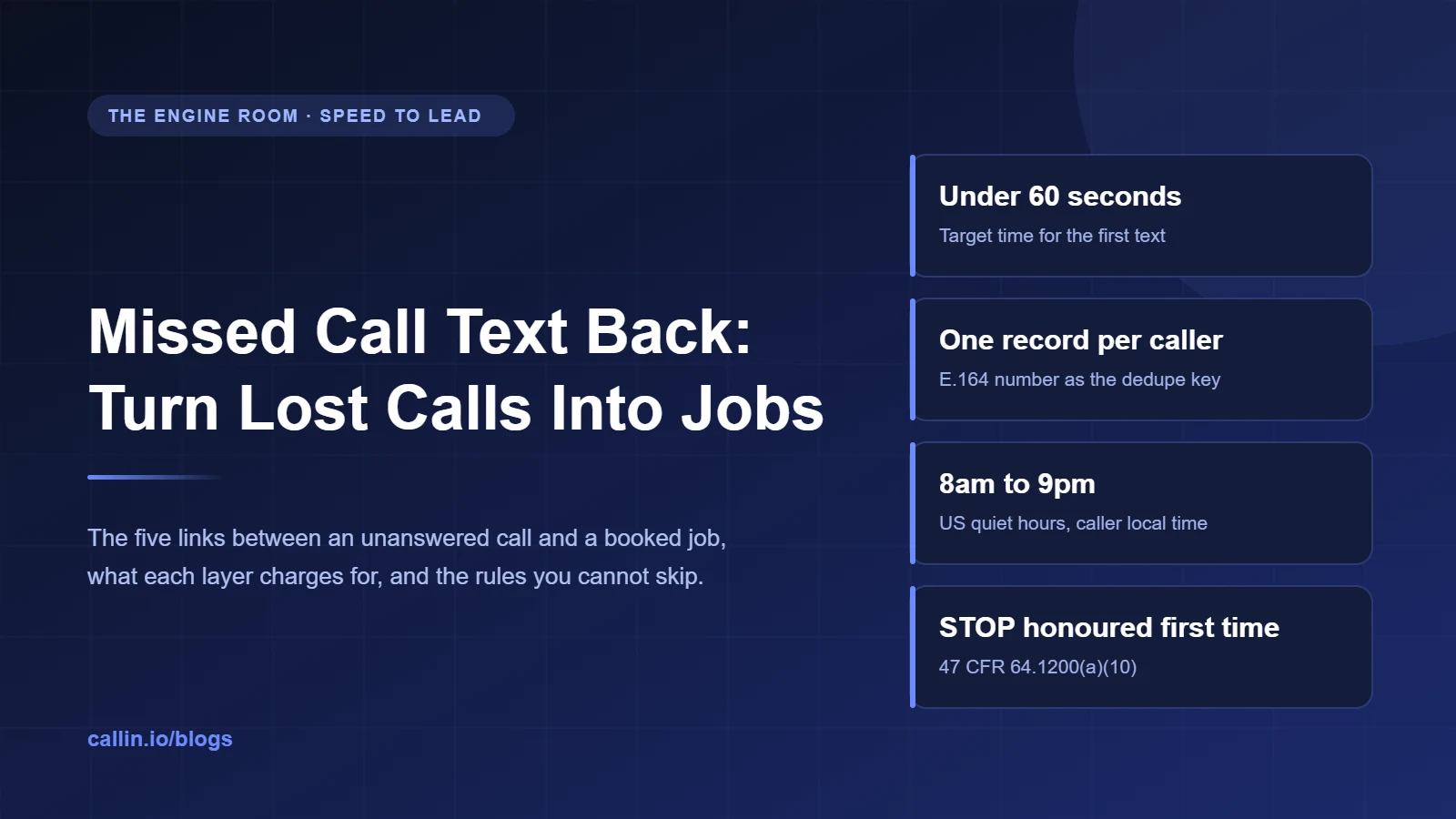
Infographic: verified figures behind the speed-to-lead case. Sources: CTIA 2024 Annual Survey, Pew Research Center, Gartner, 47 CFR 64.1200.
Message templates that get answered
Three rules. Name the business in the first six words, because an unknown number reads as spam. Give exactly one exit, a question or a link, never both. Never promise an arrival time you have not checked.
For trades: "Hi, this is Dan at Meridian Plumbing. Sorry we missed you. Is this about a leak, a quote, or an existing job?"
For a property manager: "Hi, Alex from Northgate Property. We saw your call. Is this maintenance, a lease question, or something urgent?" That version needs an urgency branch more than a sales pitch.
Notice what these do that a generic template cannot: they classify the lead in the same message that acknowledges it, so the reply tells you the queue before a human reads a word.
The SLA your team can actually keep
Targets that survive a busy Tuesday: SMS out in under sixty seconds, automated; a named owner attached in under two minutes; a human callback inside fifteen minutes during business hours. Five metrics belong on a dashboard, and no more than five:
Median seconds from miss to first text
Reply rate within twenty-four hours
Callback completion against the fifteen-minute promise
Booked rate from texted misses
Duplicate rate, which should sit near zero
Resist the industry-average ROI figures circulating on this topic, which mostly trace back to no source at all. Model your own recovered jobs at your own average ticket.
Where text back stops and a voice agent starts
A text back is an acknowledgement. It does not answer the question, quote the job, check the calendar or take the booking. Somebody still has to.
The Reddit threads show the ceiling. One owner in r/smallbusiness describes their setup approvingly: the texts know the calling number, they address the customer by name, and "a lot of the time we can answer questions and things easily this way". The admission inside the praise is that a human answers those questions, by text, all day. Fine at ten misses a week. At eighty it is a full-time job nobody was hired for.
The alternative is to not miss the call. An AI phone agent picks up on the first ring, answers the five questions that make up most of your inbound volume, checks availability and books. Gartner predicts that by 2029 agentic AI will autonomously resolve 80 percent of common customer service issues without human intervention, with a 30 percent reduction in operational costs.
Keep the other half of that picture in view. A separate Gartner forecast expects that by 2027 half the organisations planning significant customer service headcount cuts because of AI will abandon those plans. Automation absorbs the repetitive calls. It does not retire the team.
Practical rule: keep text back for calls nobody could have answered, and move the predictable volume onto the voice layer. Our dental front desk breakdown shows what that split looks like in a real diary.
SMS rules you cannot skip in the United States
Quiet hours are not a style choice. Under 47 CFR 64.1200(c)(1), solicitations to residential subscribers may not be initiated before 8am or after 9pm, local time at the called party's location. Your after-hours template has to respect the caller's time zone, not your office clock.
Opt-out is codified too. The same rule treats a reply of "stop" or "unsubscribe" as a reasonable means per se of revoking consent, requires revocation to be honoured within a reasonable time not exceeding ten business days, and bars you from designating an exclusive method for revoking consent to texts. Honour STOP immediately, and never tell someone they can only opt out through a portal.
Then registration. In the US, application-to-person traffic on standard ten-digit numbers runs through The Campaign Registry, and brands cannot register themselves: you go through a campaign service provider, which supplies a campaign ID to your connectivity partner.
The frustration this generates is documented. In r/VOIP a sole proprietor describes still sending SMS with a rejected campaign and no idea when access disappears. In another thread a business explains that the artifacts the registration asks for "just don't exist since we don't use SMS for marketing or customer communications". A small Canadian law firm in r/RingCentral reports the same confusion over texting clients twice a month.
None of that is a reason to skip it, only a reason to budget a week and confirm who holds the registration before you promise a launch date.
Video: "Window to the Law: Updated Guidance for TCPA Compliance", National Association of REALTORS, March 2024. A neutral walkthrough of FCC guidance and state mini-TCPA laws for businesses that call and text.
This is operational guidance, not legal advice. Rules differ outside the US, and several states add their own.
Rollout in two weeks, and the tests to run first
Week zero is definitions: what a caller is, what counts as a miss, who owns the callback and by when. Write the callback promise in one sentence.
Week one is plumbing. Confirm the number is text enabled, wire the miss event, normalise to E.164, add the SMS step and the task step, then test from three real handsets including one that hangs up before voicemail.
Week two is nuance: business-hours branching in the caller's time zone, one escalation path, routing by the classification the first reply gives you, and a booking surface so the thread ends in a calendar entry rather than another text.

Checklist: the nine pre-production tests, grouped by what each one protects. Source: Callin.io.
Mistakes we see most often
No named owner. A lead assigned to a team is assigned to nobody.
Promising an arrival window. "Someone will call you right back" creates a second disappointment on top of the first.
Skipping normalisation. That is how you text one person four times.
Shipping twelve automations at once. Two working steps beat a flowchart nobody can debug.
Treating compliance as a later problem. It is a prerequisite, not a polish step.
Never measuring response time. If you cannot state your median in seconds, the system is decorative.
Letting the text become the product. If a human answers forty threads a day, you automated the notification and nothing else.
Frequently asked questions
What is missed call text back?
An automation that sends an SMS to a caller when their call to your business goes unanswered. The system detects the miss, finds or creates a record for that number, and sends a short message that acknowledges the call and asks one question.
How do I text back after a missed call?
Manually, reply from the business number that received the call so the thread stays in one conversation. Automatically, you need a text-enabled number, a phone system that emits a missed-call event, and a workflow that sends the message and assigns the callback to a named person.
Can I automatically text back a missed call?
Yes, provided the number receiving the call can also send SMS. Most VoIP and cloud phone systems do this natively or through an integration. A traditional landline usually cannot, which is the dependency most people discover late.
Why am I getting text messages about missed calls?
Because the business you called has this automation switched on, or your carrier offers a missed-call alert service. If the message comes from a business you never contacted, treat it as spam and reply STOP, which the federal rule requires them to honour.
Is there free missed call text back software?
Some phone systems include a basic version in their standard plan, so there is often no extra software cost. The messaging itself is never free: SMS is billed per segment, and in the US the traffic still has to be registered.
Does it work for contractors and trades?
It works well, because trade calls are urgent and the caller is holding their phone. The limit is volume. Once the same questions arrive by text every day, answering the call with a voice agent recovers more jobs than acknowledging it faster.
The honest conclusion
Missed call text back is worth setting up. It costs very little, it takes two weeks, and it turns a dead voicemail into a live conversation. It is also a notification system, not an answer.
The business that wins is not the one that apologises fastest. It is the one whose phone gets answered, where the caller gets their question resolved and a time in the diary without waiting for anyone to ring back.
To hear what that sounds like on your own number, with your own calendar and your own branding, start with Callin.io. Keep text back for the calls that genuinely could not be answered, and consider pairing it with an email agent so the follow-up does not land back on a person either.
Further reading: the speed-to-lead playbook that prompted this piece, and our guide to outbound calling for the other half of the conversation.