Call Center Automation: What to Automate First
Call center automation works only on the right calls. What to automate first, what to leave to people, and how to measure resolution, not containment.

Every operations lead who has looked at a queue report has had the same thought: most of these calls should not need a person. Order status. Opening hours. A booking moved by two days. The work is real, but it does not reward human judgment.
That is the promise of call center automation, and it is a reasonable one. Trouble starts when a team buys the promise instead of the practice, automates the wrong half of the queue, and then wonders why hold times fell while complaints went up.
Here is what the technology actually does, what independent research says about results, and the order of operations that separates a rollout that sticks from one that gets quietly switched off.

Five levels of call center automation, from static menus to agentic resolution. Source: Callin.io analysis.
Key takeaways
Call center automation is a set of technologies, not one product: routing, self-service, agent assist, workforce planning and post-call work all count.
Gartner found only 14% of service issues are fully resolved in self-service, so assume your starting point is lower than the demo suggested.
Containment is a vanity metric. Resolution, repeat contact rate and escalation quality tell you whether it worked.
An NBER study of 5,179 support agents measured a 14% average productivity gain from AI assistance, and 34% for the least experienced staff.
Start with intents that are high volume, low judgment and data driven. Leave anything emotional or legally sensitive to people.
The FCC treats AI voices as artificial under the TCPA, and EU transparency duties apply from August 2026.
What call center automation actually means
Call center automation is the use of software, increasingly AI driven, to complete call center work without a person doing it by hand. That covers far more than a bot answering the phone.
It includes the call itself, the routing decision before it, the help an agent gets during it, and the admin that follows it. Most teams automate some of these and none of the others.
The useful model is a ladder, not a switch. Level zero is a static phone menu. Level one adds intelligent routing and callbacks. Level two resolves simple intents end to end. Level three lets the system act in other tools, such as rescheduling in a calendar. Level four runs most of the queue with people on standby for hard cases.
Most organisations that call themselves automated sit at level one or two. Nothing wrong with that, as long as the plan matches the reality.
How the technology works under the hood
A modern automated call runs through four stages, and each can fail independently.
Speech recognition turns audio into text in real time. Accents, background noise and poor lines all degrade it, which is why demo accuracy rarely survives a Monday morning.
Language understanding works out what the caller wants. Older systems matched keywords to a fixed intent list. Current systems use large language models, which handle messy phrasing far better but need tight instructions to stay inside their remit.
Action and retrieval is where value is created or lost. A system that cannot read the CRM, the booking tool and the order database can only talk. Integration depth, not voice quality, separates a useful agent from an expensive answering machine.
Speech synthesis turns the answer back into audio. The hard part is timing rather than realism: a natural pause, a clean interruption, a reply that arrives before the caller assumes the line dropped. Our notes on latency in AI voice calls cover the engineering.
Around all of it sits orchestration: the rules deciding when to escalate, what to log, and how to behave when something breaks.
The types of call center automation worth knowing
Conversational self-service
The replacement for the press-one menu. The system asks what the caller needs and acts on the answer. Our guide to conversational IVR covers the design patterns, and an AI phone agent extends the idea to full conversations.
Intelligent routing and callbacks
Routing on intent and history instead of menu selections, with callers keeping their place in queue rather than holding. Fewer transfers, fewer repeats, lower abandonment.
Agent assist
Live transcription, suggested answers and knowledge articles surfaced during the call. Gartner expected 73% of service organisations to have implemented agent assist by the end of 2025, which makes it the least controversial piece of the stack.
Forecasting and scheduling
Predicting volume and building rosters against it. Unglamorous, and often the fastest payback on the list, because overstaffing and understaffing are both expensive.
Outbound and booking automation
Reminders, renewals, qualification calls, and calendar writes during the conversation. See AI outbound calling and AI appointment scheduling, because this is where compliance bites hardest.
Post-call work and quality scoring
Summaries, CRM updates, dispositions and follow-up tasks, plus scoring every call rather than sampling five a month. Low risk, high volume, and the part teams forget to count.

Four numbers worth knowing before you budget. Sources: Gartner (2022, 2024, 2025) and NBER Working Paper 31161.
What the independent research says
Vendor case studies are not evidence. Three independent sources are more useful.
First, the ceiling. A Gartner survey of 5,728 customers found only 14% of service issues fully resolved in self-service. Even for issues customers called very simple, the figure was 36%. In 45% of failed attempts, customers said the company did not understand what they were trying to do.
Second, the agent-side gain. In Generative AI at Work, Brynjolfsson, Li and Raymond studied 5,179 support agents and measured a 14% average rise in issues resolved per hour, reaching 34% for novice and lower-skilled staff, with minimal effect on the most experienced. Automation that helps people performs more predictably than automation that replaces them.
Third, the money. Gartner forecast conversational AI would cut contact center agent labour costs by 80 billion dollars in 2026, with roughly one agent interaction in ten automated. Note the shape of that number: a tenth of interactions, not most of them.
The picture is consistent. Meaningful savings, concentrated in a minority of contacts, with the biggest per-person gains going to the newest staff.
What practitioners say when vendors are not in the room
The published research is tidy. The forums are not, and they are more useful for planning.
On r/customerexperience, a thread asking how much of your contact center is actually automated drew more than thirty replies. The top answer put real full handling at roughly 15% and suggested anyone quoting much higher is counting differently. Others noted that what gets automated is overwhelmingly the repetitive tier. One reply objected to the word deflection itself, arguing it describes pushing customers away rather than helping them.
The same theme runs through LinkedIn, where CX practitioners keep posting variations of one argument: containment rate is the most flattering number in the contact center. A conversation counts as contained if the caller did not reach a human, solved or not. An 80% containment rate means little if a large share of those callers ring back within the hour.
So the metric most dashboards lead with is the one most likely to mislead you. Three measurements fix that. Repeat contact rate at 24 and 72 hours shows whether contained calls stayed contained. A one-question resolution confirmation shows whether the caller agrees it worked. Escalation quality, measured by how often the receiving agent starts over, shows whether your handoff functions.
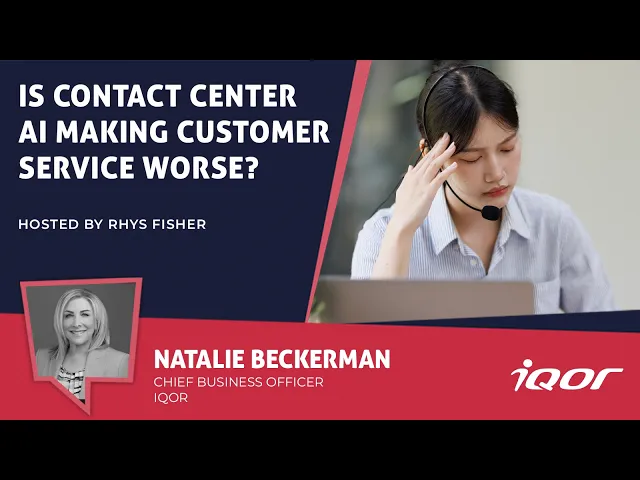
CX Today, "Is Contact Center AI Making Customer Service Worse?", October 2026. An independent industry interview on efficiency targets and service quality.
What to automate first, and what to leave alone
Score every intent in your queue on three axes: volume, judgment required and data dependency. High volume, low judgment, data driven intents are the first wave, because that is where automation is easiest and least likely to annoy anyone.
Typical first wave: opening hours and location, order and delivery status, booking, rescheduling and cancellation, balance and account lookups, simple FAQs, reminders, and routing with callback.
Second wave, once the first is stable: qualification and intake, renewals, basic troubleshooting against a known decision tree, and after-hours coverage that currently goes to voicemail.
Leave alone, probably permanently: complaints and service failures, anything involving distress or vulnerability, disputed charges, clinical or legal questions, cancellation requests from high-value accounts, and emergencies. Getting these wrong does not cost you a longer handle time, it costs you the relationship.

A three-tier framework for sequencing automation by intent. Source: Callin.io analysis.
Where automation breaks: the handoff
Handoff is the most commonly botched part of an automated call, and it fails predictably. The system holds the caller too long before giving up. The caller repeats everything. The transfer lands in a general queue instead of the right skill group.
Four fixes cover most of it. Give the receiving agent a plain-language summary on screen before they speak. Define explicit escalation triggers, including repeated failure, detected frustration and any mention of a complaint. Route on the intent the system already captured. Monitor what happens after the transfer, not just that it happened.
A clean handoff also solves a presentation problem. Callers tolerate automation that knows its limits far better than automation that pretends it has none.
Compliance is now part of the design
Two regulatory facts should shape any deployment that calls people.
In February 2024 the FCC adopted a declaratory ruling confirming that calls made with AI-generated voices count as artificial under the Telephone Consumer Protection Act. That is not a ban, but it puts them inside the TCPA's consent rules for calls to mobile numbers.
In the EU, the transparency duties in Article 50 of the AI Act apply from 2 August 2026 and require that people interacting with an AI system are told so, unless it is obvious from context.
The practical consequence is the same on both sides of the Atlantic: disclose the AI, keep consent records for outbound, and make the route to a human visible rather than buried. This does not cost conversion. It tends to raise it, because callers relax once they know what they are dealing with.
A realistic 30, 60, 90 day rollout and its economics
In the first thirty days, deploy nothing. Pull ninety days of call data, classify the top twenty intents by volume, and measure your real baseline: handle time, abandonment, after-hours volume, repeat contact rate and first contact resolution. Pick two intents.
In days thirty to sixty, launch those two on a slice of traffic, perhaps after-hours or overflow only, with a hard escalation rule and full transcript review. Expect to rewrite the instructions several times in the first fortnight; our notes on prompting AI voice agents cover the common failure modes.
In days sixty to ninety, widen the traffic share if, and only if, repeat contact rate has not risen. Add the next two intents, and start pushing call summaries into the CRM automatically, where much of the quiet saving lives.
On cost, pricing is usually per minute, per call or per seat, and the headline rate is rarely the whole bill: integration work, numbers, telephony and tuning time all belong in the model. Our breakdown of AI voice agent pricing and the Callin.io pricing page set out the ranges. Build the case on a conservative resolution rate for first-wave intents only. If it needs 70% containment to work, it does not work.
Frequently asked questions
What is call center automation in simple terms?
Software handling call center work a person would otherwise do by hand: answering routine calls, routing them, helping agents during conversations, forecasting staffing and writing up notes afterwards. It is a spectrum, not an on-off switch.
How much of a call center can realistically be automated?
For fully handled contacts, plan for a minority. Gartner measured 14% full resolution in self-service, its own 2026 forecast was roughly one agent interaction in ten, and practitioners discussing real numbers commonly cite 10% to 30% depending on how narrow the queue is.
Does call center automation reduce headcount?
It usually changes the shape of the team before the size. Routine volume falls, remaining calls get harder, and experienced staff become more valuable. The clearest measured gain in the research is productivity per agent, not agent elimination.
Will customers accept an AI on the phone?
Most will, for simple things, if two conditions hold: they are told it is an AI, and the route to a person is obvious. Resistance comes far more from feeling trapped than from the technology.
What is the difference between containment and resolution?
Containment means the caller did not reach a human. Resolution means the problem was solved. They diverge whenever a contained caller rings back, which is why repeat contact rate belongs on the same dashboard.
Is an automated voice legal for outbound calls?
In the United States, AI-generated voices are treated as artificial under the TCPA, so prior consent rules apply to calls to mobile numbers. In the EU, AI Act transparency duties apply from August 2026. Take specific legal advice for your jurisdiction and use case.

Photo: Arlington Research on Unsplash.
The short version
Call center automation works when it is pointed at the right calls. Pick a handful of high-volume, low-judgment intents, measure resolution rather than containment, build the handoff before you build the bot, and widen only when repeat contact rate stays flat.
Teams that do this get a quieter queue, faster answers out of hours, and agents spending their day on work that needs them. Teams that automate everything at once get a louder queue and a worse reputation.
To see what that looks like on your own call flow, the Callin.io voice platform and our AI phone agent are built around exactly this sequencing. Start at callin.io, with two intents, not twenty.


