Prompting AI voice agents in 2026: why a voice isn’t a chat
There's a mistake almost everyone makes when building their first voice agent: they take the system prompt that worked beautifully for a chatbot, drop it into the voice processing chain, and expect the same result. What they get instead is an entity that reads written prose out loud — grammatically flawless, perfectly robotic.
The reason runs deeper than it seems, and it's the starting point for much of the recent research on the topic. Inside a cascaded STT → LLM → TTS chain, the LLM in the middle has no awareness whatsoever that it's inside a voice conversation. From its perspective, it's operating in a traditional text environment, exactly as it does in chat. It's an observation that the prompting guides of the major voice-model providers put front and center, and it carries significant practical consequences: unless you tell it explicitly, the model will produce text to read, not speech to hear. For an overview of the topic, see our primer on the fundamentals of prompt engineering for voice agents.
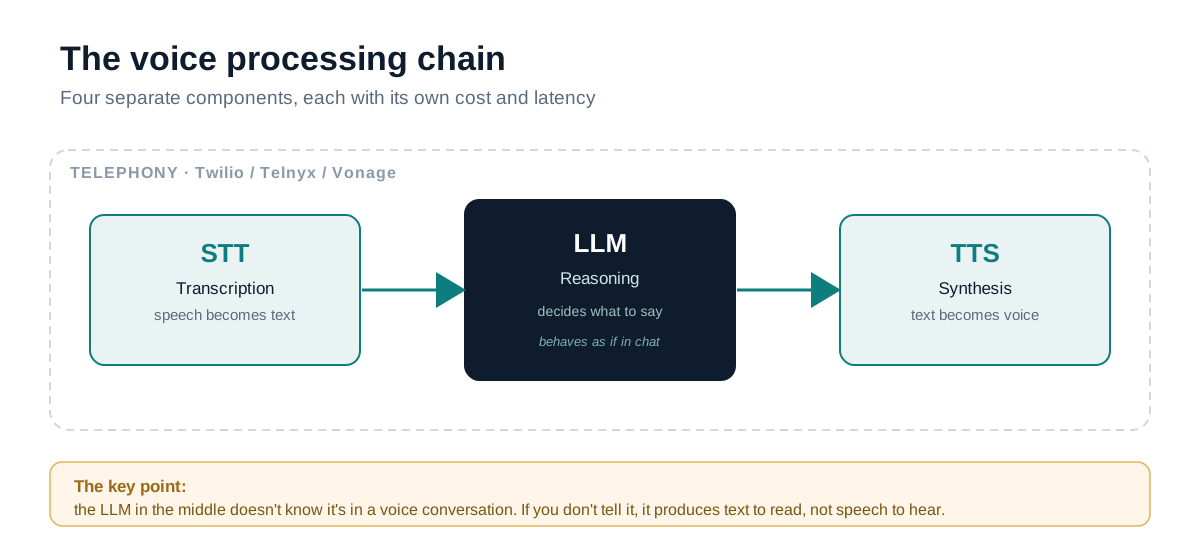
The voice processing chainFour separate components, each with its own cost and latencyTELEPHONY · Twilio / Telnyx / VonageSTTTranscriptionspeech becomes textLLMReasoningdecides what to saybehaves as if in chatTTSSynthesistext becomes voiceThe key point:the LLM in the middle doesn't know it's in a voice conversation. If you don't tell it, it produces text to read, not speech to hear.
The voice processing chain: STT, LLM and TTS, with the LLM unaware it's in a voice conversation.
On top of that comes a subtler problem, highlighted by the most recent academic research: speech is not "text plus noise." The same request can be realized with entirely different voices, accents, rhythms, emotions and disfluencies, and a robust model should hold the same behavior across all of those acoustic variants. Work from 2025–2026 on this front — such as the VocalBench-DF and DOWIS benchmarks — shows that voice prompts spoken by humans still trail behind text prompts, and that performance collapses in the presence of disfluencies: fillers, repetitions, self-corrections. In other words: high transcription quality (ASR) does not guarantee stable instruction-following.
Put the pieces together. Writing the prompt for a voice agent means working on three levels at once: making the model understand that it's speaking, not writing; making it robust to the chaotic nature of real speech; and achieving that without bloating the chain to the point of hurting latency. Here's how.
A voice agent is a compound system, not a model
It's worth framing the question through the lens that Berkeley AI Research (BAIR) proposed: the state of the art no longer comes from monolithic models, but from compound AI systems made of multiple components working together. A voice agent is the clearest example: orchestration, STT, LLM, TTS, turn-taking, tools, memory. The prompt isn't "the brain" of the system — it's one component, and it has to be designed with full awareness of how it interacts with all the others. If you want to go deeper into this whole-system view, read our piece on cognitively sovereign AI agents.
That perspective changes how you work. Instead of hunting for the "perfect prompt" that solves everything, you break the agent's behavior into smaller, manageable pieces, using handoffs and dedicated tasks. A single monolithic prompt that tries to do everything turns out to be fragile; scoped tasks are preferable — they reduce context and make behavior predictable. And every change to the prompt should be treated as a change to production code — because that's exactly what it is.
The heart of the problem: LLMs are trained to write well
The root of it all is simple. LLMs are trained on vast amounts of text and then fine-tuned to produce clean, grammatically correct writing. Great for emails and documents. Terrible when it comes to simulating a phone call. Real human speech is dense with fillers, mid-sentence corrections, small laughs, soft pauses, and sentences that wander and restart.
So yes, the fix is to ask the model to be more natural — except that, in practice, the model fights you unless you're extremely explicit. Saying "be conversational" has no effect: you'll still get polished prose. You need precise techniques. The ones below are the most effective, drawn from practice and research over the past year.
1. Start minimal, don't over-prompt
There's a principle the voice-model prompting guides repeat insistently: begin with a minimal prompt, run evaluations, and add instructions only for the behaviors that prove wrong in testing. A prompt bloated from the start doesn't make the model better; it makes it slower and less predictable. Start from the essentials and build by subtracting errors, not by accumulating rules.
2. Show, don't describe
LLMs don't internalize vague style goals. If you give them only generic instructions ("use some fillers, be brief"), they'll keep producing textbook sentences. What works instead is giving them concrete examples of the desired output, contrasted with the wrong output:
If you have recordings of real calls between customers and human agents, that's gold: extract the agent's speech patterns and use them as a template. Once you have a handful of strong examples, you can expand them by having another LLM generate variations, then add the best ones back into the system prompt.
3. Engineer disfluencies with structured pauses
Fillers on their own aren't enough. What makes them believable is the timing. When a human says "um," they usually pause briefly and then restart with a connector ("so," "well"). Agents often get this wrong by saying "um" and then barreling ahead at full speed — and the result sounds fake.
If your TTS engine supports SSML tags, you can teach the model to mimic the timing by annotating examples with explicit pauses. The LLM will include them in its generated responses, which in turn instruct the TTS on how to deliver:
Keep in mind, though, a distinction that's emerged recently. The latest generation of TTS built on a language model — Hume Octave being the most cited example — don't need SSML tags at all: they interpret the meaning of the text and infer emotion, rhythm and pauses directly from the content and from a natural-language description of the character. For traditional engines, by contrast, explicit annotation remains the way to go. So the choice of technique depends on the voice component you've chosen.
This is the part that needs the most testing and tuning. Even the best LLMs sometimes won't generate pauses where you'd expect them and, on the flip side, if you put too many in your examples, you end up with a pause in every sentence. The technique that works best is to reinforce the same rule from multiple angles: state the rule explicitly ("after every standalone 'um,' insert a pause right away"), show examples, and then restate it in a later section with more examples.
4. Treat emotion tags as constraints, not decorations
Emotion controls work best when used as guardrails. Humans don't jump from one emotion to another within the same sentence. If your agent goes from excited to amused to sad to irritated in a single turn, it'll sound deeply unstable.
Practice suggests that "calm" tones (peaceful, relaxed) tend to sound more human than "big" emotions (excited, thrilled). Set a baseline emotion, then give the model a few specific scenarios where a stronger emotion, or a laugh, makes sense. Laughter in particular should be used where it fits, but it can be generous: it's one of the most powerful signals of naturalness.
5. Normalize what the model will have to pronounce
There's a detail that almost always gets overlooked, and that the prompting guides for empathic voice tools (like Hume's EVI interface) add by default: text normalization. Numbers, dates, currencies and symbols have to be converted into actually-speakable words. "$50.25" should become "fifty dollars and twenty-five cents"; "Mon 6/9" should become "Monday, June ninth"; "Dr." should become "Doctor." It's a rule that, when skipped, produces some of the most jarring effects of all, because the model reads the symbol instead of speaking the word. Add a dedicated section to your prompt with the conversion rules for your domain (amounts, times, alphanumeric codes, abbreviations).
6. Plan for spoken preambles and tricky pronunciations
Two further touches, borrowed from the realtime-model prompting guides. First: preambles, short spoken updates the agent says while performing an action ("let me check that order," "one moment while I verify"). These aren't hidden reasoning exposed to the user — they're a handful of words that cover the processing time and make the wait feel natural. Second: a reference-pronunciations section, a small phonetic guide for the terms the model tends to get wrong — proper names, brands, technical terms, foreign words. Both cost very few tokens and noticeably improve delivery.
7. Write personality as audible behaviors, not adjectives
"Friendly and helpful" is already the default mode of nearly every LLM: writing it adds nothing. For realism, you need personality traits that translate into observable speech patterns — things the model can literally output. Treat it like a checklist, because most of what you write here will show up in the audio:
8. Redundancy, redundancy, redundancy
The thread running through all these techniques is just one: the model needs far more repetition than you'd think is necessary. State the rule, show it with examples, restate it in a different section. And when you think you've repeated it enough, repeat it again.
The prompt structure: the sections that actually matter
Beyond realism, there's the question of organization. The latest voice-model guides converge on a structured format, broken into short, labeled sections, so the model quickly finds the relevant instructions. The skeleton that recurs most often is:
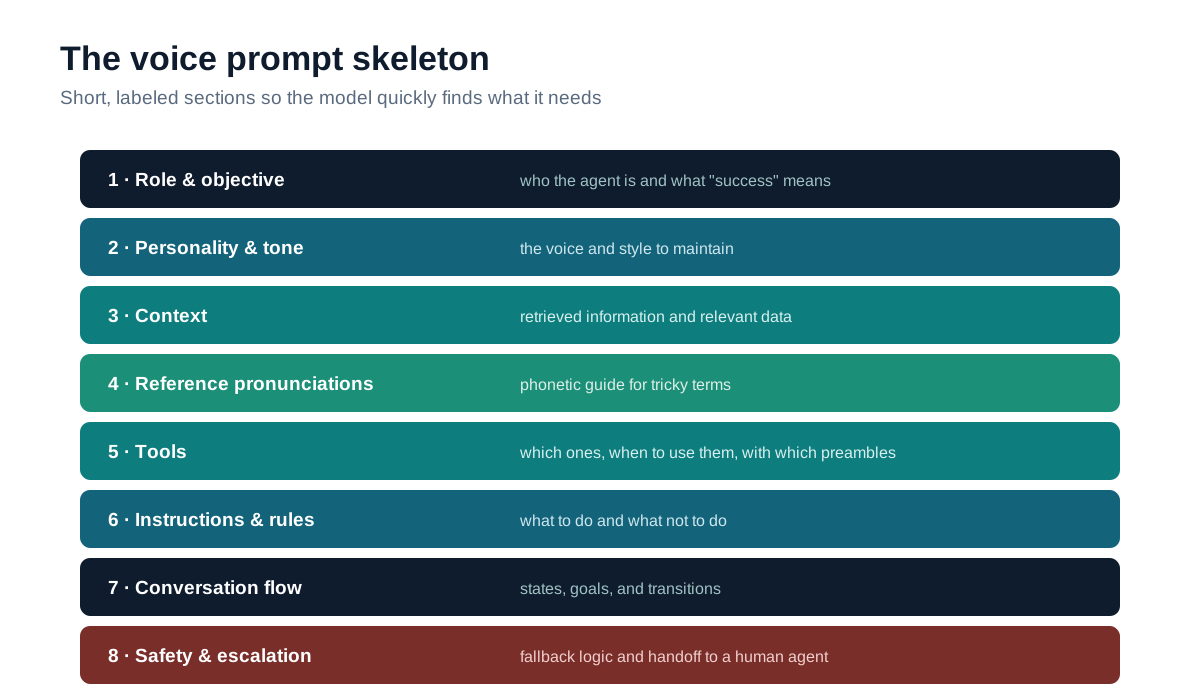
The voice prompt skeletonShort, labeled sections so the model quickly finds what it needs1 · Role & objectivewho the agent is and what "success" means2 · Personality & tonethe voice and style to maintain3 · Contextretrieved information and relevant data4 · Reference pronunciationsphonetic guide for tricky terms5 · Toolswhich ones, when to use them, with which preambles6 · Instructions & ruleswhat to do and what not to do7 · Conversation flowstates, goals, and transitions8 · Safety & escalationfallback logic and handoff to a human agent
The recurring skeleton of a voice prompt: eight short, labeled sections.
Role & objective — who the agent is and what "having succeeded" means for it.
Personality & tone — the voice and style to maintain.
Context — retrieved information and data relevant to the conversation.
Reference pronunciations — the phonetic guide for difficult terms.
Tools — which ones, when to use them, and with which spoken preambles.
Instructions & rules — what to do and what not to do.
Conversation flow — states, goals, and transitions between phases.
Safety & escalation — fallback logic and handoff to a human agent; this is also where you plan defenses against prompt injection, a real risk for any agent that accepts natural-language input.
To this, add a constraint that holds for every voice agent, even native speech-to-speech ones: the instruction to be concise. Few users have the patience to listen to monologues. This isn't cosmetic: a clear structure is what makes the agent's behavior reproducible rather than random.
The hidden tax: every word in the prompt costs latency
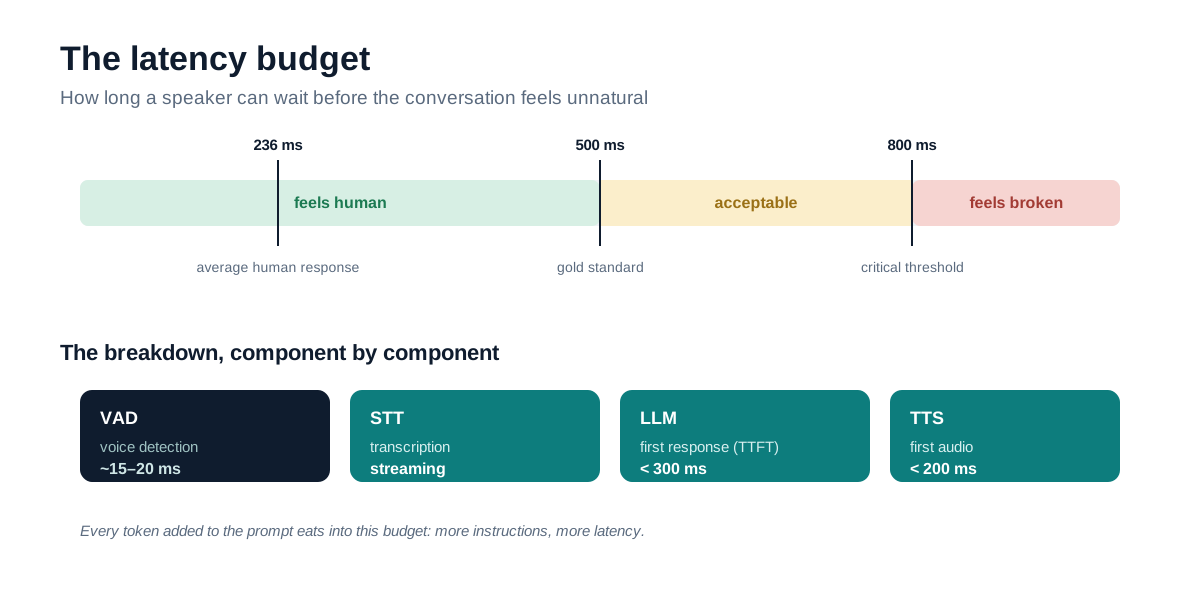
Here we reach the constraint that separates voice prompting from text prompting, and that many discover too late. A voice agent is a latency-sensitive system: below 500 ms of response it sounds like a person, beyond 800 ms it starts to feel broken. And bloated prompts, along with overly long tool lists, slow everything down.
The latency budgetHow long a speaker can wait before the conversation feels unnaturalfeels humanacceptablefeels broken236 msaverage human response500 msgold standard800 mscritical thresholdThe breakdown, component by componentVADvoice detection~15–20 msSTTtranscriptionstreamingLLMfirst response (TTFT)< 300 msTTSfirst audio< 200 msEvery token added to the prompt eats into this budget: more instructions, more latency.
The latency budget: 236 ms average human response, under 500 ms feels human, beyond 800 ms feels broken — with the per-component breakdown.
It's a real trade-off. Each of the realism techniques above adds tokens to the prompt, and every extra token means more processing time. The sweet spot isn't found at a desk: it's found by testing under real load — and a useful approach here is to put the agent through its paces with virtual personas that simulate different calls, so you can observe its behavior before exposing it to real customers. The practical recommendation is the same one that applies to production code: keep the prompt as lean as possible for a given behavior, break it into scoped tasks rather than one mega-prompt, and measure the impact of each addition on the time before the first response (the so-called time-to-first-token). One useful practical note for those working with realtime models: keeping the system prompt stable lets you take advantage of caching, with a far-from-trivial saving in cost and latency.
When prompting isn't enough: the boundary with fine-tuning
There's a limit recent research has made explicit, and it's honest to acknowledge it. A 2025 paper directly compared fine-tuning against system prompting, precisely on the goal of a "conversational tone of voice" for voice applications. The conclusion: a growing list of complex instructions in the prompt leads to degraded instruction-following and to in-context bias. Sometimes the model doesn't follow even a single system instruction.
Their result is that fine-tuning a small, open-weights model (a 1-billion-parameter Llama, tuned with LoRA on synthetically generated data) beats prompting at aligning the model to a natural conversational tone. More broadly, a parallel line of research shows that behavioral alignment via reinforcement learning — treating the different acoustic realizations of the same request as an alignment signal — makes voice models considerably more robust.
The pragmatic reading, for those building in production, isn't to abandon prompting, but to recognize that it's the starting point, not always the finish line. For most use cases, a well-engineered prompt using the techniques above is more than enough and infinitely faster to iterate. When you need a very specific tone, consistent across millions of calls, and the prompt starts becoming unmanageable (and costing latency), that's the signal it's worth evaluating a small model fine-tuned on your domain. It's also worth remembering that the choice of model at the center of the chain directly affects the reliability of the responses: on that, see our deep dive on LLM hallucinations and how to curb them.
The frontier: beyond turn-by-turn
It's worth knowing where research is heading, because it will change how prompts are written in the coming months. Several strands from 2025–2026 are pushing the problem beyond the classic "turn-by-turn" exchange:
Full-duplex — models that listen and speak simultaneously, handled by instructing the LLM to operate as a finite-state machine with two states (SPEAK / LISTEN), so it can interrupt or yield the turn in real time, the way humans do.
"Chunked" reasoning while speaking — approaches like STITCH have the model think and talk together, generating reasoning in blocks while it's already producing voice, to cut perceived latency.
Time control — models that follow duration-constrained instructions ("respond in about 15 seconds"), useful for agents that have to stay within precise time windows.
This is still largely research territory, but these strands point the direction: the prompt of the future won't only describe what to say, but how to manage the timing and the turns of the conversation.
Operational checklist
If tomorrow you have to work on a voice agent's prompt, these are the points to focus on, in order:
Start minimal. An essential prompt, then add rules only for the errors that emerge in testing.
State that it's a voice conversation. The LLM doesn't know. Tell it, and enforce conciseness.
Show concrete examples of good versus bad speech, ideally pulled from real calls.
Engineer disfluencies with pauses (SSML for traditional TTS, natural-language descriptions for language-model-based TTS).
Use emotions as constraints, starting from a calm baseline.
Normalize numbers, dates, currencies and abbreviations into speakable words.
Plan for spoken preambles and a guide to tricky pronunciations.
Write personality as audible behaviors, not adjectives.
Structure the prompt in short, labeled sections.
Watch latency: every token costs. Trim, decompose, measure, and keep the prompt stable to leverage caching.
Repeat the key rules from multiple angles.
Know when to stop prompting: if the prompt becomes unmanageable for a very specific, consistent tone, consider a small fine-tuned model.
Prompt engineering for voice agents, in the 2026 landscape, has become a discipline in its own right, sitting halfway between writing, real-time systems engineering, and theatrical direction. The good news is that the techniques are concrete and repeatable. The bad — or perhaps the interesting — news is that they require testing, listening, and iteration: no prompt sounds right on the first try. You write, you listen, you correct. Exactly as you would with a real voice.
Resources and further reading
From the Callin.io blog (The Engine Room):
The fundamentals of prompt engineering for voice agents — the starting point on the topic.
LLM hallucinations and how to curb them — the reliability of the model at the center of the chain.
What prompt injection is — security for agents that accept natural language.
Virtual personas for testing voice agents — how to test the agent before production.
Cognitively sovereign AI agents — the perspective on compound systems and agent identity.
External sources:
OpenAI's prompting guide for realtime voice models and the companion cookbook.
Berkeley AI Research (BAIR) — "The Shift from Models to Compound AI Systems".
Fine-tuning versus prompting for tone of voice (paper, 2025).
Behavioral alignment of voice models — with references to the DOWIS and VocalBench-DF benchmarks.
Callin.io — modular, white-label AI voice agents, built for the European framework. Your stack, your brand, your margins.