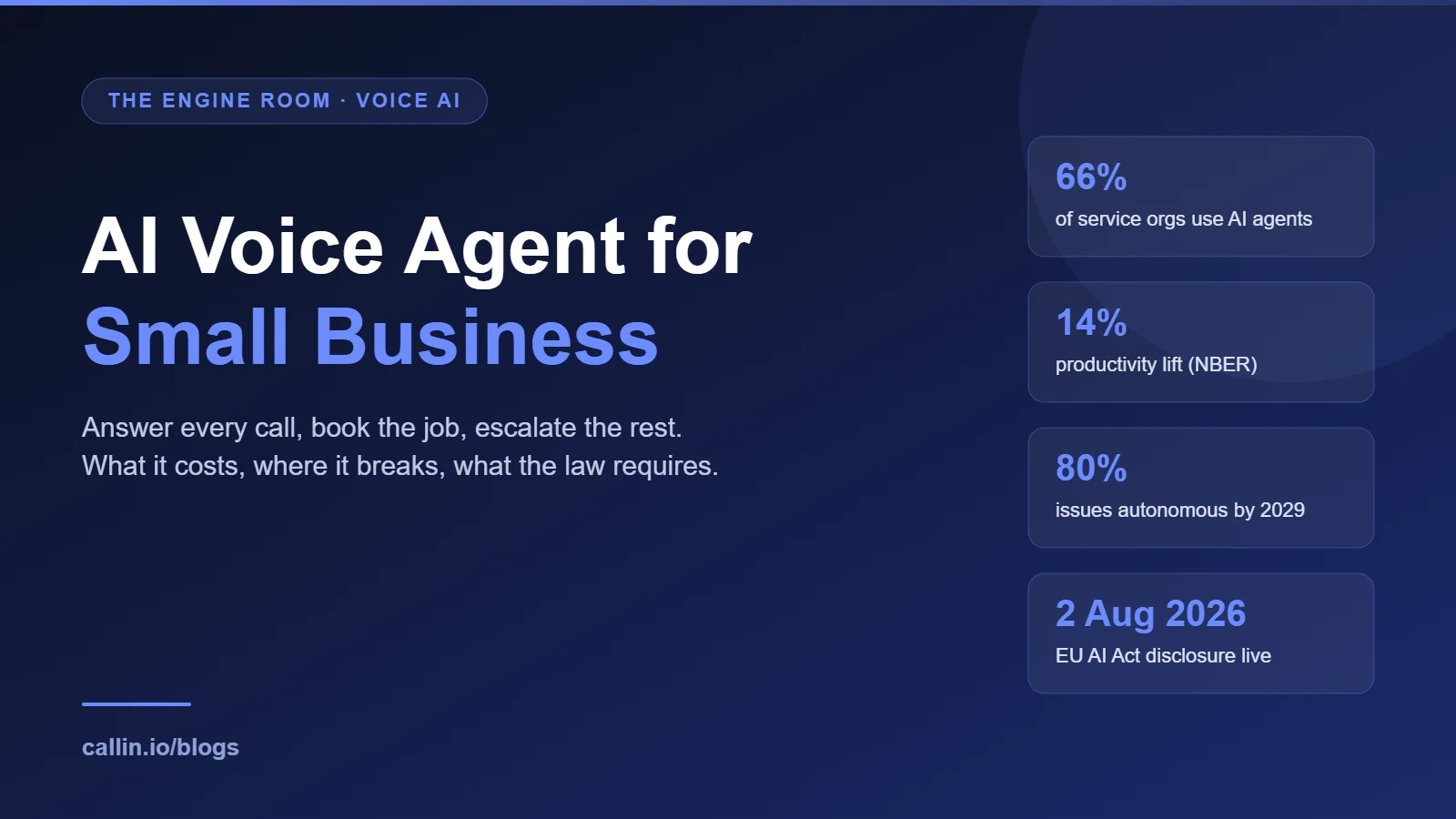
AI Outbound Calling: Dial Less, Book More, Stay Legal
AI outbound calling reaches every lead in minutes, qualifies them in a real conversation and hands your closers only the calls worth taking.
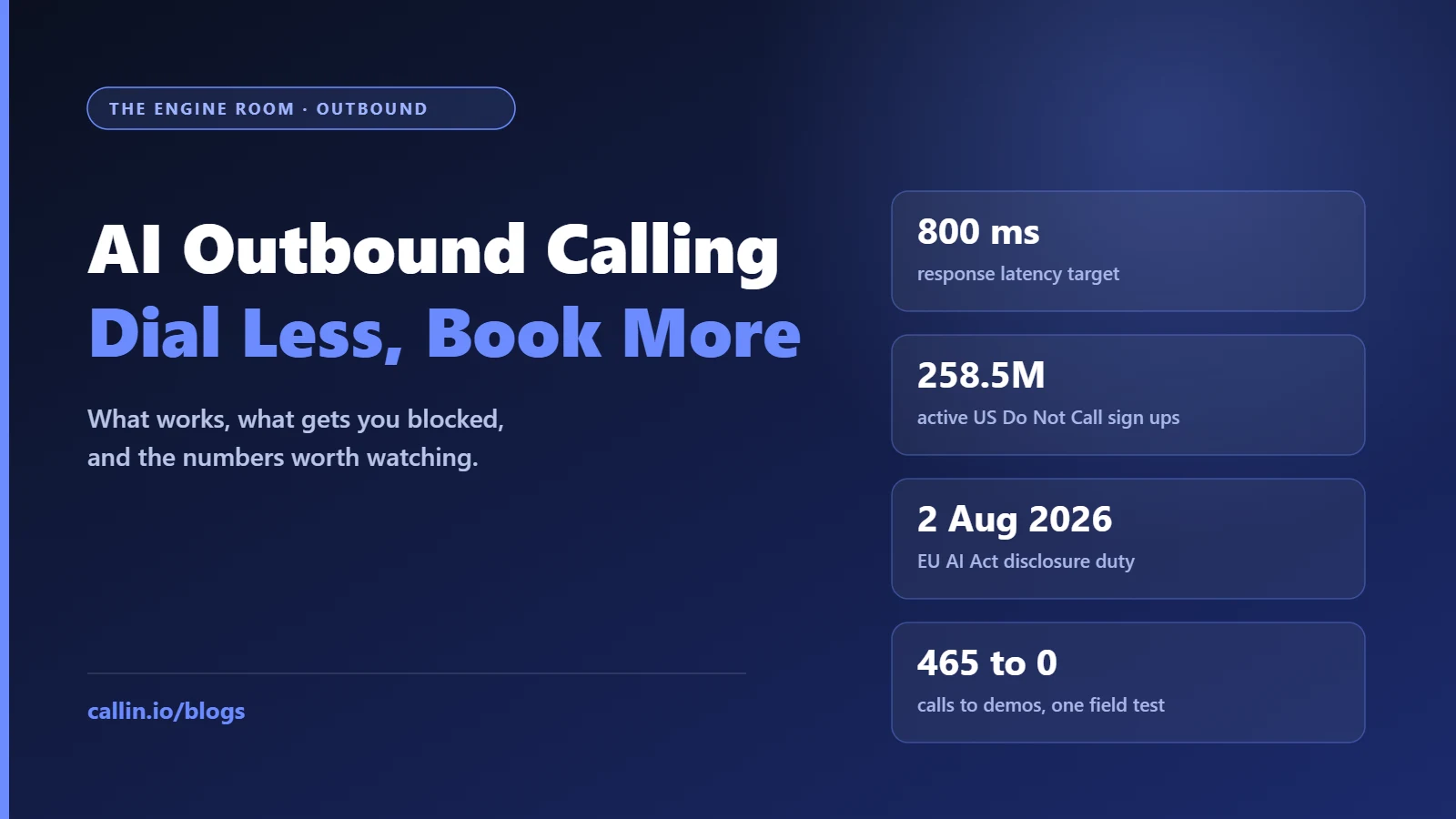
Your best lead filled in a form at 9:14 on a Tuesday night. Someone saw it at 9:40 the next morning. By then the prospect had spoken to two competitors. That gap, not your pitch, is what lost the deal.
AI outbound calling exists to close it. Instead of a queue of names waiting for a human, every contact gets a real conversation within minutes, at any hour, from a voice that listens rather than recites.
It also carries real risk. Regulators have ruled on synthetic voices, carriers flag suspicious numbers within days, and plenty of teams have burned a good list learning that the hard way. This guide covers both halves.
Key takeaways
AI outbound calling uses generative voice agents to hold two way conversations on calls your business initiates. It is neither an IVR nor a power dialer.
In the United States the FCC ruled on 8 February 2024 that AI generated voices count as artificial under the TCPA, so consent rules apply in full.
In Europe, Article 50 of the AI Act requires you to tell people they are talking to a machine, and Italy now blocks spoofed caller IDs at network level.
The model that pays is hybrid: AI carries volume at the top of the funnel, humans take the conversations where money changes hands.
Under 800 ms of response latency is the practical line between a conversation and an awkward pause.
Field reports are blunt. One founder logged 465 AI calls in four days and booked nothing, because the offer was wrong. The dialer is not the strategy.
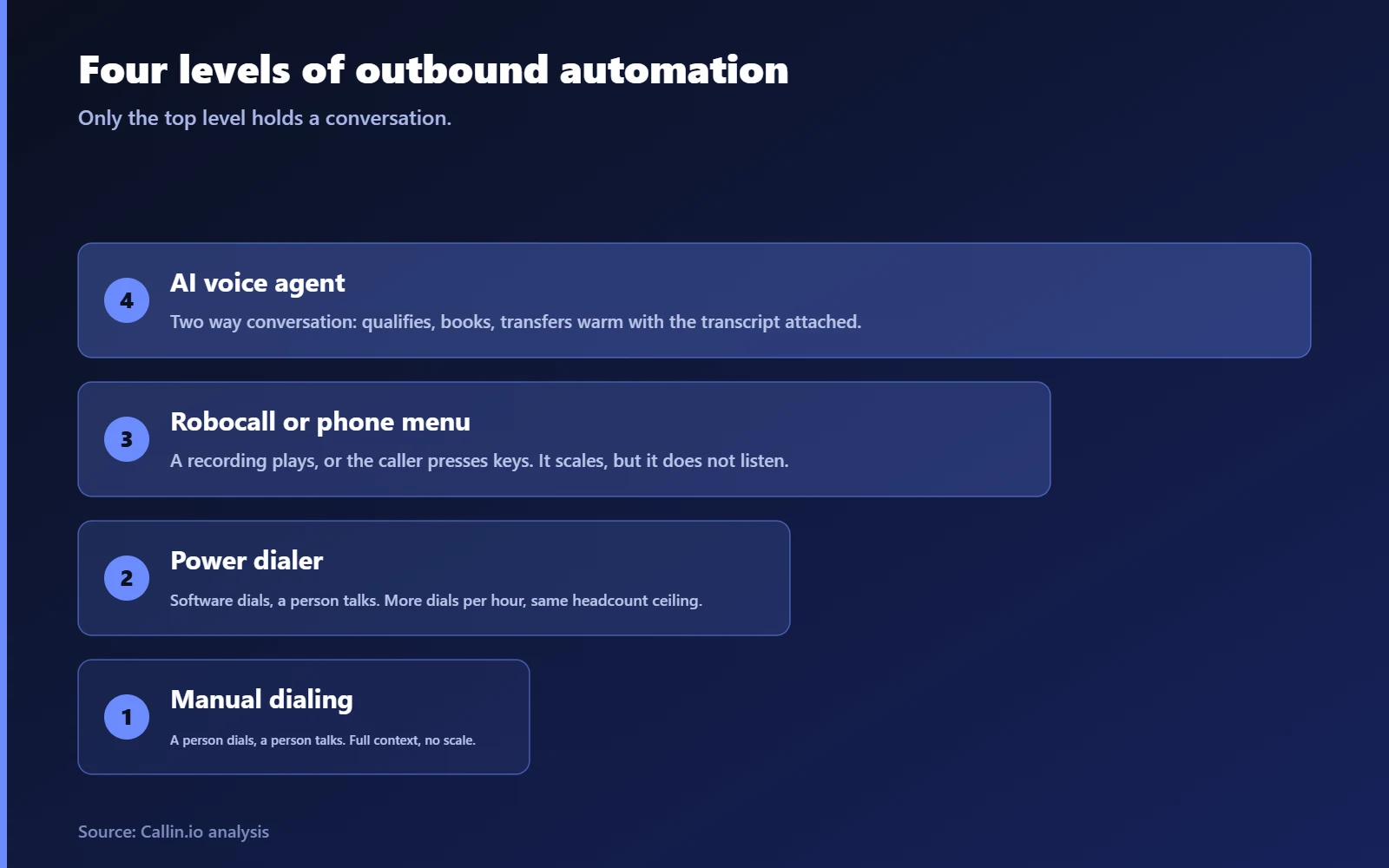
Four levels of outbound automation, from manual dialing to a full voice agent. Source: Callin.io analysis.
What AI outbound calling actually means
AI outbound calling means using a generative voice agent to run calls your company starts: prospecting, qualification, follow ups, reminders and appointment setting, handled as a genuine back and forth rather than a recorded message.
Three things get confused with it. A robocall plays a fixed recording and does not listen. A power dialer automates only the dialing, then drops a human onto the line. A phone menu asks the caller to press numbers.
An AI voice agent holds a conversation instead. It understands what was said, decides what to say next, and adapts when the person interrupts, objects or changes the subject. For the inbound counterpart, our guide to conversational IVR covers how the menu disappears entirely.
How the voice pipeline works
Every turn runs through three stages. Speech to text transcribes what the person said. A language model reads intent, context and tone, then writes the reply. Text to speech turns it back into audio.
The loop has to finish fast. The working benchmark is under 800 milliseconds from the moment the person stops talking. Above roughly a second, people talk over the agent and the call feels broken even when the words are right.
Latency is where cheap setups fall apart, and a demo on a quiet line proves nothing. Test with background noise, accents and interruptions, the discipline we describe in how an AI phone agent is built.
Is AI outbound calling legal?
Yes, with conditions that are not optional and not the same on both sides of the Atlantic.
In the United States, the FCC issued a declaratory ruling on 8 February 2024 stating that calls made with AI generated voices are artificial under the Telephone Consumer Protection Act. The practical effect: the consent rules that already applied to prerecorded robocalls now cover your voice agent too. The FCC announcement is short and worth reading in full.
Public appetite for unsolicited calls is not improving. The FTC counted around 258.5 million active registrations on the National Do Not Call Registry as of 30 September 2025, with complaints rising again that year, per the FTC Data Book release.
Europe adds two more layers
Article 50 of the EU AI Act requires that people be told they are interacting with an AI system, clearly and from the start of the first interaction, unless it is already obvious. Those transparency obligations apply from 2 August 2026, as the European Commission FAQ sets out. GDPR sits underneath all of it: calling a number you scraped is a lawful basis problem long before it is an AI problem.
Italy shows where enforcement is heading. The regulator AGCOM extended its anti spoofing filter to mobile caller IDs on 19 November 2025, blocking foreign calls that fake an Italian number. Earlier that year the Italian data protection authority fined an energy retailer three million euro for aggressive telemarketing built on lists gathered without proper consent.
Three rules you cannot skip
Consent, documented. Keep the record of where each number came from and what the person agreed to. A purchased list with no provenance is a liability, not an asset.
Do Not Call sync, automated. Check national and regional registries before every campaign, not once a quarter.
Disclosure, immediate. Say it is an AI assistant in the opening seconds, in plain words. Teams that do this find it costs far less than they feared.

An outbound floor is a queue problem before it is a talent problem. Photo by Arlington Research on Unsplash.
What practitioners report when nobody is selling
Vendor case studies are uniformly glowing. The open forums are more useful. One founder posted a full teardown on r/SaaS after running 465 outbound calls to contractors over four days with an AI voice agent. 101 went to voicemail or no answer. Demos booked: zero. His conclusion was that the technology worked and the offer did not.
A thread on r/automation put it more sharply: anyone can now wire up a voice model, a telephony provider and a lead list over a weekend, which is exactly why so many campaigns fail. The build is trivial. The targeting, the offer and the follow up are not.
On LinkedIn, one operator described spending five thousand dollars on an AI agent to book sales calls and getting beaten by a human intern. Another, writing about disclosure, argued the agent should declare itself artificial within the first ten seconds, and that scripting it that way removed the awkwardness entirely.
The pattern is consistent. AI outbound calling amplifies whatever you already have, and amplifying a weak offer just produces failure faster.
Where AI belongs and where it does not
The calls AI handles well share a shape: high volume, time sensitive, low emotional stakes, clear success condition.
Speed to lead on inbound form fills, within two minutes rather than the next morning.
Reactivating dormant leads that nobody has time to work.
Reminders, confirmations and rescheduling, which pairs naturally with AI appointment scheduling.
Payment and renewal chasing.
Event invitations and RSVP follow up.
Post sale surveys and verification calls on an ageing database.
Three situations call for a human, every time. Named accounts and existing relationships, because sending a machine to someone signing a large renewal reads as a downgrade. Complaints and disputes, because an upset customer handed to an agent that cannot fix the problem escalates from annoyed to furious in under a minute. Anything urgent or safety related, which belongs with people and is illegal to automate for sales purposes in most markets anyway.
The hybrid model: AI opens, humans close
The highest return setup is not AI replacing a sales team. It is AI clearing everything that sits in front of a real conversation. The agent works the list, disqualifies the wrong fits, answers obvious questions and books the meeting. Your closers arrive at a calendar full of people who already asked to talk.
The mechanism is the warm transfer. When the agent detects buying intent it patches in a human mid call and passes the transcript and summary at the same time. The rep picks up with full context and the prospect never repeats themselves. It is the handoff logic that makes voice AI for customer service tolerable rather than infuriating.
Get the escalation thresholds wrong and the whole thing collapses. Too eager and your reps drown in unqualified transfers. Too strict and the agent talks good buyers out of the funnel.
Jake Dunlap on building an AI layer into a sales process, on the independent sales podcast 30 Minutes to President's Club.
Human rep versus AI voice agent, honestly
On cost per dial, a human conversation carries salary, tooling and management overhead while an agent is priced in cents per minute. On availability, a rep works a shift and an agent works nights and weekends, which matters most for speed to lead. On scale, human capacity means hiring and ramping, agent capacity means changing a number in a settings panel. On consistency, the agent delivers the same opening on call four hundred as on call one and logs every outcome to the CRM.
On negotiation, empathy and reading a room, humans win and will keep winning. That is precisely why you want them off the dialing.
Research supports amplification rather than replacement. In a study of 5,179 customer support agents, economists at the National Bureau of Economic Research measured a 14% average productivity gain from generative AI assistance, rising to 34% for novice workers and close to nothing for the most experienced. AI lifts the floor much more than it lifts the ceiling.

Numbers worth knowing before you build. Sources: FTC, Gartner, NBER, r/SaaS field report.
Launching your first campaign in four steps
1. Clean the list before anything else
Remove duplicates, dead numbers and anything without a documented consent trail, then cross check the Do Not Call registries. Bad data does not just waste minutes. It damages the reputation of your phone numbers with carriers, and that damage is slow to undo.
2. Write for the ear, not the eye
Short sentences. One idea per line. No subordinate clauses, no jargon the speech engine will mangle. Read every line aloud before it ships and rewrite anything you stumble over.
Open with the disclosure, state the reason for the call in one sentence, then ask a question. Silence after a question is how the agent learns whether the person is interested.
3. Test internally until it stops being embarrassing
Have your own team call in and try to break it. Interrupt mid sentence, ask something off script, use a heavy accent, go quiet. The bar to clear is simple: a colleague who does not know should not work it out inside the first thirty seconds.
4. Ramp slowly
Do not send ten thousand calls on day one. Start around fifty a day to warm the numbers, then increase over two or three weeks while watching connect rates. Sudden volume on a fresh number is the fastest way to get labelled as spam likely, and once carriers flag you the label sticks.
The metrics that actually tell you something
Most teams watch call volume, the least informative number available. Connect rate tells you whether your numbers are trusted and your calling windows make sense. Conversation rate, meaning calls that got past the first ten seconds, tells you whether the opening works. Qualification rate tells you whether the list matches the offer.
Transfer acceptance, the share of warm transfers your reps judge worth taking, is the best single signal that the thresholds are set correctly. Cost per booked meeting is the only number a finance team will care about. Track opt out rates as a safety gauge: a rising one means you are calling the wrong people, and it shows up weeks before anything else.
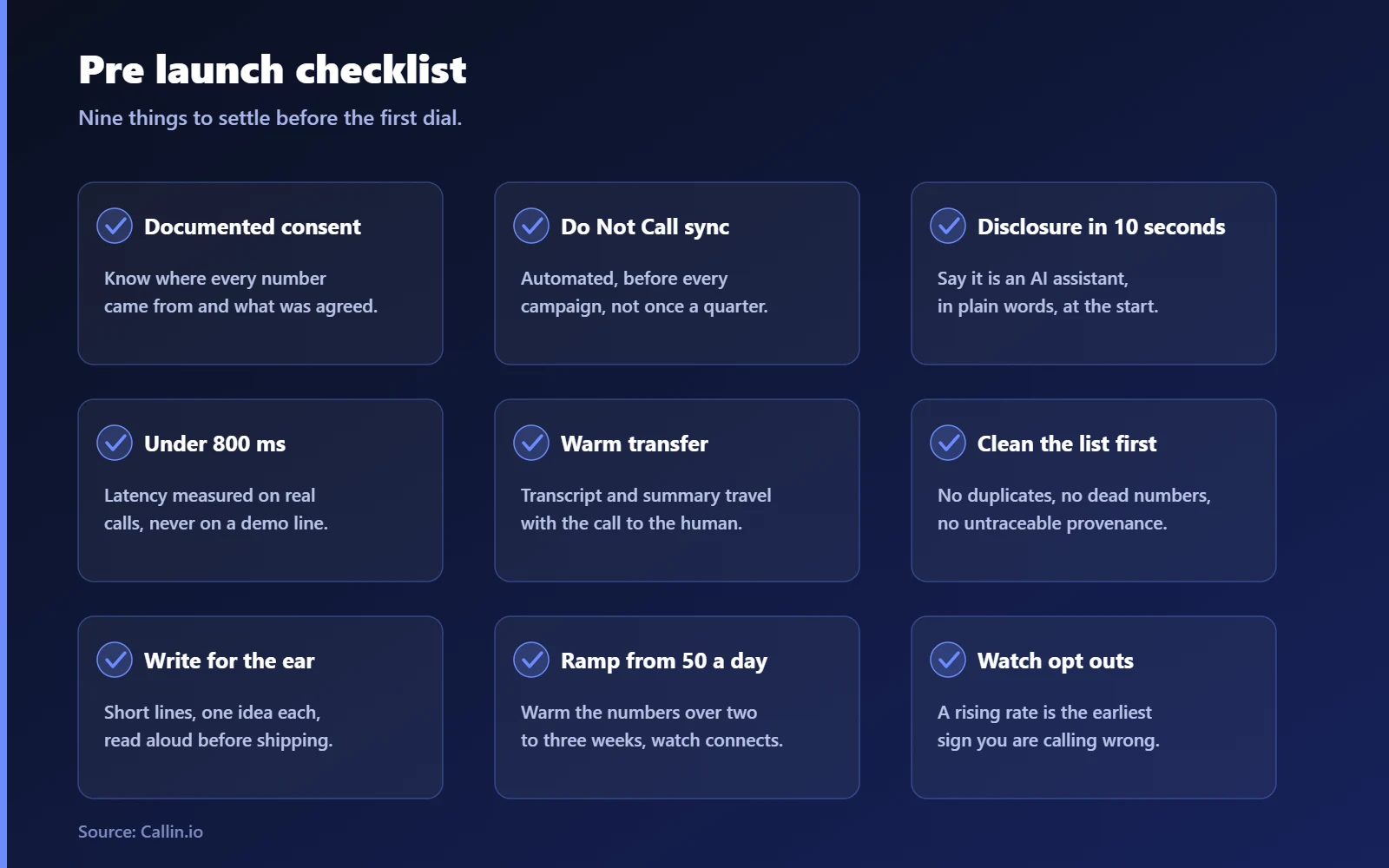
A pre launch checklist for compliant, effective AI outbound. Source: Callin.io.
How to judge a platform, and where this is heading
Demos are designed to impress. Judge instead on what decides whether the programme survives month three: latency measured on real calls, built in disclosure and consent logging, automated Do Not Call handling, native CRM sync, warm transfer with transcript attached, searchable recordings for coaching, reliable voicemail detection, and per minute pricing you can model in advance on our pricing page.
If you are building calling into your own product rather than buying seats, the Callin.io voice platform exposes the same components through an API, while our AI phone agent covers the operational side.
Three shifts are visible in what ships next. Agents are starting to adjust pace to the person, slower when someone sounds confused and shorter when they sound rushed. One agent will run the call while sending the calendar link by SMS and the summary by email. And dialing will move from time zone rules to per contact prediction, based on when that person has answered before.
The economics are not speculative. Gartner predicted that conversational AI in contact centres would cut agent labour costs by 80 billion dollars in 2026, in a forecast published in August 2022. The money moved once the conversations became good enough.
Frequently asked questions
Is AI outbound calling illegal?
No, but it is regulated. In the United States the FCC treats AI generated voices as artificial under the TCPA, so prior express written consent applies to marketing calls. In the EU you must also disclose that the caller is an AI system. Illegal is what happens when you skip consent, skip Do Not Call checks or hide the disclosure.
What does AI outbound mean?
Any outreach your business initiates where an AI system handles the conversation rather than a person. On the phone that means a voice agent that can qualify, answer questions, book time and transfer to a human when it matters.
Can AI voice agents detect voicemail?
Yes. A capable agent recognises voicemail and either hangs up to save minutes or leaves a short prewritten message to prompt a callback. Reading a full pitch to an answering machine means detection is not working.
Is there a free AI caller?
Free tiers exist and are fine for testing a script. They are not fine for a real campaign, because they usually lack Do Not Call handling, consent logging, recording and the number reputation management that keeps you out of the spam bucket.
How much does AI outbound calling cost?
Pricing is usually per minute and lands in the cents, against several dollars for a human dial once salary and overhead are included. Model it per booked meeting rather than per minute, since a cheap agent that books nothing costs more than an expensive one that books well.
Which industries get the most out of it?
Anywhere the phone is the bottleneck and speed decides the outcome. Property teams are an obvious case, covered in AI for property management calls, alongside home services, healthcare scheduling, insurance renewals and B2B reactivation lists.
Start with one campaign, not a transformation
The teams that succeed with AI outbound calling do not begin by automating outbound. They pick the single most repetitive call on the list, automate that one properly, measure it for a month, and only then move to the next.
Pick your worst queue: leads untouched for two days, reminders nobody makes, the reactivation list everyone agrees is valuable and nobody calls. Give it to an agent, disclose honestly, keep a human at the other end of the transfer, and watch the connect rate rather than the call count.
To hear what that sounds like on your own numbers, build and test an agent at callin.io and have it running before the end of the week.