AI for Property Management Calls: What Actually Works
AI for property management calls answers every tenant 24/7, triages emergencies and books showings, so your team stops losing leases to voicemail.

A burst pipe at 11pm. A prospect calling about a two bedroom while you are mid showing. A resident who wants to know, for the fourth time this month, whether the pool is open. Property management is a phone business disguised as a real estate business, and the phone does not respect office hours.
AI for property management calls is the practical answer to that pressure. A voice agent picks up every line, works out what the caller needs, resolves what it can, logs what it cannot, and wakes a human only when the situation genuinely needs one. Done well, it removes the voicemail queue without removing the human judgment.
Key takeaways
Triage, not answering, is the hard part. Picking up a call is trivial. Deciding whether a leak is an emergency is where value is created or destroyed.
Peer reviewed evidence for AI assistance in support work is real but modest at the average, and largest for less experienced staff.
Outbound AI voice calls in the United States are regulated. The FCC treats AI generated voices as artificial under the TCPA.
Fair housing rules follow the technology. HUD has said explicitly that using a third party system does not transfer your responsibility.
Residents forgive automation that is fast and honest. They punish automation that loops, stalls, or pretends to be human.
What AI for property management calls actually means
The narrow version is an answering layer: a voice agent picks up, takes a name and unit, and leaves a message. That is a better voicemail. The broad version is an operational layer. The agent knows which property the caller lives at, reads the maintenance policy for that building, tells a running toilet from a flooded unit, books a showing against a live calendar, and dispatches an on call vendor with address and access notes attached.
Most disappointments come from buying the first and expecting the second. If you want a mental model for the difference, our breakdown of what an AI phone agent is and is not covers the mechanics in more detail.
Why the phone is still the bottleneck
Property management sits on an unusually awkward call profile. The volume is moderate but the variance is brutal, and the cost of mishandling a single call is asymmetric.
A missed leasing call is a lost lease. A mishandled emergency is a habitability claim. A resident who cannot reach anyone about a broken lock is a review, then a renewal that does not happen.
The staffing math is tight too. The US Bureau of Labor Statistics counts about 460,400 property, real estate and community association managers, with employment projected to grow 4 percent between 2025 and 2035.
Meanwhile the resident side is under strain. Harvard's Joint Center for Housing Studies reported in March 2026 that 22.7 million renter households spend more than 30 percent of income on rent and utilities, which is 49 percent of all renters. Rental vacancy sat at 5.2 percent. Softer markets mean leasing calls matter more, not less.
The four levels of call handling
The useful way to scope an AI deployment is not by feature list. It is by how far up the decision ladder you are willing to let the system go.
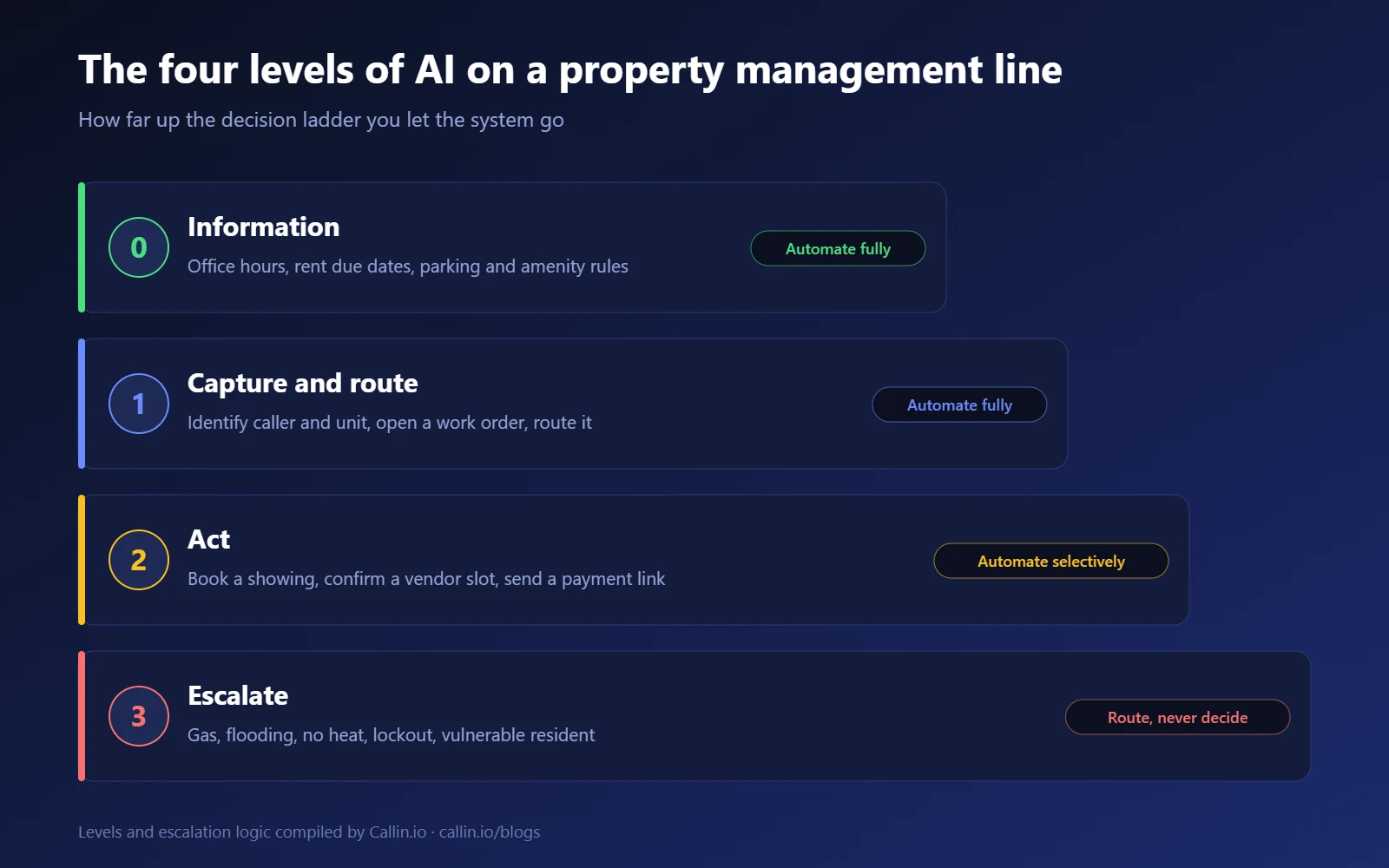
The four levels of automation on a property management line. Levels and escalation logic compiled by Callin.io.
Level 0, information. Office hours, rent due dates, parking rules, amenity schedules, where to send a certificate of insurance. No system access needed, no risk if automated, and a large share of total volume.
Level 1, capture and route. The agent identifies the caller, matches the unit, opens a work order with a category and description, and sends it to the right queue. Still low risk, because a human reviews before anything is dispatched.
Level 2, act. Booking a showing against a live calendar, confirming a vendor appointment, sending a payment portal link by SMS during the call. This is where the time savings become visible. Our guide to AI appointment scheduling covers the calendar integration side.
Level 3, escalate. Gas smell, no heat in winter, flooding, fire, lockout, anything involving a vulnerable resident. The agent's only job here is to recognise the pattern fast and hand over to a human with context attached. Speed of handover is the metric, not containment rate.
What the evidence actually supports
Vendor case studies in this category are generous. The peer reviewed picture is narrower and more useful.
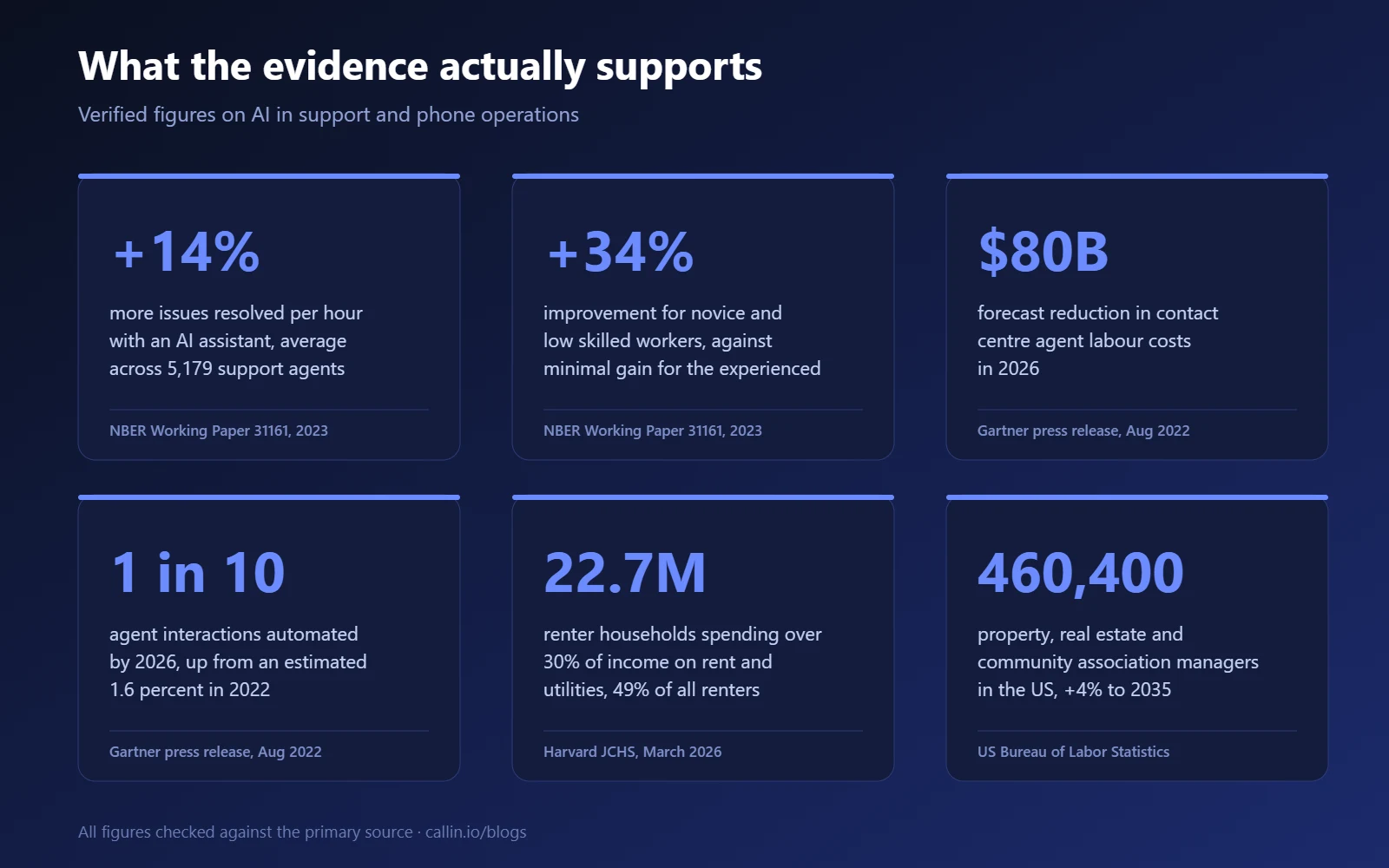
Verified figures on AI in support and phone operations. Sources: NBER, Gartner, Harvard JCHS, US BLS.
The strongest study is Brynjolfsson, Li and Raymond's Generative AI at Work, which tracked 5,179 customer support agents. Access to an AI assistant raised issues resolved per hour by 14 percent on average, with a 34 percent improvement for novice and low skilled workers and minimal impact on experienced ones.
On the forecast side, Gartner predicted in August 2022 that conversational AI would cut contact centre agent labour costs by 80 billion dollars in 2026, and that one in ten agent interactions would be automated by 2026, up from an estimated 1.6 percent at the time. Even the optimistic forecast assumes nine in ten interactions still involve a person.
Who gets the most value
Single family and small multifamily operators gain the most. There is no front desk, calls land on a personal mobile, and after hours coverage is either an answering service or nothing.
Multifamily leasing teams gain on the top of funnel. Tour bookings and availability questions are high volume, low judgment, and time sensitive. Our note on the AI receptionist for real estate goes deeper on the leasing side.
HOA and community association managers gain on repetition. Rules, dues, violation processes and board meeting dates generate enormous call volume with almost no variation.
What a serious setup has to do
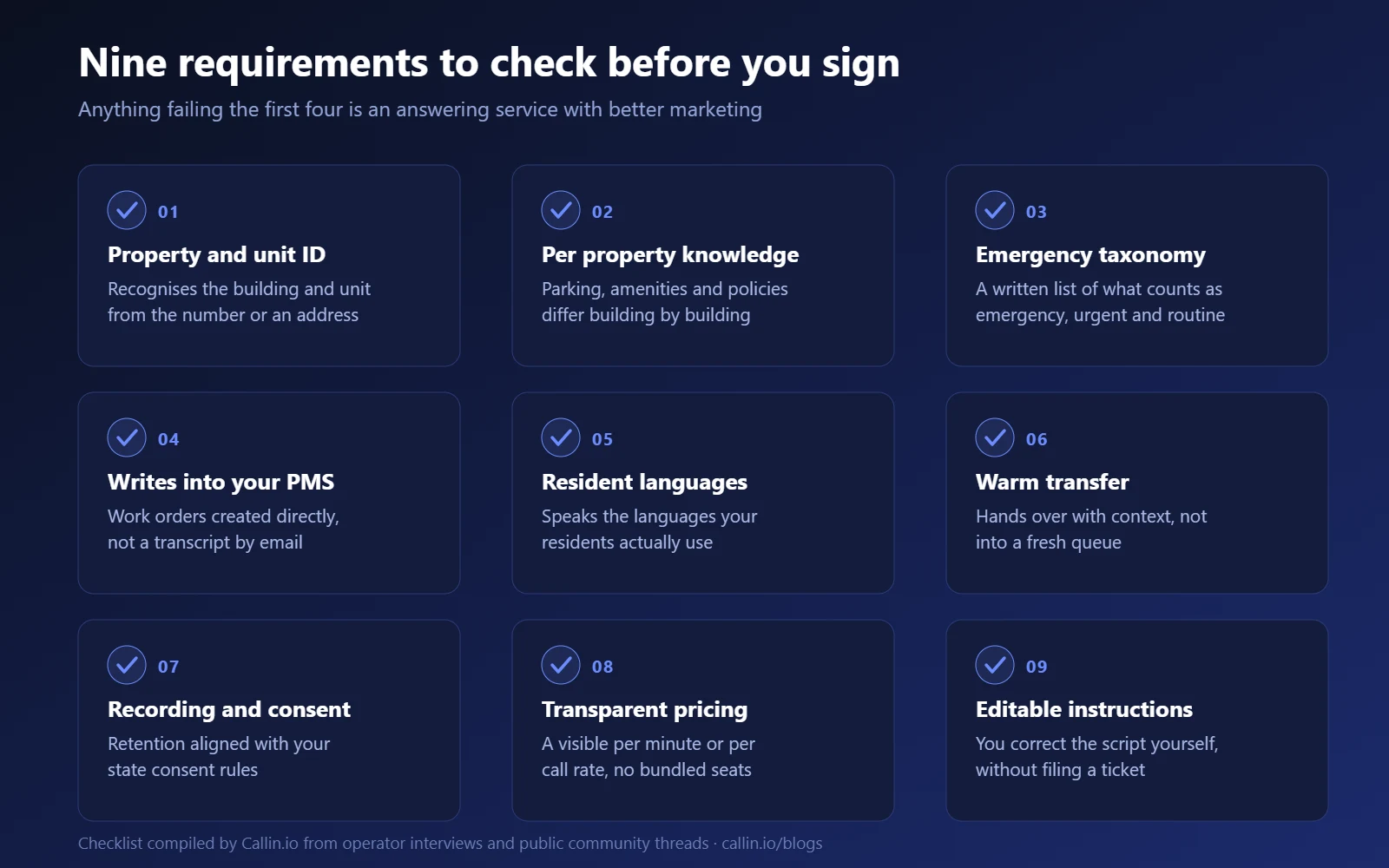
Nine requirements to check before signing. Checklist compiled by Callin.io from operator interviews and public community threads.
It must identify the property and unit from the phone number or a spoken address, because generic answering is useless in a multi property portfolio. It must hold a per property knowledge base, since rules differ building by building. It must run an explicit emergency taxonomy with a written escalation path. It must write into your property management system rather than emailing a transcript.
Beyond that: it should speak the languages your residents speak, warm transfer with context instead of dropping the caller into a fresh queue, record and retain calls in line with your state's consent rules, expose a plain per minute or per call price, and let you read and correct the agent's instructions yourself. A voice platform you cannot edit without filing a ticket becomes stale within a quarter.
What residents and managers actually say
The public conversation is more instructive than any case study, and it is not uniformly positive.
On Reddit, a thread in r/AIReceptionists asking for the best AI receptionist for property management drew more than sixty replies from operators describing calls landing while they were showing units. The top voted answer made the point this whole category turns on: the make or break piece is the triage, not just answering the phone.
Other threads are blunter. One resident thread described an apartment building switching to an AI chatbot that failed to respond usefully and told people to go to the leasing office, producing a queue of angry residents at the desk. Another, titled as a prospective tenant's view, argued that AI interactions in leasing are simply worse than talking to a person.
On Quora, a widely answered question asked small business owners whether an AI answering service actually saved money or just annoyed customers. The top answer drew the right line: it depends almost entirely on what people are calling about. Hours and bookings automate well. Anything requiring a decision does not.
LinkedIn shows the same split. Operators publish posts on how AI answers every call and books tours in real time, while others publish equally direct posts on how AI can quietly damage net operating income when a service coordinator is taken out of the loop.
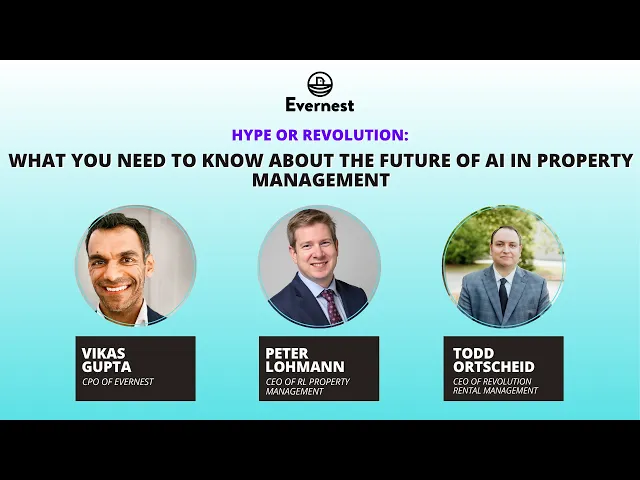
The Evernest Property Management Show, "The AI Tools Property Managers Are Using in 2026 (Part 1)", a discussion between operators from Evernest, RL Property Management and Revolution Rental Management on leasing automation and maintenance workflows.
Compliance is not optional
Two regulatory facts should shape any deployment in the United States, and both are frequently ignored in product demos.
First, outbound. On 8 February 2024 the FCC adopted a declaratory ruling making clear that calls using AI generated voices are artificial under the Telephone Consumer Protection Act. It took effect immediately. If you plan AI driven rent reminders or renewal campaigns, the consent rules for artificial and prerecorded voice calls apply to you.
Second, fair housing. On 2 May 2024 HUD issued guidance on the Fair Housing Act and AI, covering tenant screening and advertising through digital platforms. The guidance is explicit that use of third party systems, including those using artificial intelligence, must comply with the Fair Housing Act. Outsourcing the tool does not outsource the liability.
The practical consequence is simple. A voice agent may collect availability and book a tour. It should not evaluate an applicant, comment on eligibility, or vary its script based on anything that resembles a protected characteristic.
A thirty day rollout that does not blow up

Modern apartment building at dusk. Photo by Tobias Wilden on Unsplash.
Days 1 to 5, listen. Pull ninety days of call logs. Categorise by reason, time of day and outcome. You are looking for the three reasons that make up most of your volume. In most portfolios they are maintenance status, rent and balance questions, and availability.
Days 6 to 10, write the rules. Draft the emergency taxonomy before touching any software. List what is an emergency, what is urgent but next day, and what is routine, per property. This document is the deployment. Everything else is configuration.
Days 11 to 18, after hours only. Point the agent at the overnight and weekend line. Volume is lower, tolerance for automation is higher, and the alternative was voicemail anyway.
Days 19 to 25, review every transcript. Not a sample. Every one. You will find three or four phrasings the agent mishandles and fixing those covers most of the failure surface.
Days 26 to 30, extend to overflow. Let the agent take calls that ring more than four times during business hours. Keep the direct human path intact and visible. If you are calculating budget at this stage, our pricing page shows how per minute costs scale with portfolio size.
The numbers worth tracking
Most dashboards in this category measure the wrong thing. Containment rate, the share of calls the agent handled alone, rewards a system for refusing to escalate.
Track these instead. Answer rate across all hours, which should approach 100 percent. Emergency recognition accuracy, measured by auditing every level 3 call by hand. Time from call to work order created. Showing bookings per hundred leasing calls. Repeat call rate within 24 hours, which is the clearest signal that a first call failed. And resident sentiment on renewal surveys, segmented by whether the resident ever spoke to the agent.
Mistakes that sink deployments
Letting the agent claim to be human. Residents find out, and the trust cost outlasts the efficiency gain. A short, plain disclosure at the start of the call costs nothing.
Automating emergencies to save money. The one call category where you should accept a lower automation rate is the one where automation is most often oversold.
Hiding the human path. Every call must have an obvious route to a person, stated early, not buried after three failed attempts.
Never reading transcripts. The system drifts as policies change. Sampling calls monthly is the minimum maintenance cost of running one of these. The same discipline applies in any deployment, as our piece on voice AI for customer service sets out.
Frequently asked questions
Can AI handle after hours emergency maintenance calls safely?
It can recognise and route them, which is the part that matters at 2am. It should not decide whether a vendor is dispatched without a human in the loop for anything involving water, gas, heat or safety. Treat it as a fast, accurate switchboard for emergencies, not a decision maker.
Will residents know they are speaking to AI?
Most will, within a sentence or two. Say so at the start and make the transfer to a person obvious. Community threads show the anger comes from concealment and dead ends, not from automation itself.
Does it integrate with my property management software?
Ask this before pricing. A system that emails you a transcript has moved the work, not removed it. You want work orders created directly, with unit, category and priority populated.
Is it legal to use AI voices for rent reminder calls?
In the United States, outbound calls with AI generated voices fall under the TCPA's artificial voice rules following the FCC's February 2024 ruling, so the usual consent requirements apply. Check with counsel before running any outbound campaign, and note that state rules add further requirements.
How much of my call volume can realistically be automated?
For most portfolios, the information and capture layers represent a large share of calls and automate cleanly. Gartner's own forecast put automated agent interactions at roughly one in ten across all industries by 2026, so treat any claim of 90 percent automation with scepticism.
Do I need a separate system for leasing and for maintenance?
No, and separating them creates the worst resident experience, because callers get routed by menu rather than by intent. One agent with two decision trees and access to both calendars and work orders performs better. Our property management overview shows how both flows sit on one number.
Where to start
AI for property management calls works when it is scoped honestly. It is excellent at the repetitive, time sensitive, judgment free share of your call volume, which is larger than most managers assume. It is poor at anything requiring discretion, and dangerous when it is asked to make safety decisions alone.
Start with the after hours line, write the emergency taxonomy before you write a prompt, read the transcripts, and measure repeat calls rather than containment. That sequence turns a phone problem into a process, which is the only version of this that survives contact with a real portfolio.
If you want to see what this looks like on your own numbers, you can build and test an agent for your portfolio at Callin.io, or look at how the phone agent handles a live maintenance call before you commit to anything.