Voice AI for Customer Service: How It Works, Where It Pays Off and How to Earn Trust
Voice AI for customer service explained: how AI phone agents work, real results, what customers think, costs, the right to a human and a 7-step launch plan.
Voice AI for customer service means AI agents that answer and make phone calls, understand what customers say in natural language and resolve their requests in real time. For years companies did the opposite: they hid phone numbers, pushed customers to chat and forms, and treated every call as a cost to reduce. Voice AI is reversing that trend, because a single AI agent can hold thousands of conversations at once, at any hour, without a queue.
The shift is visible in the numbers. As Computer Weekly reports, Twilio's voice AI revenues grew 49% year over year in 2025, and its executives say businesses are putting phone numbers back on their websites, as long as layers of AI handle part of the volume. This guide takes the same starting point and goes further: how the technology works, where it pays off, what customers really think about it, what it costs and how to launch it without losing their trust.
Key takeaways
Voice AI is making the phone channel affordable again, and even a source of revenue.
The winning architecture is modular: AI connected to your existing systems, with the freedom to change language models.
Start with simple, predictable calls and climb the complexity ladder step by step.
Customers accept AI when it solves their problem and never blocks the way to a person.
What is voice AI for customer service?
It is a set of technologies that lets software hold a spoken conversation with a customer. In practice it takes three forms. AI voice agents resolve calls on their own: bookings, order tracking, payments, account changes. Agent assist listens to calls handled by people and suggests answers and next steps in real time. Speech analytics transcribes and analyses every call to find patterns, problems and opportunities.
The difference from the old phone menu is huge. An IVR asks you to press 1 or 2 and only routes the call. A voice AI agent understands a free sentence such as "I moved last month and my bill still goes to the old address", finds the account and fixes it.
How voice AI works during a call
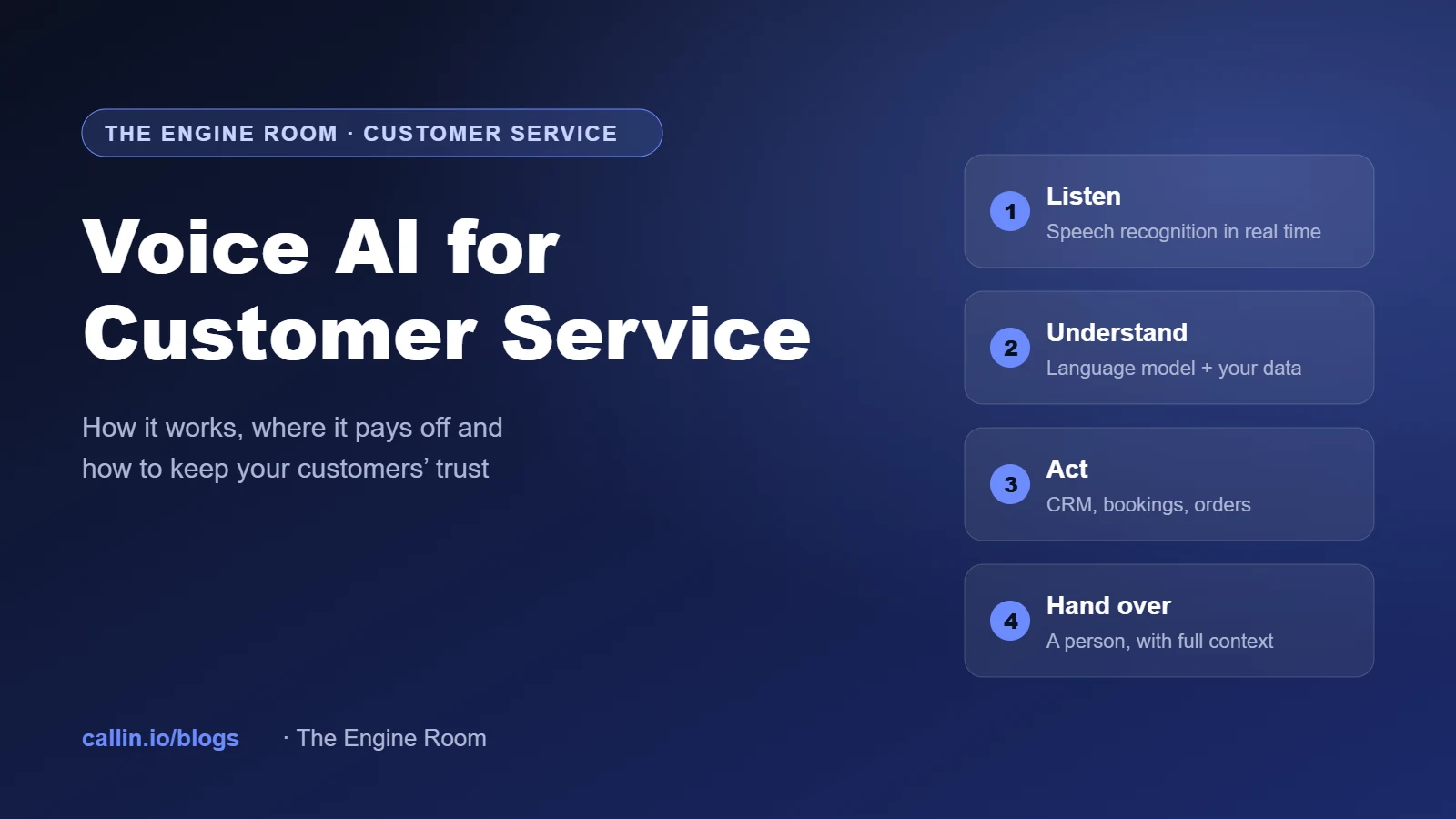
Every conversation runs through three stages: listening, understanding and responding. Speech recognition turns the caller's words into text, even with background noise, accents and poor lines. A language model understands the request and decides what to do, using your knowledge base and your systems. Text-to-speech turns the answer into a natural voice. Around them, telephony connects the call and integrations let the agent read and update your CRM, calendar or order system.
Speed matters more than most people think. Research on conversation published in PNAS found that, across ten languages, people typically reply to each other within about 200 milliseconds. An AI agent that takes two seconds to answer feels broken, however clever its answer. Low latency is part of the customer experience.
Why modular beats black box
Twilio's product leaders describe a clear preference: a modular, decoupled architecture instead of a closed "black box". The AI plugs into the systems a company already has, and the company can swap language models as better ones appear. Andy O'Dower, Twilio's VP of product management, told Computer Weekly that the platform is language-model agnostic, so customers can plug and play different models.
This matters because the market moves fast. A model that is the best choice today may be slower, more expensive or less accurate than a newer one in six months. A modular setup also helps with a problem that Twilio's Robert Woolfrey highlights for multi-country companies: a model that works in Thailand does not necessarily work in Japan. With a flexible architecture you can choose the best model and voice for each language. Our guide to choosing an AI voice platform explains what to check.
Start simple: the complexity ladder
The most successful projects do not automate everything on day one. They climb a ladder, from predictable calls to complex ones, and move up only when the previous step works.
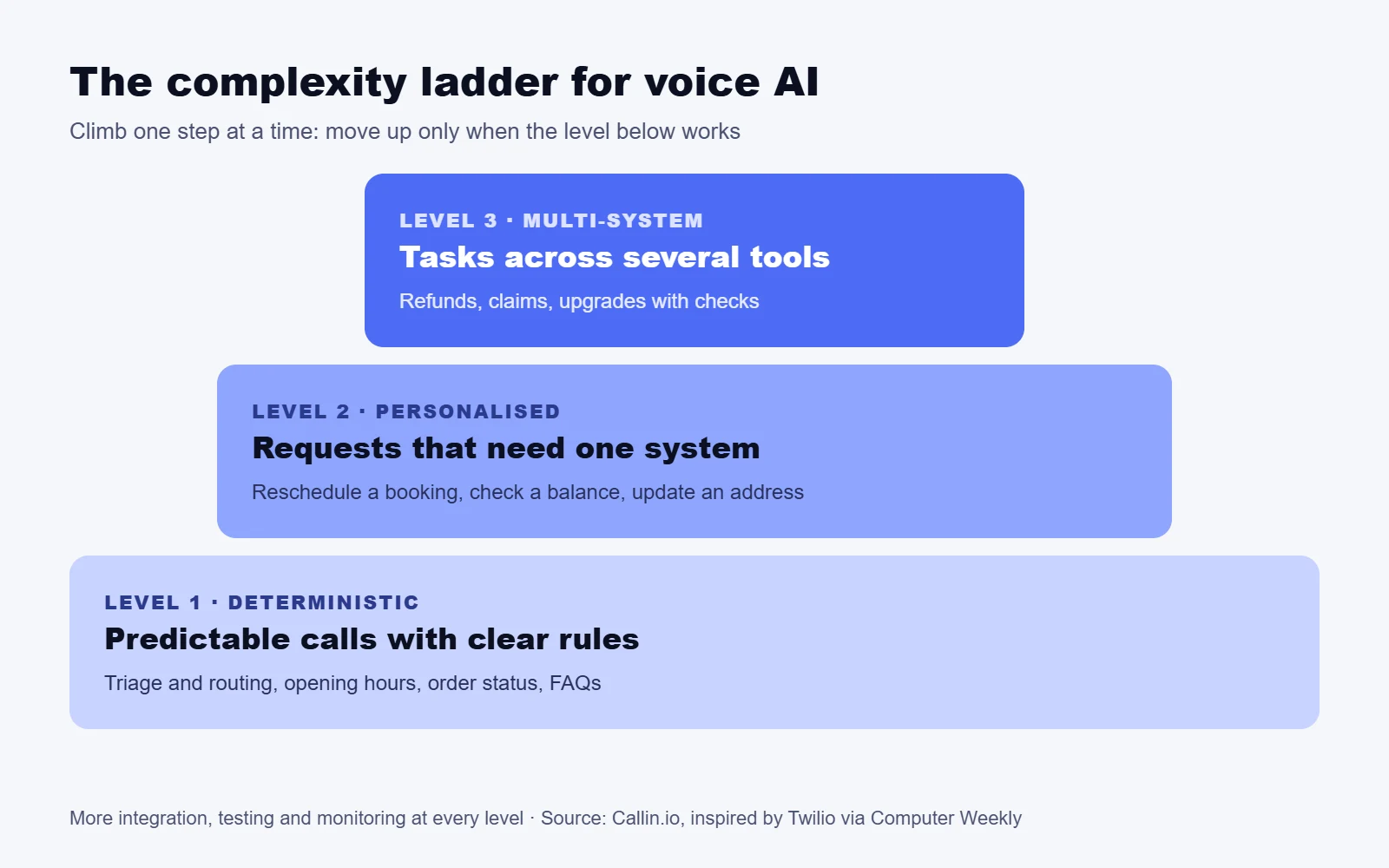
Infographic: Callin.io, The Engine Room. Approach inspired by the complexity pyramid described by Twilio to Computer Weekly
At the bottom are deterministic workflows with clear rules: triage, opening hours, order status. In the middle are personalised requests that need data from one system, such as rescheduling a booking. At the top are multi-system tasks, where the agent has to read and write in several tools during the same call. Each level needs more integration work, more testing and more monitoring.
Case study: Philippine Airlines
Philippine Airlines offers a concrete example. After its 2021 restructuring, the airline adopted Twilio Flex to get a unified view of each customer journey across channels. According to Computer Weekly, contact center wait times dropped to under one minute and monthly customer service costs fell by about 30%. The airline set itself the goal of automating 80% of tasks.
The lesson is not the single number. It is the order of the steps: first unify data and channels, then automate. Voice AI without access to customer history can only give generic answers.
Where voice AI pays off
Order and delivery questions: "Where is my order?" is often the most frequent call in e-commerce. Italian Gourmet UK automated requests like these and saved £66,000 a year.
Bookings and appointments: new bookings, changes and cancellations, directly in your calendar.
Billing and payments: balances, due dates, refund status.
Authentication: identity checks before the call reaches a person, saving minutes on every transfer.
First-level technical support: password resets and common issues, as in our AI voice agents for IT support.
After-hours and peak times: calls that would otherwise end in voicemail or in a long queue.
The results you can expect
Independent data and vendor data should be read differently, so here they are side by side.
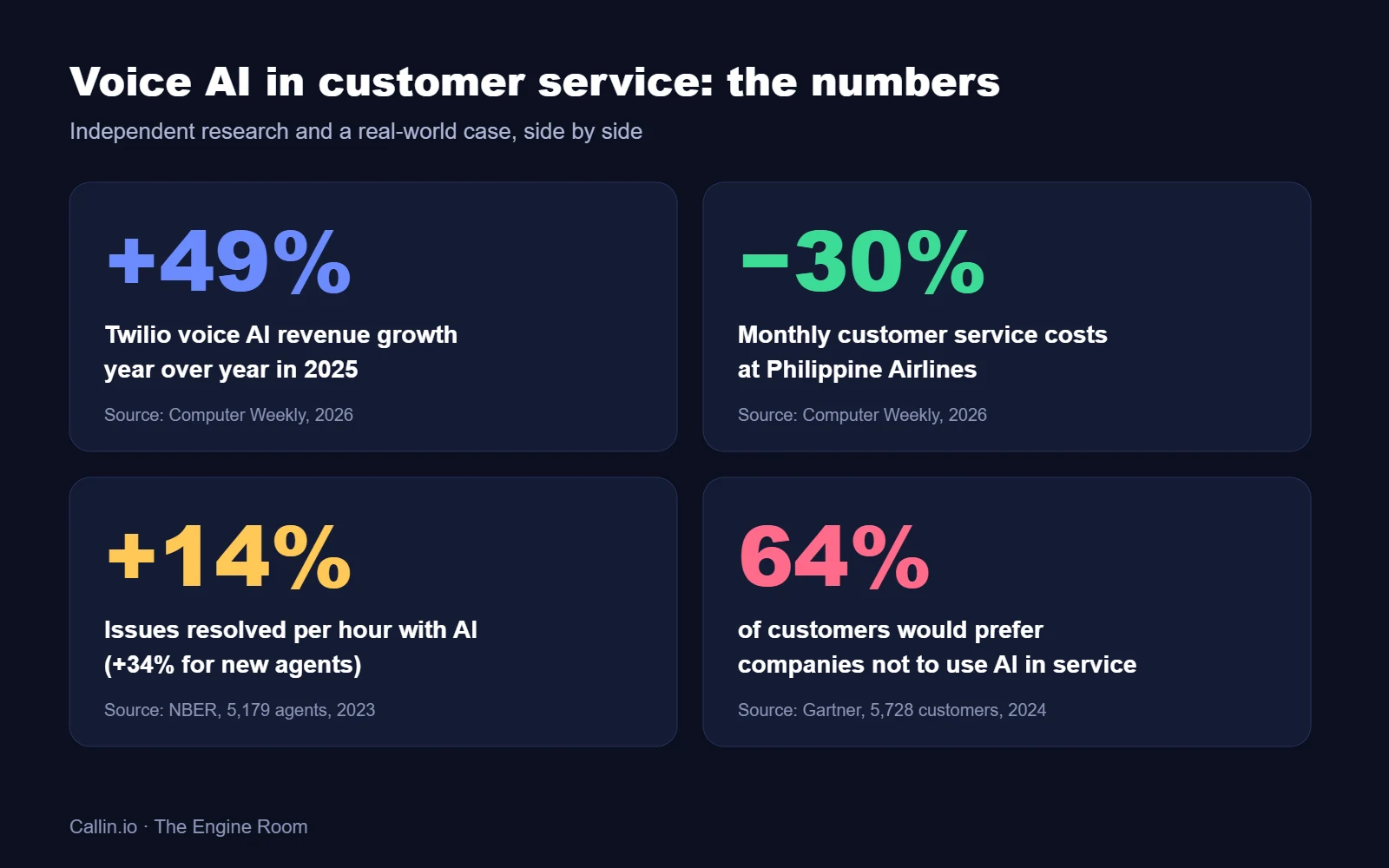
Infographic: Callin.io, The Engine Room. Sources: Computer Weekly (2026), NBER (2023), Gartner (2024)
The most solid evidence on productivity comes from an NBER study of 5,179 support agents: with an AI assistant, they resolved 14% more issues per hour on average, and new agents improved by 34%. Voice AI helps in two ways at once: it takes simple calls off the queue and it makes people faster on the rest.
What customers really think
Here is the part many vendor guides skip. A Gartner survey of 5,728 customers found that 64% would prefer companies not to use AI for customer service, and 53% would consider switching to a competitor. Their top worry was not the technology itself: it was the fear of never reaching a human, followed by job losses and wrong answers.
The same frustration appears in online discussions, from Reddit threads to LinkedIn posts. People do not complain that an AI answered. They complain when the AI loops, pretends to understand, or refuses to transfer them. The answer is design, not denial: tell callers they are speaking with an AI, solve simple requests fast and offer a person as soon as they ask or the situation needs it.

Photo: Charanjeet Dhiman on Unsplash. The best results come when AI and people work as one team.
The right to talk to a human
Regulation is moving in the same direction. Gartner predicted that by 2028 the EU will mandate a "right to talk to a human" in customer service. It already requires transparency: under Article 50 of the AI Act, people must be informed when they interact with an AI system, unless it is obvious.
In a 2026 forecast, Gartner went further: it expects assisted service volume to grow by 30% by 2028, as customers use these rights to bypass AI agents. Companies that cut their human team too deeply may have to rehire at higher cost. The safe strategy is a hybrid model, with a smaller but well-trained human team.
Security: deepfakes and scams
As synthetic voices become indistinguishable from human ones, the risk of voice scams and deepfakes grows. Twilio told Computer Weekly that it adds protections at the infrastructure level: KYC checks on customers, deepfake detection and traffic monitoring.
For your own agent, three rules help. Never let it perform sensitive actions, such as refunds or account changes, without proper identity checks. Limit the tools it can use to what the task requires. And test it against manipulation attempts: our article on prompt injection explains how attackers try to trick AI agents, and our guide to LLM hallucinations covers wrong answers.
How the economics are changing
Classic automation was justified by headcount reduction. Voice AI changes the equation in two ways. First, it absorbs seasonal peaks without permanent hiring: the same agent handles ten calls or ten thousand. Second, it can turn the contact center from a cost center into a source of revenue, because every call becomes a chance to suggest an upgrade, a renewal or an extra service.
Costs deserve an honest look too. Usage-based voice AI typically costs about $0.09 to $0.30 per minute all-in, depending on model, voice and telephony; our AI voice agent pricing guide breaks it down. Gartner warns that the cost per resolution of generative AI could exceed $3 by 2030, as vendors stop subsidising growth. The metric to watch is therefore the cost per resolved call, not the price per minute.
How to launch voice AI in your customer service
These seven principles separate the projects that work from those that frustrate customers.
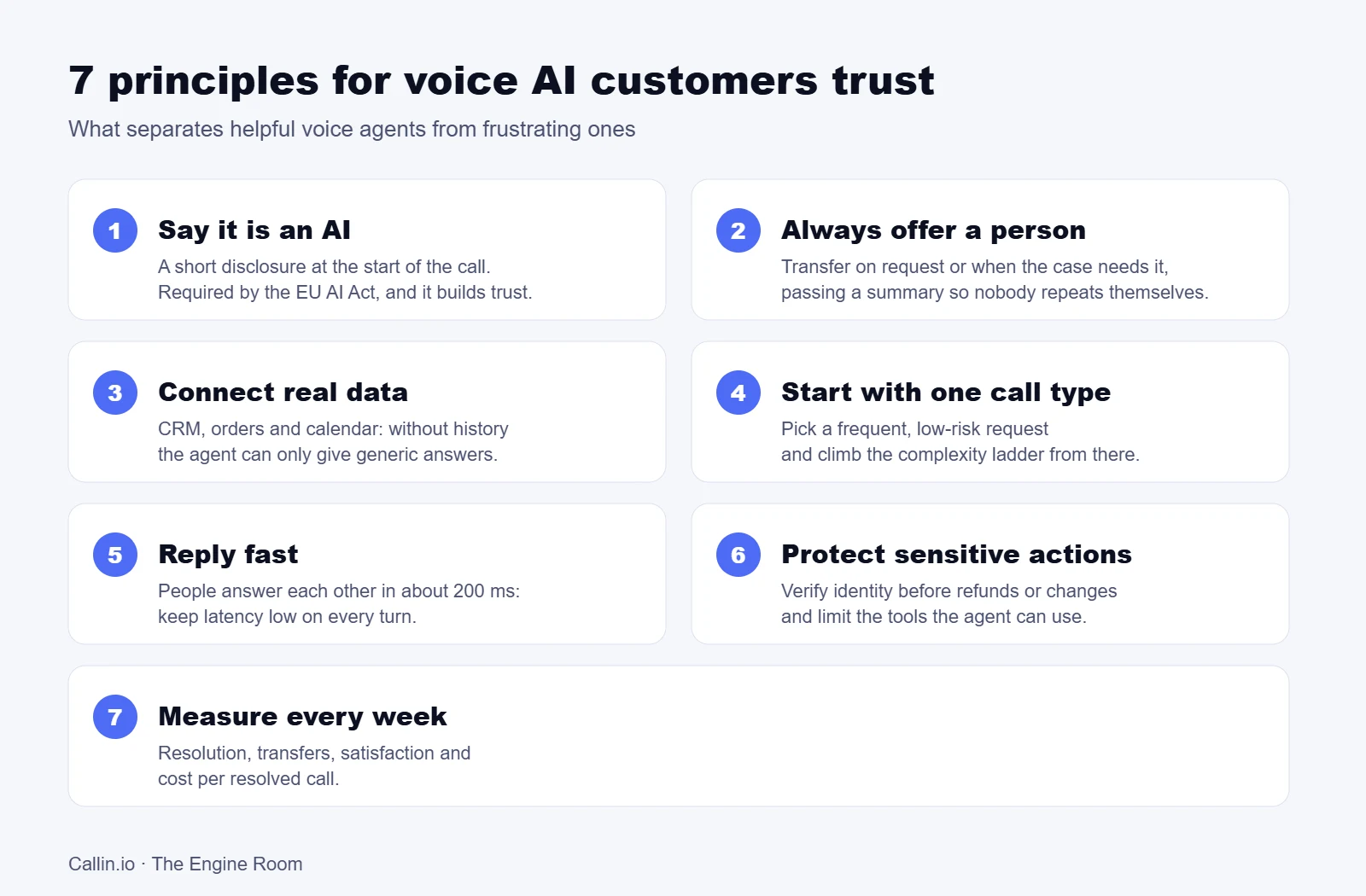
Infographic: Callin.io, The Engine Room
Two principles are often underestimated. Voice needs its own writing style: short sentences, one question at a time, numbers read back for confirmation, as explained in our guide to prompting AI voice agents. And launch is only the beginning: as we describe in AI voice agents in production, most problems appear when real callers arrive.
Metrics to track every week
Resolution rate: calls closed with the job done, without a person.
Transfer rate and reasons: why the agent handed over, and whether it passed the context.
Customer satisfaction: a short survey after the call or sentiment analysis on transcripts.
Average handle time for both AI and human calls.
Response latency: how long the agent takes to reply on each turn.
Cost per resolved call, compared with your cost before AI.
Watch: a16z on AI voice agents in call centers
In this episode of the Cognitive Revolution podcast, Olivia Moore and Anish Acharya of Andreessen Horowitz discuss where voice agents already work, from after-hours answering to appointment scheduling, and the challenges that remain: interruptions, emotional tone and integration with company data. Their key point: today AI mostly amplifies human teams rather than replacing them.
Frequently asked questions
Can voice AI replace human customer service agents?
It can replace many simple, repetitive calls, but not the whole team. Complaints, emotional situations and complex cases still need people, and customers increasingly expect the option to speak with one.
Do customers know they are talking to an AI?
They should. Under the EU AI Act you must inform callers unless it is obvious, and a clear disclosure also builds trust. Modern voices are so natural that many callers would not notice otherwise.
Is voice AI better than an IVR?
For most uses, yes. An IVR routes calls through menus; voice AI understands free speech and completes tasks. Many companies replace the IVR first, then add automation.
How long does it take to launch?
A first use case, such as order status or bookings, can go live in a few weeks. Complex, multi-system flows take a few months of integration and testing.
Does voice AI work in several languages?
Yes, but quality varies by language, accent and model. Test each language with real callers and choose the model and voice that perform best for it.
How much does it cost?
Usage-based platforms usually charge from about $0.09 to $0.30 per minute all-in. Compare offers on the cost per resolved call, including integration and maintenance.
The bottom line
Voice AI is bringing the phone back to the center of customer service. The companies that benefit most start with simple calls, connect AI to real data, keep a person always within reach and measure every week. Done this way, AI shortens queues, supports the team and can even generate revenue.
Want to hear a voice AI agent handle your customer calls? Try Callin.io for free, or read our guide to AI call center software.