AI Lead Qualification: Call Every Lead in 60 Seconds
AI lead qualification calls every inbound lead in seconds, asks your qualifying questions, scores the answer and books the meeting for your reps.

Key takeaways
AI lead qualification puts a voice agent on every inbound lead within seconds, asks your qualifying questions and writes the result back to your CRM.
Speed is the whole game. In one audit of 114 B2B companies, more than 99% failed to respond within five minutes and no company called back in that window.
The agent is a filter, not a closer. It confirms fit, urgency and authority, then hands a warm, scored lead to a human.
Scoring rules have to be yours. Generic "hot, warm, cold" labels fall apart the moment a rep disagrees with them twice.
Disclosure is now a legal requirement in the EU, and in the US the FCC treats an AI voice as an artificial voice under the TCPA.
Measure answer rate, qualification rate, booked-meeting rate and escalation accuracy. Anything else is vanity.

Figure 1. How the odds change with every minute a lead waits. Data: Workato lead response time study (114 B2B companies).
What AI lead qualification actually is
AI lead qualification is the use of a voice agent to run the first real conversation with a lead, instead of a form autoresponder or a rep who gets to it tomorrow.
The agent calls or answers, confirms who the person is, asks what your team needs to know, decides whether the lead fits, and routes it.
That is different from lead scoring. Scoring guesses intent from behaviour: pages visited, emails opened, company size. Qualification asks the person directly.
It is also different from routing. Routing decides who gets the lead. Qualification decides whether anyone should.
A good agent does all three in one call, then logs a transcript, a summary and a structured record your CRM can filter on.
The speed-to-lead problem nobody has fixed
The research is old and the behaviour has not moved. In 2011 Harvard Business Review published a study of online sales leads whose conclusion was blunt: most companies are not responding nearly fast enough.
Fifteen years later, a study by Workato submitted demo requests to 114 B2B companies and timed the replies.
More than 99% of them did not respond within five minutes. Exactly one sent a personalised email in that window. Not a single company picked up the phone.
The average personalised email took 11 hours and 54 minutes. Nearly one in five companies never replied by email at all.
On the phone the numbers were worse. Only 31% of companies called back. Those that did took an average of 14 hours and 29 minutes.
Read that again. Two thirds of B2B companies never call a person who asked for a demo.
Workato also found that companies using a lead routing tool answered in 3 hours 32 minutes on average, against nearly 13 hours for companies without one. Tooling helps. It just does not get you to seconds.
That gap is the entire business case. For the original framing, see the Harvard Business Review article that started the conversation.

Figure 2. The numbers behind the case for automated qualification. Sources: Workato, Gartner, NBER, Salesforce.
How the qualification happens on the call
Most teams still qualify against some version of BANT: budget, authority, need, timeline. The framework is fine. The problem has always been getting a human to apply it consistently at 9pm on a Friday.
An AI agent applies it the same way every time, which is both its strength and its limit.
In practice the call has four jobs.
Identify. Confirm name, company and the reason for the enquiry, and match it to the form, ad or page that triggered the call.
Diagnose. Ask two or three open questions about the problem, not the product. What are you trying to fix, how are you handling it now, what happens if nothing changes.
Disqualify. Check the hard gates: region, company size, budget range, timeline, whether this person can sign or influence.
Dispatch. Book, transfer, or close politely, and write the reason down either way.
The fourth job is the one teams under-build. A lead the agent cannot qualify is still information, and the reason it failed is worth more than the label.
If you want the mechanics of how an agent holds that kind of conversation, our guide to AI phone agents covers the call stack underneath.
Four conversations an AI voice agent handles well
Not every sales conversation suits automation. These four do.
Inbound enquiry. Somebody fills a form or calls your main line. The agent answers in seconds, qualifies and books. This is the highest-value case because the intent is already there.
Lead reactivation. A list of contacts who went quiet six months ago. The agent calls to ask whether the need came back. Cheap to run, and the only cost of a no is a polite goodbye.
Appointment setting. The lead is already qualified and just needs a slot. See our breakdown of AI appointment scheduling for the calendar logic.
Content follow-up. Somebody downloaded a guide or priced a plan. A short call within the hour separates research from intent.
And the ones to keep human: contract negotiation, anything with a procurement committee, renewal saves, and any conversation where the person is already unhappy.
A worked example: the 11pm form fill
Here is what the handover looks like when it works.
23:04 The form arrives
A property manager clicks a search ad, lands on your pricing page and submits a form. Your sales team logged off six hours ago.
23:04 The agent calls
The agent dials within forty seconds, opens by naming the page the person was on, and states clearly that it is an automated assistant.
23:07 Qualification
Three questions: how many units they manage, how many calls a week they miss, and when they want this solved. The answers come back as structured fields, not free text.
23:08 Booking
The lead fits. The agent offers two slots for the following afternoon and books the one the person picks.
07:30 The rep opens the CRM
There is a meeting, a transcript, a three-line summary, a score and the four fields the rep would otherwise have spent the first ten minutes collecting.
The win is not that a robot made a call. It is that the rep starts the conversation ten minutes ahead.

Photo by Vitaly Gariev on Unsplash. The first call still decides the deal, it just no longer has to wait for office hours.
The workflow, step by step
1. Trigger
A form submission, a missed call, an ad click or a CRM status change fires the call. Keep the trigger narrow at first. One source, one script.
2. Context load
Before the agent speaks it should know the source, the page, the campaign and any record that already exists. An agent that asks for information you already hold sounds like a stranger.
3. The conversation
Short questions, one at a time, with permission to go off script when the person asks something. Our notes on prompting AI voice agents go into how to write that without the agent rambling.
4. Scoring
Score against your own gates, and store the reason next to the label. "Cold, budget under threshold" is useful. "Cold" is not.
5. Routing and booking
Qualified leads get a calendar slot and an owner. Borderline leads get a human callback task. Disqualified leads get a courteous close and a tag.
6. Write-back and follow-up
Transcript, summary, fields and recording go to the CRM while the call is still warm, followed by a confirmation message to the lead.
If the same agent also needs to handle menu-style routing for existing customers, conversational IVR covers that side.
What the numbers say about the payoff
Three independent sources are worth knowing before you build a business case.
Gartner forecast that conversational AI would reduce contact centre agent labour costs by 80 billion dollars in 2026, with roughly one in ten agent interactions automated by then, up from an estimated 1.6% in 2022.
The NBER working paper Generative AI at Work measured a 14% average rise in issues resolved per hour among support staff with an AI assistant, and 34% among novices, with minimal effect on the most experienced workers.
That last finding matters for sales too. AI qualification lifts your weakest coverage, which is the night shift, the overflow and the new hire, far more than it lifts your best closer.
Salesforce reports in its State of Sales research that nine in ten sales teams already use AI agents or expect to within two years.
What to measure
Time to first contact. Median, not average. One outlier at six hours hides a hundred good calls.
Answer rate. If people are not picking up, the problem is caller ID and timing, not the script.
Qualification rate. Share of answered calls that produce a complete, usable record.
Booked-meeting rate and show rate. A booking that nobody attends is a worse outcome than no booking.
Escalation accuracy. How often the agent handed over when it should have, and how often it pushed on when it should have stopped.
Cost per qualified lead. Compare against what the same lead costs through a rep's calendar. Our pricing breakdown for AI voice agents has the per-minute arithmetic.
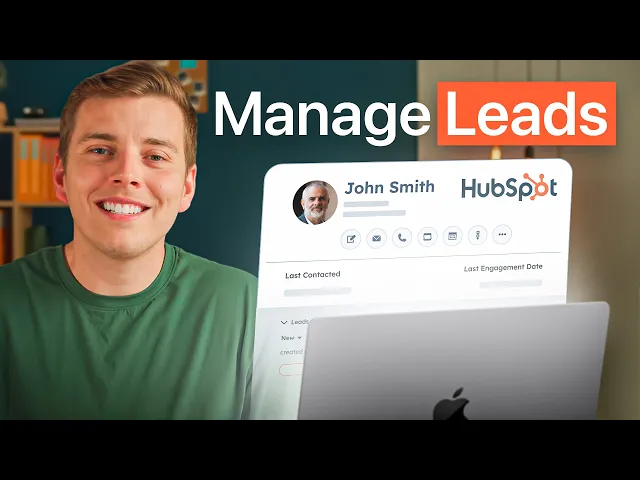
Video: HubSpot Academy on managing and prioritising leads inside a CRM, the layer an AI qualifier writes into.
Where AI lead qualification goes wrong
Practitioner threads on Reddit, in r/automation and r/n8n in particular, read very differently from vendor pages. Builders who have shipped these systems keep returning to the same four failures.
The scoring is invented, not agreed. A popular r/n8n build scored leads one to ten on budget, urgency and specificity, then output hot, warm or cold with a written reason. The reason is what makes it survive contact with a sales team. Without it, reps stop trusting the label within a fortnight.
The call is too fast. One widely discussed r/automation build calls paid-ad leads within sixty seconds. That works for high-intent ads and feels invasive for a whitepaper download. Match urgency to intent.
Nobody tested the unhappy path. Wrong number, gatekeeper, somebody driving, a lead who wants pricing immediately. These are most of the calls and almost none of the demos.
The handover loses the thread. If the rep has to ask the same three questions again, the lead concludes the company is disorganised and the automation has cost you trust rather than saved time.
We wrote up the operational side of this in what nobody tells you before launching an AI voice agent.
Disclosure and compliance
Two rules matter wherever you operate.
In the EU, Article 50 of the AI Act requires that people interacting directly with an AI system are informed of it, at the latest at the time of the first interaction. Those transparency obligations apply from 2 August 2026. The text of Article 50 is short and worth reading in full.
In the United States, the FCC has ruled that calls using AI-generated voices count as artificial voices under the Telephone Consumer Protection Act, which pulls them into the existing consent regime. The declaratory ruling is the primary source.
Practically, that means three things: say it is an AI assistant in the opening line, keep proof of consent for outbound calls, and make opting out a single sentence away. Our guide to AI outbound calling goes deeper on the consent side.
How to launch in a week
Day 1. Write the five questions a qualified lead must answer. If your team cannot agree on five, you do not have a qualification process to automate.
Day 2. Define the gates and the disqualification reasons as a closed list, not free text.
Day 3. Build on one source only. Inbound form, business hours off, so you can compare like with like.
Day 4. Run twenty test calls, including the unhappy paths, and read every transcript yourself.
Day 5. Wire the CRM write-back and the calendar. Nothing goes live until the record lands correctly.
Day 6 and 7. Shadow mode. The agent calls, a human listens, and you fix the script before volume arrives.
Then widen one source at a time. You can see the building blocks on our AI voice platform page, and the vertical setups on property management and phone agent.

Figure 3. Eight rules that separate a qualifier reps trust from one they switch off.
Frequently asked questions
How is AI lead qualification different from lead scoring?
Scoring infers intent from behaviour you observe. Qualification asks the lead directly and records the answer. Most teams run both, and the call result should override the model when the two disagree.
Will leads hang up when they realise it is an AI?
Some will. In practice the drop is smaller than teams fear when the agent is fast, brief and honest about what it is. The comparison that matters is not a human call, it is the call that never happened.
Can the agent book straight into a calendar?
Yes. Standard calendar integrations such as Google Calendar, Outlook or Calendly let the agent offer real availability and write the event during the call, which is why show rates hold up.
What happens to leads the agent cannot qualify?
They should be tagged with a reason and routed to a human task, not deleted. Disqualification reasons are the most useful data the system produces in month one.
How many questions should the agent ask?
Five or fewer. Every extra question costs completion rate, and anything beyond the hard gates is better asked by the rep who takes the meeting.
Does this replace SDRs?
It replaces the first ninety seconds of their day, repeated several hundred times. The research on AI assistance points the same way: the biggest gains land on the least experienced coverage, not on your best people.
The call you are not making is the one costing you
Nothing in the data suggests buyers got more patient. It suggests that almost nobody calls back, and that the company which does gets the conversation.
AI lead qualification is not a clever way to avoid talking to prospects. It is a way to make sure the conversation starts while the person still wants to have it.
If you want to see what that sounds like on your own inbound leads, start at callin.io and build the first agent against a single form. One source, five questions, one week.