AI Call Routing: Get Every Caller to the Right Agent
AI call routing sends every caller to the right agent using spoken intent and live availability, so you cut transfers, hold time and repeat calls.

A customer dials your main number, works through three keypad menus, explains the problem to whoever answers, and still lands in the wrong queue. Now they are repeating themselves while handle time climbs and your agent hunts for context. Multiply that by a few hundred calls a day and you do not have an agent problem. You have a routing problem.
AI call routing is the layer that fixes it. Instead of asking callers to sort themselves into categories they cannot see, the system works out what the call is about, checks who can help, and connects the two. This guide covers how it works, what the research supports, and what to check before you sign anything.
Key takeaways
AI call routing matches callers to the right destination using spoken intent, account context and live agent availability, not keypad selections.
Every misroute adds transfer time, forces the caller to repeat themselves and pushes first contact resolution down.
Gartner expects agentic AI to resolve 80% of common service issues autonomously by 2029, with a 30% cut in operating costs.
Only 24% of service leaders could show positive financial returns on their AI use cases, so design and measurement matter more than the model.
Containment rate is the wrong headline metric. Fast, clean escalation is good routing, not failure.
The fastest wins come from visibility: being able to see why a call went where it went.
What is AI call routing?
AI call routing, also called intelligent call routing or automated call routing, directs an incoming call, chat or message to the person or workflow best equipped to handle it, based on what the caller needs and who is free right now.
Rather than reading a menu out loud and waiting for a keypress, the system listens to the caller's own words, or reads the context left behind by an earlier interaction, and routes on intent. For an operations lead that means fewer blind transfers. For an IT team it means retiring keypad logic that has been patched for years.
The difference is who does the sorting. Traditional routing asks the caller to classify their own problem. AI routing classifies it, using speech recognition and language understanding, weighs account history and channel signals, then checks which qualified person is actually available. Both steps take seconds.

How routing maturity progresses, from keypad menus to intent and context based routing. Source: Callin.io analysis, based on routing methods described by skills-based routing literature and contact centre practice.
Why traditional call routing breaks down
Rigid menu trees force callers to guess. Someone with a billing dispute has to decide whether that sits under account services or general support, and guessing wrong means a transfer, a second wait, or a redial.
Every misroute also costs money. The agent who picks up has to work out why the call reached them, the caller repeats what they already said, and handle time grows before anyone touches the actual problem. It never shows up as one dramatic failure, but as a slow leak across thousands of calls a month.
IT teams feel it differently. Every new product, promotion or policy change means another branch bolted onto the tree, and someone has to maintain it. The load grows while accuracy falls, because a static menu cannot account for reasons people started calling last week. Industry association ICMI documented this years ago: over-segmented skill groups, stale skill assignments and rules nobody owns quietly degrade service levels. Read the classic list of skills-based routing problems and you will recognise most of your current setup.
What practitioners actually say about misrouted calls
The vendor pitch for routing is tidy. The conversations between the people who live with it are not, and they are more useful.
On r/callcentres, agents compare numbers in a thread titled how many misrouted calls do you get. In r/CustomerService the recurring complaint is calls arriving in the wrong place, with the agent as unpaid switchboard. A r/talesfromcallcenters thread includes the admission that their own menu misroutes people sometimes. And on r/sysadmin, a rant about robo-operator menus captures the rage of being sent back to the queue after a long hold.
Three themes repeat across all of them:
Nobody owns the tree. The menu reflects an org chart from several reorganisations ago, and the person who built it has left.
The agent absorbs the failure. Misroutes are logged as agent handle time, not as a routing defect, so the data never argues for a fix.
Callers learn to cheat. People press 0 repeatedly, say nothing, or pick the sales option because it answers fastest. Your menu statistics then describe a game, not real demand.
Practitioners on LinkedIn make the same point in commercial terms: routing is a revenue decision, since a high-value account sitting in a general queue is a renewal risk, not just a long call.
How AI call routing works
Intent detection replaces the menu
The system parses what the caller says, or types on digital channels, and matches it against known intents, account data, interaction history and identity signals from previous contact. There is no menu to navigate, and the caller does not have to use your internal vocabulary. "My card got declined twice this morning" is enough.
Skill and availability matching
Once the system knows what the call is about, it weighs who has the right skill, language, licence or seniority, and who is genuinely free. Routing that ignores availability only moves the wait somewhere else. This is also where business rules belong: priority accounts, at-risk renewals, callers whose tone suggests they should reach a senior agent rather than a queue.
Context-rich handoff
When a human takes over, the receiving agent should get a summary, the detected intent and the relevant record already open. If the caller has to restart the explanation, the routing worked and the handoff failed. That distinction matters, because most of the frustration customers report comes from the handoff, not the detection.

Verified figures behind the business case for intent-based routing. Sources: Gartner, March 2025, Gartner, July 2026, NBER Working Paper 31161.
One routing brain across voice, chat and SMS
Intent routing is not a voice-only capability. The same logic that reads a spoken request reads a chat message or a text thread, which matters if you run three channels through three unrelated queues and wonder why the experience shifts depending on how someone contacts you. Unifying the logic does not mean every channel behaves identically: speech carries more ambiguity than typed text, so voice needs a wider tolerance for clarifying questions. Ask any vendor whether one intent model serves every channel, or whether phone and digital were bolted together after the fact.
Gartner's 2026 customer survey adds a reason to care. Use of third-party generative AI tools during service interactions has nearly doubled in a year while company chatbot use has not moved since 2022, and 58% of customers who use these tools have asked one to complete a task for them, rising to 74% in business-to-business settings. Callers increasingly arrive mid-task, not at the start of a menu.
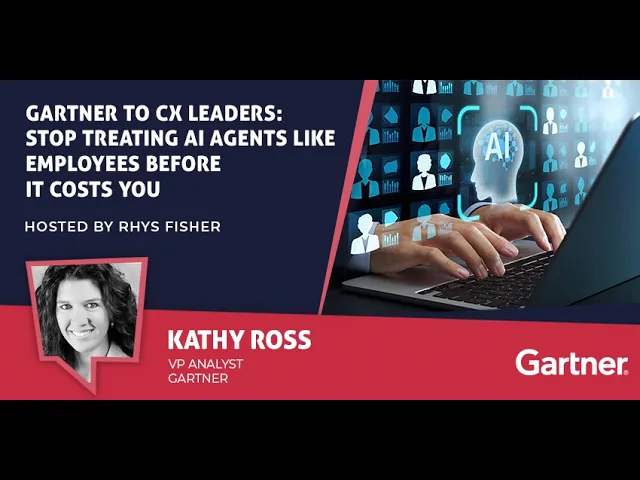
Independent industry media CX Today interviews Gartner VP Analyst Kathy Ross on why AI agents belong in the tech stack rather than on the org chart, and what goes wrong when service leaders manage them like staff. Source: CX Today, July 2026.
What the research actually supports
Routing projects get approved on numbers, so it is worth separating the verified ones from the marketing ones.
80% of common issues, autonomously, by 2029. Gartner predicts agentic AI will resolve that share of routine service issues without human intervention, cutting operating costs by 30%, and advises leaders to implement dynamic routing that tells human callers apart from AI agents acting for them. See the Gartner press release.
14% more issues resolved per hour. Across 5,179 customer support agents, economists Erik Brynjolfsson, Danielle Li and Lindsey Raymond measured a 14% average productivity gain from an AI conversational assistant, and 34% for novice staff, in NBER Working Paper 31161.
Only 24% showed positive returns. Among 1,303 senior leaders surveyed in early 2026, service and support invested a median 12% of budget in AI, the highest of ten functions, yet only a quarter could show positive financial returns, per Gartner's July 2026 survey.
The cost of handling problems badly. The National Customer Rage Survey, run by Customer Care Measurement & Consulting with Arizona State University, found 74% of Americans hit a product or service problem in a year, 63% felt rage about it, and put $887 billion of revenue at risk from mediocre complaint handling.

Routing decides which desk a call lands on, and whether the person at it has any context. Photo by Arlington Research on Unsplash.
What to look for when you evaluate a platform
Plenty of products market AI routing and far fewer hold up under real volume. The differences show in specific places.
Intent accuracy on every channel you use. A platform that routes phone well and treats chat and SMS as an afterthought leaves gaps where digital volume keeps growing.
Integration depth. If routing cannot read account history, order status or case state from the systems you already run, your agents hunt for context manually and the time saving disappears.
Explainable decisions. A dashboard that confirms a call reached someone tells you nothing. You need the signals the system used, per call, exportable.
Supervisor visibility in real time. Teams that only see misroutes in next month's report debug patterns too late to matter.
Escalation quality. Ask to watch a live handoff. Does the agent receive a summary and the record, or just a connected call?
Language and dialect coverage. If you serve more than one market, test the second language with real callers, not a demo script.
Ask vendors directly how routing decisions reach supervisors. If the answer is a call log with no reasoning attached, you are buying automation without oversight. TechTarget's practitioner guide to AI call routing makes a related point worth repeating: the hard parts are rarely technical, and learned routing logic that nobody can explain becomes a compliance problem later.

A six-point checklist to take into platform demos, built from the evaluation criteria above. Source: Callin.io.
Metrics that tell you routing is working
Containment rate, the share of calls that never reach a human, is the most common headline metric and the most misleading. It rewards deflection over resolution, in the same way average handle time once rewarded rushing people off the phone. Industry publication Call Centre Helper has published a sharp argument that containment is the wrong metric for voice automation, and that escalation should be treated as good design.
Track these instead:
Transfer rate and transfers per resolved call. The direct measure of routing accuracy.
Repeat contact within 24 to 48 hours. Catches calls that were closed rather than resolved.
First contact resolution, segmented by intent. An aggregate number hides the two intents that are failing.
Time to the right person, not just time to answer.
Escalation latency. How long a caller waits between the system deciding to escalate and a human speaking.
Post-call confirmation. One question: did you get what you called for?
A sane rollout, and the traps
Nobody should replace a live menu tree in one evening. The sequence that works:
Week one, listen. Label the real reasons people call from transcripts. Most operations find six to ten intents cover the majority, and that two were missing from the menu entirely.
Week two, route one intent. Pick something high-volume and low-risk: opening hours, order status, booking changes. Leave everything else on the existing path.
Week three, add context. Connect the CRM or calendar so routing knows who is calling and handoffs carry history. Scheduling tools such as Calendly and standard CRMs plug in here.
Week four, measure and widen. Compare transfer rate and repeat contacts against last month on the same intents, then add the next two.
Four traps account for most failed projects. Automating the existing tree keeps every flaw and adds latency. Leaving no staffed human fallback turns a dead end into a redial. Hiding the escape route trains callers to game the menu. And leaving the rules unowned brings back the decay described earlier, so name a person and set a monthly review. For the self-service side, our guide to conversational IVR covers menu replacement and AI appointment scheduling covers the booking path.
How Callin.io approaches routing
Our view is that routing should be visible and boring. The AI phone agent answers in the caller's own language, identifies the reason for the call, handles routine requests end to end, and hands the rest to a person with the intent and transcript attached. Rules sit in one place on the voice platform, so whoever owns the queue can change a destination without raising a ticket.
Routing rules also differ by sector. Inbound property enquiries need owner, tenant and prospect separated before anything else, which is what our property management setup does, while internal helpdesk traffic has its own priorities, covered in IT support. If you resell under your own brand, the white label AI voice agent guide explains how routing templates carry across client accounts, and pricing is published rather than quoted.
Frequently asked questions
What is AI call routing?
AI call routing directs calls, chats and messages to the person or workflow best suited to handle them, based on the caller's stated intent, their account context and who is available, instead of a keypad menu. It replaces static branching logic with a decision made per call.
How is it different from a traditional IVR?
A traditional IVR asks the caller to classify their own problem through menu choices that rarely match why they are calling. AI routing works out the intent from what the caller says, then matches it to a qualified, available destination. Our conversational IVR guide compares the two in detail.
What is the difference between intelligent routing and skills-based routing?
Skills-based routing matches a call to an agent group by predefined skill tags, which still depends on someone classifying the call first. Intelligent routing works out the classification itself and then applies skill and availability matching, so the two are layers rather than alternatives.
Do I need a full contact centre platform?
No, but routing is only as good as the data it can reach. A tool with no view of availability, skills or history can only guess. A small team gets most of the benefit from an AI phone agent connected to a calendar and a CRM.
How long does a rollout take?
One intent can go live in days. A full replacement depends on how much legacy branching and how many integrations are involved, and is usually measured in weeks. Platforms built for intent from the start deploy faster than legacy systems retrofitted with a speech layer.
Will AI routing send angry callers to a human?
It should, and that is a configuration choice rather than a side effect. Set explicit escalation rules for negative sentiment, repeat contacts, out-of-scope requests and named accounts, then measure how fast those escalations connect.
Start with routing you can see
Routing quality is as much about visibility as automation. Once you can see why each call landed where it did, the pattern that keeps sending people to the wrong place becomes obvious, and fixing it is a configuration change rather than a project. The teams that get value here are not the ones with the most advanced model. They are the ones who labelled their intents honestly, escalated fast, and kept someone responsible for the rules.
To see intent-based routing running on your own call flow, with handoffs that carry context and rules you can read, start at callin.io.


