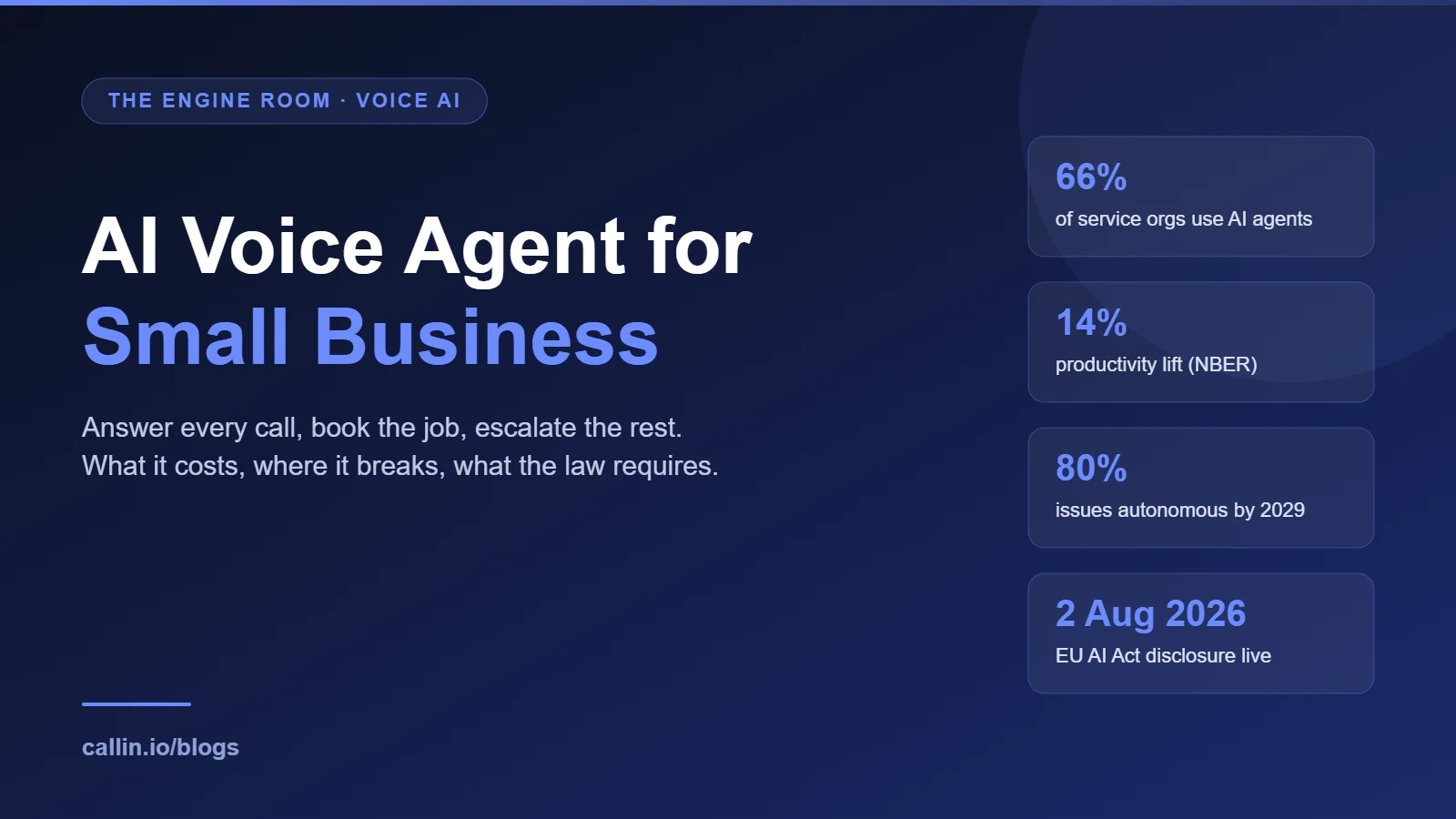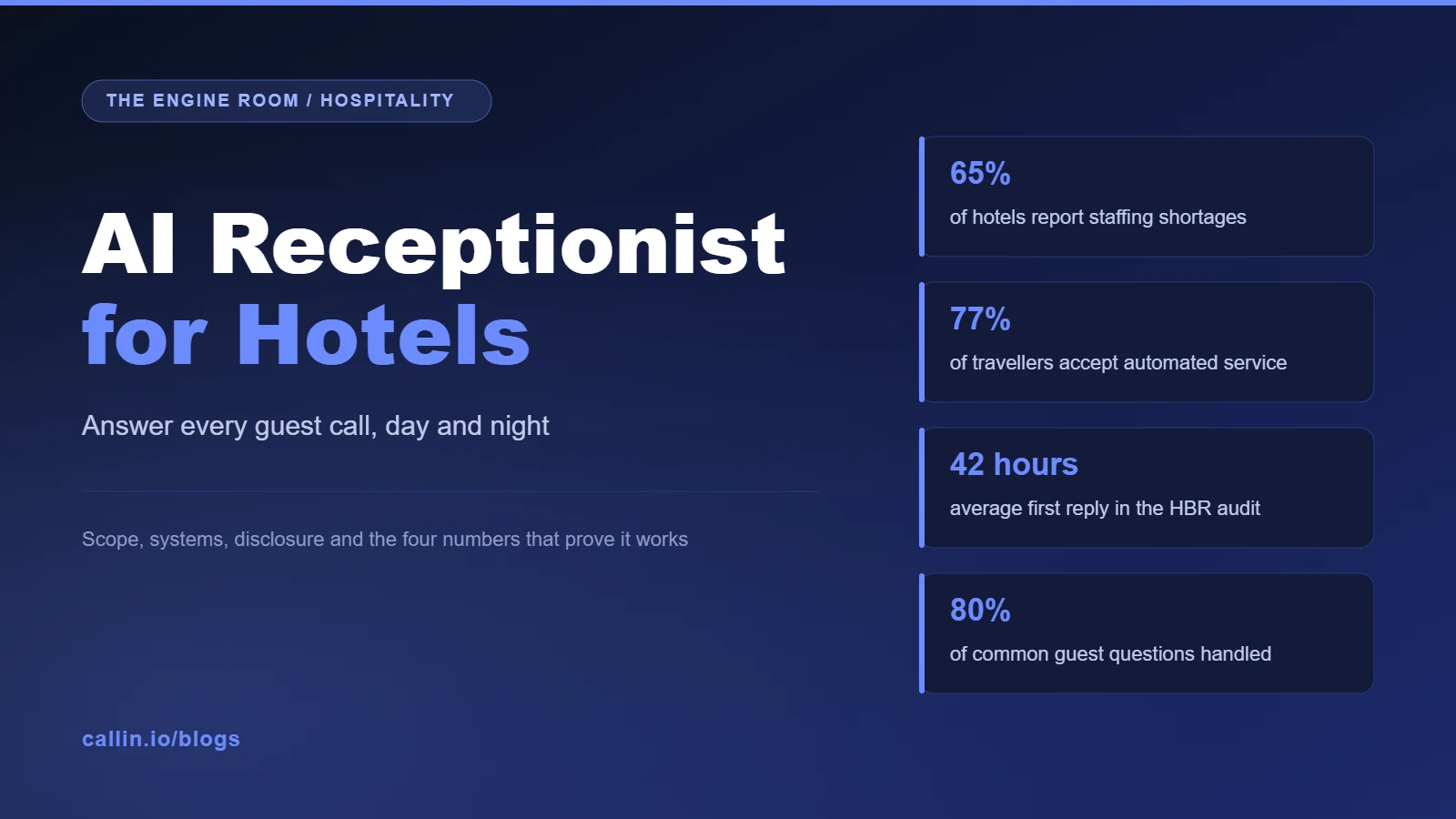
AI Phone Agent: How It Works, Where It Pays Off and How to Deploy One in 2026
What an AI phone agent is, what happens during a call, the use cases that pay off, where it fails, EU rules for inbound and outbound calls and the metrics to track.
An AI phone agent is software that makes and receives real phone calls on behalf of a business. It talks with people in natural language, understands what they need, looks up information in your systems and completes tasks such as booking a meeting, qualifying a lead or updating an order. Unlike a phone menu, it does not force callers down a script: it holds a conversation.
Most guides stop at the promise. This one also covers the parts vendors tend to skip: what really happens during a call, where AI phone agents fail, what they cost and which rules apply in Europe. The goal is simple: help you decide whether a phone agent fits your business, and how to launch one without damaging your customer experience.
Key takeaways
An AI phone agent combines telephony, speech recognition, a language model, a synthetic voice and integrations with your tools.
It shines on high-volume, repetitive calls: lead qualification, bookings, order status and first-level support.
It fails when it lacks data, faces emotional situations or has no clear escalation path.
Inbound and outbound calls follow different rules. Outbound calling needs extra care with consent and disclosure.
What is an AI phone agent?
An AI phone agent is a voice-based AI system connected to a phone line. It can answer inbound calls, place outbound calls, or both, and it works around the clock without breaks or queues. You define what it knows, what it can do and when it must hand over to a person.
How it differs from a chatbot and an IVR
A chatbot works in text, on a website or messaging app, where the user can reread and scroll. A phone agent must understand speech in real time, cope with background noise and interruptions, and reply fast enough to sound natural. An IVR, the classic menu with numbered options, only routes calls; it cannot understand a free sentence or take an action on its own.
How AI phone agents work
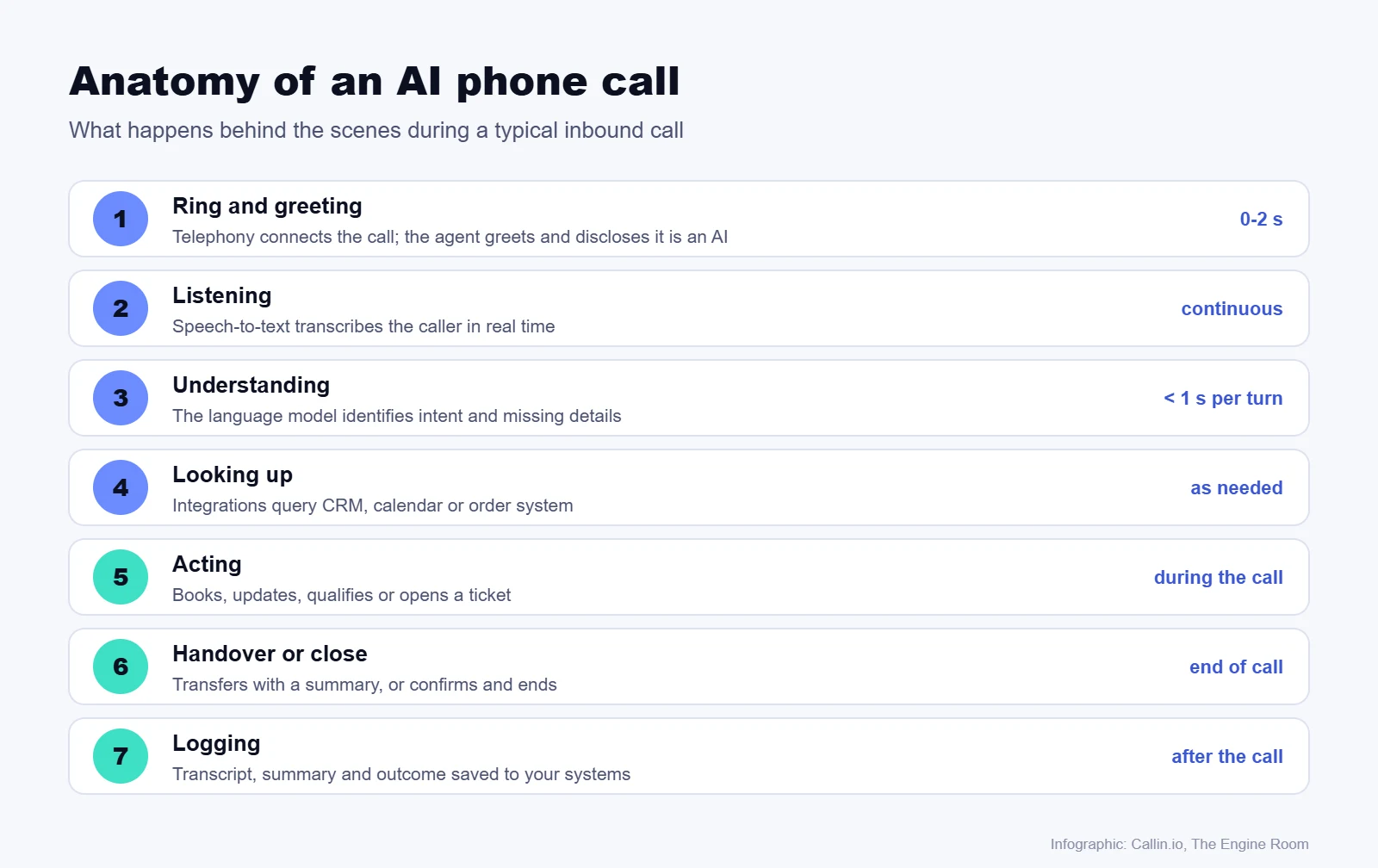
Every call runs through the same technology stack. Telephony connects the call to a number, a carrier or your SIP trunk. Speech-to-text transcribes what the caller says. A language model decides what to say and do next, following your instructions. Text-to-speech turns the answer into a natural voice. Integrations let the agent read and write data in your CRM, calendar or helpdesk.
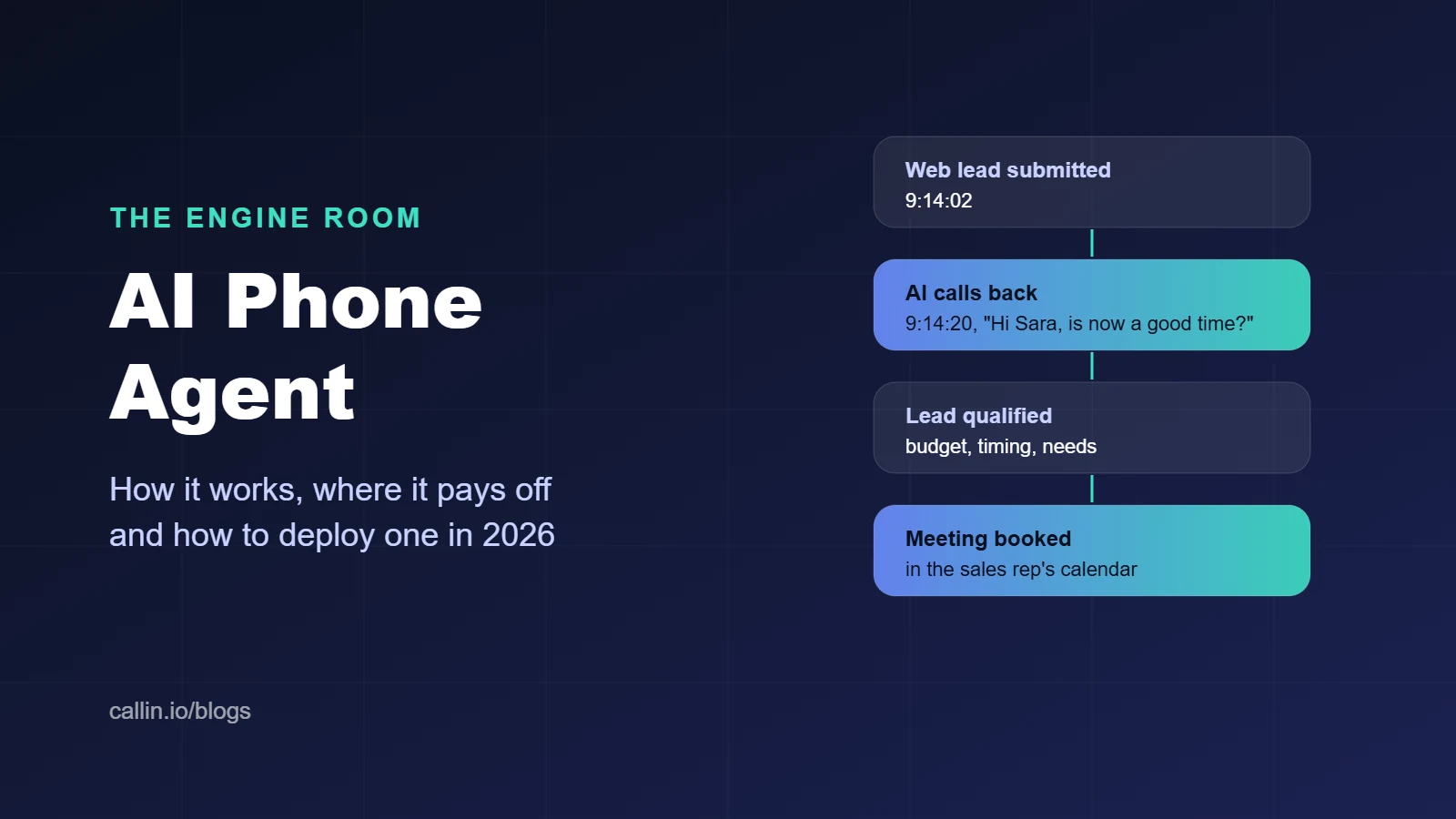
The best way to picture it is to follow one call from start to finish.
Infographic: Callin.io, The Engine Room
Complex scenarios are handled with rules, not magic. When a caller changes topic, the agent keeps the context. When it lacks information, it asks a clarifying question. When the request is outside its scope, or the caller asks for a person, it transfers the call with a summary. How the agent finds the right information matters a lot: we compared the two main approaches in RAG or MCP for AI voice agents.
Where AI phone agents pay off
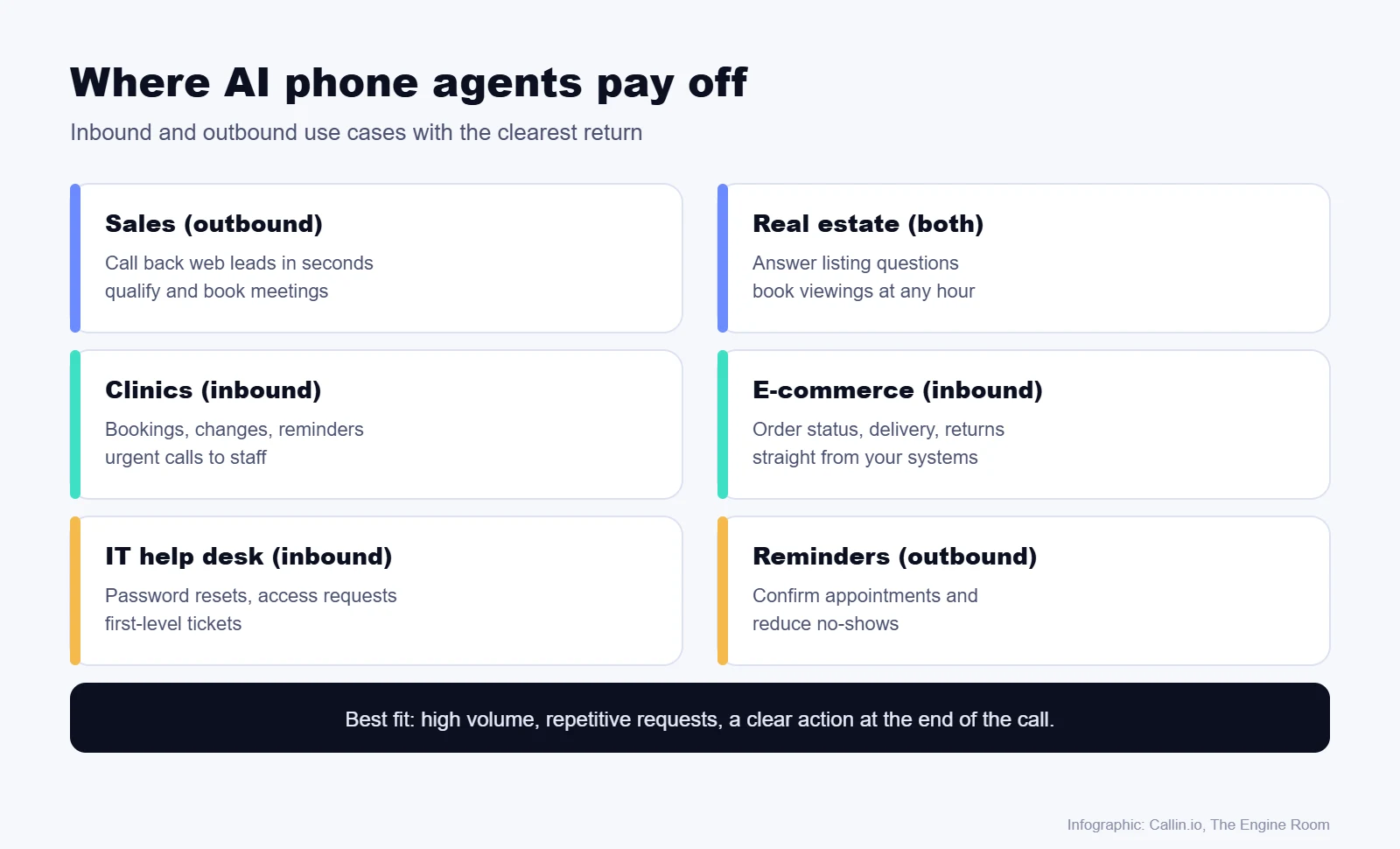
Sales: responding to leads in seconds
Speed is the biggest lever in sales. A study published in the Harvard Business Review found that companies contacting a lead within an hour were nearly seven times as likely to qualify it as those that waited longer. An AI phone agent can call back a web lead within seconds, ask the qualifying questions and book a meeting in the salesperson's calendar.
Real estate: enquiries and viewings
Property enquiries peak in the evening and at weekends. An agent can answer questions about a listing, check the caller's budget and timing, and book a viewing. See how our AI phone agents for real estate handle lead qualification.
Healthcare and clinics: appointments
Booking, rescheduling and reminders are ideal for automation, as long as anything that sounds urgent goes straight to staff and health data is handled under strict privacy rules.
E-commerce and support: orders and returns
Order status, delivery times and return procedures are repetitive questions with clear answers in your systems. Italian Gourmet UK automated this kind of request and saved £66,000 a year.
IT help desks: first-level tickets
Password resets and access requests can be solved during the call. Our page on AI voice agents for IT support shows a typical setup.
Infographic: Callin.io, The Engine Room
Where AI phone agents fail, and how to prevent it
Missing data. An agent without access to the right information will guess, and a guess on the phone sounds like a promise. Connect it to verified sources and instruct it to admit when it does not know. Our article on LLM hallucinations explains the safeguards.
Emotional calls. Complaints, bereavement or medical worries need a person. Train the agent to recognise these moments and transfer immediately.
Manipulation. A caller can try to trick the agent into breaking its rules. If the agent can issue refunds or change bookings, read about prompt injection before you connect those actions.
Launching without monitoring. Many projects fail after the demo, not during it. As we describe in AI voice agents in production, you need tests, dashboards and a way to stop the agent instantly.
Rules for inbound and outbound calls in Europe
Since August 2026, Article 50 of the EU AI Act requires that people are informed when they interact with an AI system, unless it is obvious. For phone agents, a short disclosure at the start of each call is the simplest way to comply.
Outbound calls add more obligations. Personal data must be processed on a valid legal basis under the GDPR, and many countries have national rules on marketing calls and opt-out registers. Call people who expect to hear from you, such as leads who filled in a form or existing customers, and always offer an easy way to stop further calls. This is not legal advice: check the rules in each country where you call.
How to implement an AI phone agent
A successful launch usually follows five steps.
Pick one call type. Start with a single, frequent, well-defined call, such as lead callbacks or appointment booking.
Write the knowledge and the rules. Short answers, clear limits and a list of situations that must go to a person. Voice needs its own style, as explained in our guide to prompting AI voice agents.
Connect your systems. Calendar, CRM or helpdesk, so the agent can act and log every call.
Test like a customer. Interrupt it, change your mind, call from a noisy street, ask something unexpected.
Launch small and measure. Start with a share of calls or a time window, then expand.

Photo: Vitaly Gariev on Unsplash
Which metrics to track
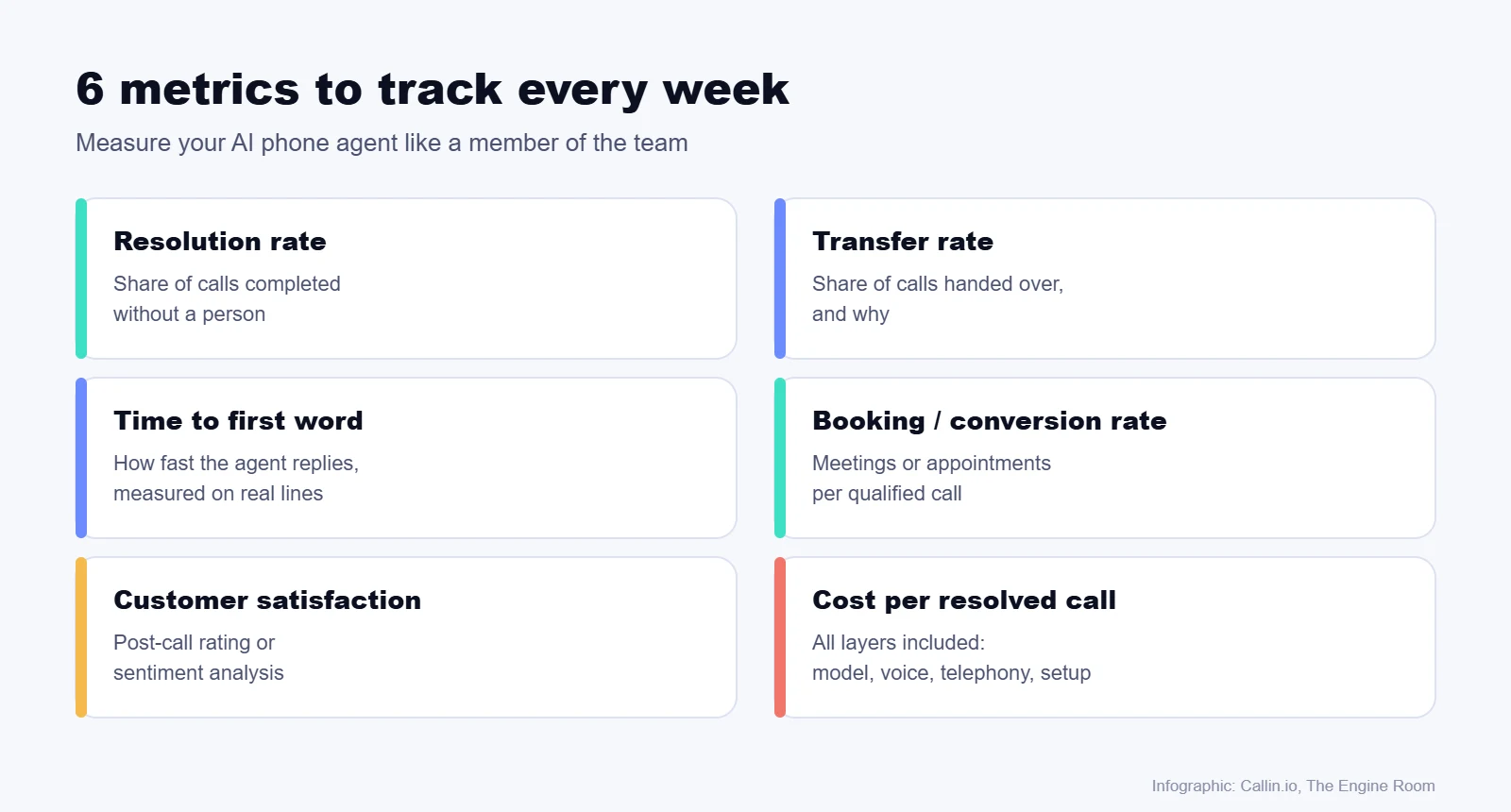
Measure the agent like a member of your team, with a small set of numbers reviewed every week.
Infographic: Callin.io, The Engine Room
Two numbers matter most. The resolution rate tells you how many calls end with the job done, without a person. The cost per resolved call tells you whether the agent is really saving money, once you add every layer of cost. Our guide to AI voice agent pricing shows how to calculate it.
Watch: AI voice agents explained
This video from the Potential channel walks through how AI voice agents are built and used, and is a useful primer before your first vendor demo.
Frequently asked questions
Can an AI phone agent make outbound calls?
Yes. It can call back leads, confirm appointments or run reminders. Outbound calling requires extra care with consent, disclosure and national rules on marketing calls.
How long does it take to set up?
A simple agent can go live in a few days. A setup with integrations, custom rules and proper testing usually takes two to four weeks.
Does it work in languages other than English?
Most modern platforms support many languages. Test each one with real callers, because accuracy and voice quality can vary between languages.
Will it replace my team?
It replaces repetitive calls, not people. Your team keeps the complex and valuable conversations, with better information from the calls the agent has already handled.
How much does an AI phone agent cost?
Usage-based platforms typically charge from about $0.09 to $0.30 per minute all-in, depending on the model, voice, carrier and call direction. Always compare the cost per resolved call.
The bottom line
An AI phone agent is not a replacement for good service, it is a way to deliver it at any hour and at any volume. Start with one call type, connect it to your data, give it clear limits and measure it every week. The results follow.
Want to hear an AI phone agent on a real call? Try Callin.io for free or explore our white-label AI voice platform.