AI Receptionist for HVAC: Answer Every Service Call
AI receptionist for HVAC: answer every service call around the clock, triage no-heat emergencies and book jobs straight into your dispatch calendar.

A furnace dies at 11pm in January. A compressor quits during the first real heat wave of July. The homeowner does not shop around. They call the first number they find, and if nobody picks up, they call the next one.
That is the whole business case for an AI receptionist in heating and cooling. Not clever technology. Just the plain fact that the phone rings hardest at the exact moments your office is closed and every technician you have is already on a roof.

Call triage ladder for a heating and cooling business. Source: Callin.io analysis.
Key takeaways
Phone calls are still the front door: 60% of first customer contacts in residential trades happen by phone, against 13% through online booking, according to ServiceTitan's 2026 Residential State of the Trades survey reported by The ACHR News.
An AI receptionist earns its keep on the boring majority of calls: booking maintenance, rescheduling, confirming service areas, taking messages, screening spam.
Emergencies need an escalation path to a human on-call technician, with a timed fallback, not a transcript someone reads in the morning.
Check your field service software first. Several platforms now bundle a voice agent, and a bundled tool you already pay for beats a second subscription.
Do not plan headcount around it. Gartner predicts that by 2027, half of the companies that blamed headcount cuts on AI will rehire for the same work.
Why HVAC calls get missed exactly when they matter
Air conditioning is no longer optional in most of the country. The US Energy Information Administration found that 88% of US households used air conditioning in 2020, rising to 93% across the South and 92% in the Midwest.
That installed base fails on a schedule nobody controls. Demand arrives in a three-day spike when the temperature breaks a record, and at night when a family notices the house is getting cold.
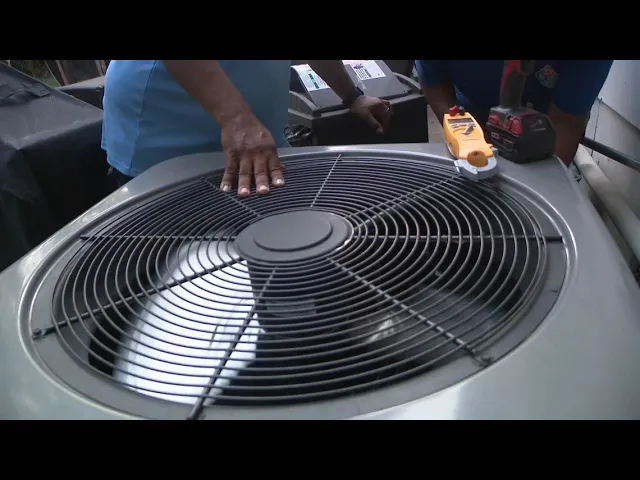
Local news coverage of HVAC companies absorbing a surge of emergency calls during a heat wave. Source: 13News Now (WVEC).
Meanwhile the labour side gets tighter. The US Bureau of Labor Statistics projects employment of heating, air conditioning and refrigeration mechanics to grow 11% from 2025 to 2035, with about 40,600 openings projected each year. Plumbing, a trade most HVAC shops touch, shows about 42,000 openings a year on the same basis.
You cannot hire your way to a phone that always gets answered. There is also a second, quieter problem: callers have stopped trusting unknown numbers. Hiya's State of the Call 2026, based on a survey of more than 12,000 consumers across six countries, reports that 86% of unknown calls go unanswered. Your callback is competing with that wall of suspicion, which makes answering live the first time far more valuable than calling back later.
What an AI receptionist does on an HVAC call
An AI receptionist is a voice agent that picks up your line, holds a real conversation, and does something with the result: a booking, a message, a transfer, a text. The useful split is not technical. It is which calls it may finish alone and which it must hand off.
Calls it can finish without a dispatcher
Booking seasonal maintenance and tune-ups into an open slot
Rescheduling or cancelling an existing appointment
Confirming whether an address falls inside your service area
Answering filter sizes, hours, payment methods, membership terms
Telling a customer where their technician is in the schedule
Taking supplier and recruiter calls as messages instead of interruptions
Screening the spam that eats a dispatcher's morning
Calls it should hand to a human
Some calls are not scheduling problems. They are safety problems.
A smell of gas, a carbon monoxide alarm, or a visible flame issue
No heat during a freeze warning, especially with infants or elderly residents at home
No cooling during a heat advisory, same vulnerability check
Water pouring from a unit or a flooded mechanical room
Commercial accounts with contractual response windows
For these, the agent should collect the address and the symptom, state that a technician is being paged, then run an escalation cascade: on-call technician first, backup after a set number of seconds, owner last, with a text alert at every step. A voicemail transcript is not an escalation path.
What HVAC businesses need from an AI receptionist
Real booking, not a lead form read aloud
There is a large gap between an agent that writes an appointment into your dispatch board and one that emails you a request. Ask what happens to arrival windows, to capacity limits per technician, and to a reschedule two days later. If the answer is a webhook and an email, you have bought a message service with better grammar.
After-hours and emergency escalation
Night and weekend coverage is usually the reason shops start looking. Decide in advance what counts as an emergency in your business, write it down as a list of trigger phrases, and test the agent against that list before it ever touches a customer.
Service areas, trip fees and what it may quote
Pricing is where goodwill is won or lost. The ServiceTitan survey found 73% of customers name clear upfront pricing as their main reason for choosing a contractor.
Draw a hard line. Diagnostic fees, after-hours surcharges and published flat rates are safe for an agent to state. Repair estimates, equipment sizing, warranty status and anything that depends on seeing the unit belong to a technician.
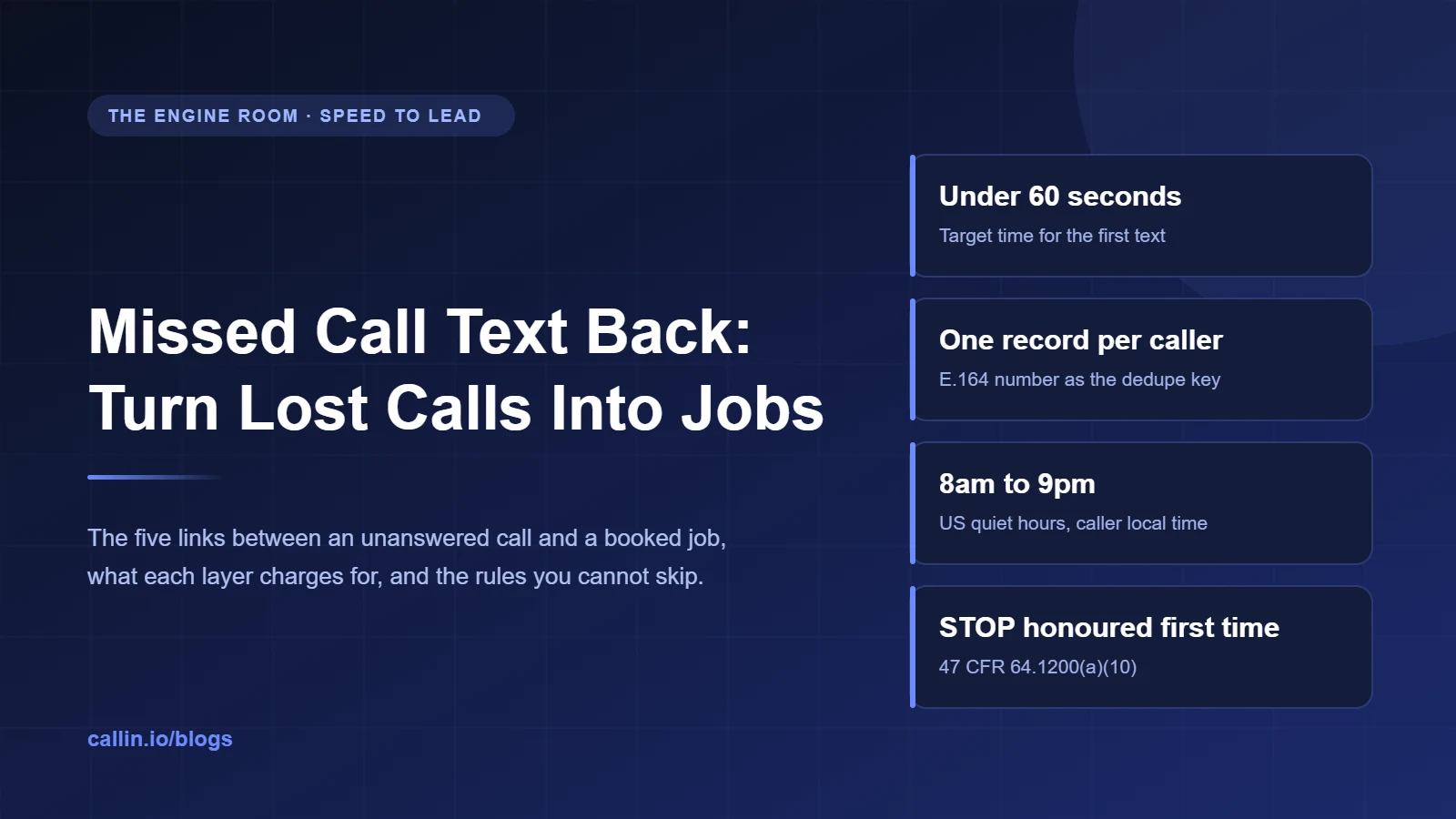
Missed call text back and speed to lead
Even a perfect setup drops calls occasionally. An automatic text with a booking link turns a dropped call into a second chance, and it works on the people who will not answer an unknown callback.
Speed matters more than polish here. In the same survey, 52% of contractors said they respond to new leads within an hour, which means roughly half do not. Our guide to missed call text back covers the setup in detail.

Verified figures behind the HVAC phone problem. Sources: EIA RECS 2020, Hiya State of the Call 2026, US BLS, ServiceTitan 2026 Residential State of the Trades via The ACHR News.
Your field service software may already include one
Before you add a subscription, open the add-ons page of the platform you already run. Several field service systems now ship a voice agent or an AI customer service module, often cheaper than a standalone product because they are selling you the ecosystem, not the minutes.
Two caveats. A bundled agent is rarely a phone system, so routing, queues and call recording may still live elsewhere. And it is only as good as the data in the platform, which is an argument for cleaning up your service areas and price book first.
The four ways an HVAC shop answers the phone
Every option is a trade between cost, consistency and judgement.
In-house CSR. Best judgement, best conversion on a tricky sales call, and the most expensive per hour. Cannot cover nights, cannot take six simultaneous calls during a heat wave, and takes holidays.
Live answering service. Human voice around the clock, usually priced per call or per minute. Quality varies with who is on shift, and most operators work from a script rather than your dispatch board.
Built-in agent in your field service platform. One bill, native booking, limited flexibility. Good first step for shops already standardised on one system.
Dedicated AI voice agent. Answers every call at once, never queues, follows the same script at 2am as at 2pm, and integrates where you tell it to. Needs real configuration work and a human escalation path to be safe.
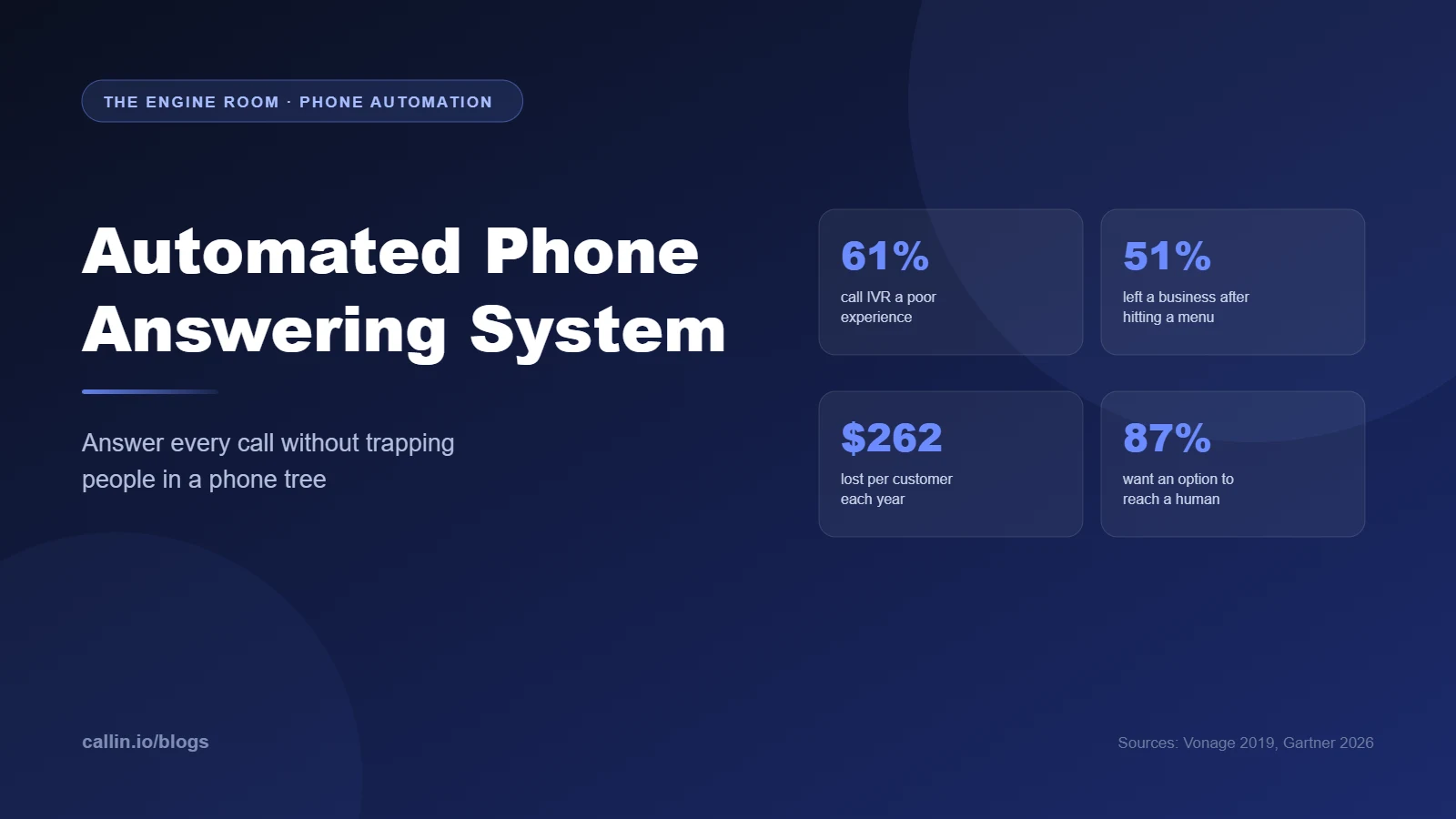
Most shops that get this right end up blended: AI for volume and after-hours, a person for the calls where judgement pays. If you want the broader picture across industries, see our overview of the AI receptionist and how an AI answering service for small business is usually priced.
Pick by shop size
Solo operator or two trucks. Your real problem is answering at all while your hands are in a unit. Prioritise fast setup, reliable booking and a text-back. Skip anything that needs a developer.
Three to fifteen trucks. Now the dispatch integration is the whole decision. Ask about two-way sync, duplicate customer records, and whether a reschedule made by the agent shows up on the board without someone retyping it.
Multi-location or franchise. You need per-location routing, per-location service areas, one place to update scripts across all of them, and reporting that compares booking rate by branch. For property and facilities work, our notes on AI for property management calls cover the multi-site patterns.
What to check before you sign

Pre-purchase checklist for an HVAC voice agent. Source: Callin.io analysis.
Nine things worth an email to the vendor before money changes hands.
Does it write bookings into your dispatch system, or send a request?
How many calls can it take at the same time during a storm week?
Warm transfer or blind transfer, and what happens if nobody answers?
Can it run a Spanish conversation end to end, including emergency vocabulary?
What is the overage rate once you pass the included minutes?
Who owns the integration if the platform changes its API?
Can you hear a recording and read a transcript of every call?
Can you register your business name for caller ID so outbound confirmations get answered?
What exactly does the agent say when it does not know something?
The last one matters most. An agent that invents an answer about a warranty costs more than the subscription saves. Our piece on conversational IVR explains why fallback behaviour, not peak performance, defines a good deployment.
AI receptionist or live answering service
Compare them by call type rather than by headline price.
A live service is worth paying for when the call needs a human to absorb anger, when a commercial client expects a named account contact, or when the caller will hang up on anything automated.
An AI agent wins on volume, simultaneity and consistency. Ten calls in the same minute do not form a queue, the 2am script matches the 2pm script, and because it is metered rather than staffed, a quiet February does not cost what a brutal July costs.
One regulatory note for the US. The FCC adopted a declaratory ruling confirming that calls made with AI-generated voices are artificial under the TCPA. That rule bites on outbound campaigns, not on answering your own inbound line, but it is the reason outbound reminder calls need their own consent review. See our guide to AI outbound calling before you automate follow-ups.
What the research says about replacing people
Be sceptical of any pitch that frames a voice agent as a headcount plan.
Gartner surveyed 321 customer service and support leaders in October 2025 and found only 20% had actually reduced agent staffing because of AI. The firm went further and predicted that by 2027, 50% of companies that attributed headcount reduction to AI will rehire staff for similar functions under different titles.
Contractors reach the same conclusion from the other direction. In the ServiceTitan research reported by The ACHR News, 25% of residential contractors said they use AI, with barriers of operational complexity (53%), lack of trust in outputs (43%) and data security (32%). One contractor quoted there, Luke Peluso of Quality Service Company, said nearly 30% of their bookings now flow end to end without human involvement. Meaningful, and not all of them.
The sensible reading: the agent absorbs repetitive volume so your dispatcher spends the day on the calls that convert.
From forwarded line to live in a week
You do not need a quarter-long project. You need seven days of discipline.
Days one and two. Write the emergency trigger list, the service area, the price points the agent may state, and the escalation order with names and numbers.
Days three and four. Configure and test. Call it yourself twenty times. Book, reschedule, mispronounce your street, interrupt it, ask for a price it should refuse to give, and simulate a gas smell.
Day five. Forward only after-hours and overflow calls. Keep business hours on your people.

A homeowner adjusting a thermostat. Photo by HUUM on Unsplash.
Days six and seven. Read every transcript. Count three numbers: calls answered, calls booked, calls escalated correctly. Fix the script where it failed, then widen the hours.
If you want help modelling cost before you start, our pricing page and the phone agent overview set out how minutes and concurrency are usually charged.
Frequently asked questions
How much does an AI receptionist cost for an HVAC company?
Published rates run from roughly $29 a month for simple message taking to several hundred for booking, transfers and multiple locations. Most two to six truck shops land in the low hundreds once overage is included. Price the overage rate, not the headline plan, because a heat wave is exactly when you blow past the included minutes.
Can it book directly into my dispatch software?
Some can write appointments natively, some go through an automation layer, and some only send a request for a human to enter. Ask for a live demonstration against a test account in your own system rather than a slide.
What happens on a genuine emergency call at 2am?
A well-configured agent recognises the trigger phrases, captures address and symptom, tells the caller a technician is being paged, and starts the escalation cascade with text alerts. Test this before launch and test it again after any script change.
Will customers be annoyed that it is not a person?
Most callers care about being helped at 11pm more than about who helps them. Annoyance comes from loops, from an agent that cannot transfer, and from one that pretends to know a price. Give it a clean handoff and a short, honest fallback line.
Do I have to tell callers they are speaking to AI?
Rules vary by state and are evolving, and some require disclosure at least when the caller asks. Disclosure tends to help rather than hurt, because it sets expectations. Check your own state rules and, if you operate in the EU, your transparency obligations there.
Can one agent handle a storm week on its own?
Concurrency is the thing to verify. A voice agent does not queue in the way a two-person office does, so ten simultaneous calls are normally fine, but ask the vendor for a number rather than assuming it is unlimited.
The bottom line
An AI receptionist will not sell a system replacement or calm a furious commercial client. It will make sure that the 11pm no-heat call, the Saturday tune-up request and the third simultaneous caller during a heat advisory all get answered, logged and routed instead of hitting voicemail.
That is the margin most shops are leaving on the table, and it is recoverable in a week. If you want to hear what your own calls would sound like, you can build and test an agent for your shop at callin.io.