AI Receptionist for Contractors: Stop Losing Jobs
AI receptionist for contractors answers every call, triages the emergency, qualifies the job and books the estimate while your crew stays on the tools.

A missed call on a contractor's phone is almost never just a missed call. It is a homeowner standing in two inches of water, a repeat client trying to move Thursday's install, or a general contractor pricing a job that gets awarded this week.
By the time you climb off the roof and play the voicemail back, that caller has worked down the next three names on the search results page.
This guide covers what an AI receptionist for contractors can realistically do on those calls, what it should never decide, how to test it before it touches a paying customer, and what the monthly bill actually adds up to.
Key takeaways
An AI receptionist answers on the first ring, captures name, number, address and the actual job, then routes or books it. It is intake, not dispatch.
Emergency triage is the setting that decides whether the whole thing is safe to run. Define it first.
Your real cost is subscription plus usage overage plus any human coverage you keep, not the headline price.
Test unanswered transfers, jobsite noise and a full calendar before a real number points at it.
AI disclosure, recording consent and outbound permission are three separate obligations.
Measure one number: cost per usable booked appointment.
What an AI receptionist for contractors actually does
Strip away the marketing and it is a voice agent sitting on your business number, handling the first ninety seconds of a call. It answers immediately at any hour, takes a name and a callback number before anything else, and asks for the service address.
It checks that address against the postcodes you actually drive to, works out what the job is, and sorts the call into emergency, quotable job or routine service. Then it books a slot, warm transfers to whoever is on call, or takes a structured message, and sends you the summary and transcript.
What it does not do is quote a price, promise a window nobody checked, or decide which van goes where. That is dispatch, and dispatch needs someone who can see the board.

The five jobs an AI receptionist should own on a contractor's inbound call, and the two it should hand off. Source: Callin.io.
Why contractor phones go unanswered in the first place
The office chair is the first one a small contractor leaves empty. Labour goes where it bills.
The hiring picture backs that up. Associated Builders and Contractors estimated in January 2026 that US construction needs to attract 349,000 net new workers in 2026, with 456,000 more projected for 2027 as spending growth resumes.
ABC chief economist Anirban Basu framed that as what the industry needs "just to keep the supply and demand for labour in equilibrium". When you cannot fill trade roles, you do not fill the front desk either.
So the phone rings while two of you are on a roof and one is driving. Voicemail is not a decision anyone made. It is what is left.
Harvard Business Review made the broader point in 2011 in The Short Life of Online Sales Leads, concluding that most companies "are not responding nearly fast enough" to inbound interest.
AI receptionist, answering service or hybrid: the real difference
These get sold as the same product. The difference shows up at 2am.
AI-first. A voice agent answers everything, books what it can, escalates what it cannot. Instant, consistent, cheap per call. Weaker than a good human on a rambling or heavily accented call.
Human-first. A staffed service picks up. Better judgement, far more expensive per minute, usually billed in minute blocks that an estimate conversation eats through fast.
Hybrid. AI takes the first pass and hands off on defined triggers. More moving parts, but the honest answer for trades with real emergency work.
If your pain is evenings and weekends rather than daytime overflow, read our breakdown of an after hours answering service before buying anything that runs all day.
What the call must capture before anything gets booked
Most disappointing pilots fail here, not on voice quality. The agent sounded fine and still produced records nobody could work from.
Insist on six things in every intake record:
Caller identity and a number that rings, captured first, before the conversation can go wrong.
The service address, plus a yes or no on whether it is inside your area.
What the work actually is, in the caller's words, not a dropdown category.
Urgency and the route taken, including which rule fired and who was notified.
Whether the agent could book, and what it booked.
What it refused to commit to: price, scope and timing promises it declined to make.
Then read one saved record. If you cannot act on it in ten seconds, the configuration is not finished. Our guide to AI lead qualification goes deeper on scoring those records.
One more rule on booking: the agent must write into the calendar your office already treats as authoritative. Estimates and service calls need different default durations, travel time between zones has to sit inside the slot, and double booking has to be impossible rather than unlikely. The mechanics are in our guide to AI appointment scheduling.

The six fields a contractor intake record needs before a booking is worth anything. Source: Callin.io.
Emergency triage: the part most setups get wrong
This decides whether an AI receptionist is safe on a trade phone, and most people configure it last.
Give the agent a short, trade-specific list instead of a general notion of urgency: a burst pipe or active leak, no heat in freezing weather, a sparking panel or burning smell, a lockout on a commercial site, water coming through a ceiling.
Each gets one job: route it now, to a named person, with confirmation that the person actually answered. A detailed message about a flooding kitchen is still a failure.
Two categories need a hard rule. A gas smell, a fire or an injury should produce one instruction, hang up and call emergency services, then an alert to you. No booking, no qualifying, no hold music.
Trade specifics matter, which is why we wrote separate guides for an AI receptionist for plumbers and an AI receptionist for HVAC. A no-heat call in January is not a bathroom remodel enquiry.
What contractors actually say about handing over the phone
The useful opinions are in trade threads, and they are more nuanced than either side of the sales argument.
On r/Construction, one trades owner described their agent as not a receptionist replacement yet, saying the technology is not quite there, but that it handles the basics well: it answers, takes a detailed message and sends a summary by text or email, so they never replay voicemails.
That is the realistic win. On r/Contractor the recurring complaint is an owner missing calls all day, then catching up for hours after dinner, while nowhere near able to justify a full-time receptionist.
The objections are just as consistent. On r/smallbusiness, commenters recommend a staffed service specifically for people worried about the AI getting things wrong. On r/Entrepreneur, one requirement was blunt: a bot that does not sound robotic, can answer calls and can schedule a job, in that order.
The scepticism sits in thread titles like "Anyone actually trust these AI call answering services". That is a configuration problem more than a technology problem.
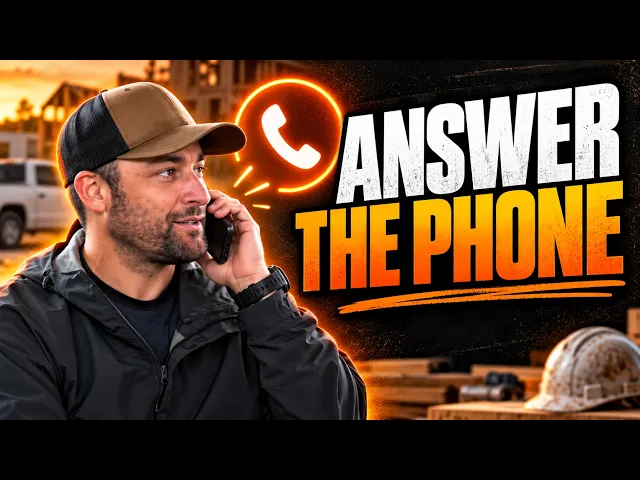
Chuck Kile, who has spent around a decade marketing for contractors at Adapt Digital Solutions, on the work contractors lose simply by not picking up. Source: Chuck the Contractor on YouTube.

The call that goes to voicemail is usually the one placed while the crew is already on site. Photo: Artem Korolev on Unsplash.
How to test transfer reliability before you go live
Run these eight calls yourself, from a phone the system does not recognise, before a customer hears the agent.
A team member answers the transfer normally.
Nobody answers the transfer destination. Where does the caller land?
The caller asks for a human in the first five seconds.
A call at 1am on a Sunday.
Two calls arriving at the same moment.
A booking request into a week that is already full.
Jobsite audio: a compressor running, wind, a caller on speaker in a van.
A declared emergency, timed from the first word to a human actually speaking.
Test seven catches most trade deployments. Test two quietly loses jobs for months. If you are replacing a phone menu rather than voicemail, our piece on conversational IVR covers the same failure modes.
What an AI receptionist for contractors really costs
Headline pricing is close to useless, because almost nobody pays only the headline. Build the number yourself:
Monthly cost = platform subscription + answering plan + usage overage + any human coverage you keep + number and integration charges.
Overage is where contractors get surprised. Trade intake runs long, because an estimate conversation involves address, access, scope and photos. A plan sized on a 90 second average will not survive a storm week.
Work an example. A plan at $29 a month covering 30 conversations, charging $0.79 per extra one, costs $84.30 in a 100 conversation month, not $29. Still cheap against a salary, but three times the sticker.
For comparison, a staffed service discussed on r/smallbusiness came in at $125 a month for inbound calls, and human receptionist plans commonly start in the low hundreds for a small block of minutes.
The metric worth tracking is cost per usable booked appointment. A cheap plan that books three jobs you would have lost pays for itself. An expensive one producing records your office rewrites does not. We break the models down in our guide to AI voice agent pricing.

Verified figures behind the contractor phone problem, with primary sources. Sources: ABC (Jan 2026), FCC 24-17, EU AI Act Article 50.
Disclosure, recording and consent: three separate obligations
None of this is legal advice, and rules differ by state and country. People routinely treat three different things as one.
Outbound AI voice calls. In February 2024 the FCC adopted a Declaratory Ruling (FCC 24-17, CG Docket 23-362) confirming that AI-generated voices are "artificial" under the Telephone Consumer Protection Act, because a person is not speaking them. Inbound answering is a different situation from outbound campaigns.
Call recording. Consent rules vary by state. California's Penal Code section 632 requires all parties to consent to recording a confidential communication, which is why a recording notice opens so many scripts. Check your states, not the average.
Telemarketing. If the agent will ever call past customers with offers, read the FTC's Telemarketing Sales Rule separately from anything about AI.
In Europe, add one more. Article 50 of the EU AI Act requires that people interacting directly with an AI system are informed that they are, unless it is obvious from the context. Those transparency rules became applicable on 2 August 2026, and the text of Article 50 is worth reading before you write your greeting.
In practice this collapses into one opening sentence saying a virtual assistant is answering and the call may be recorded, plus a working path to a human.
Run a 30 day pilot, then widen it
Do not point your main line at a new agent on day one.
Pick one stream. After hours only, or overflow only. Not everything.
Write the rules down. Which services are bookable, which need a human, what the agent may never promise.
Run the eight tests, including the unanswered transfer path.
Reconcile weekly. Compare transcripts against what reached the calendar and what your office corrected.
Expand when the records are clean, not when the demo sounded good.
Five numbers tell you whether to keep it: eligible calls answered, appointments confirmed, successful transfers, records fixed manually, and cost per usable booked appointment. Contractors who also manage buildings will find the same framework on a different call mix in our guide to AI for property management calls.
Frequently asked questions
Can an AI receptionist book contractor estimates, not just take messages?
Yes, provided it writes into one authoritative calendar with separate durations for estimates and service calls, plus travel buffers between zones. Without those rules it books appointments your crew cannot keep.
What is the difference between an AI receptionist and an answering service?
An AI receptionist is software answering the call; an answering service is staffed by people. AI is instant, consistent and cheap per call but weaker on unusual conversations. Most trades with emergency work end up running a hybrid.
How much should a small contractor budget?
Build it from the formula rather than a sticker price: subscription, plan, overage, any human coverage, plus number and integration fees. Entry plans sit in the tens of dollars, and a busy single-crew outfit commonly lands in the low hundreds once overage is counted.
Can I keep my existing business number?
In most setups yes, by forwarding your current number to the agent rather than publishing a new one. Keep the forwarding rules simple, and know where a call lands if the agent is unreachable.
Will callers be annoyed that it is not a person?
Some will, which is why an honest opening line and a transfer that works on the first request matter more than voice quality. In trade threads the complaint is rarely that AI answered. It is that the caller could not reach a human, or the message was useless.
Can an AI receptionist replace a dispatcher?
No. The agent collects clean information and routes by rule. Deciding which crew goes where, with which parts, needs someone who can see the whole board.
Where to start
Start with the call you are definitely losing. For most contractors that is evenings, weekends and the hour either side of a jobsite day, not the whole phone.
Define your emergency list, give the agent one calendar, run the eight tests, and measure cost per usable booked appointment for thirty days. That sequence separates a voice agent that books work from one you switch off in week three.
To see how intake, triage and booking run on a real trade phone, the Callin.io phone agent is built for this call mix, and you can compare plans on our pricing page.
Stop paying for leads you never answer. Set up your AI receptionist at callin.io and let every call get picked up on the first ring.


