Conversational IVR: Replace Menus That Lose Calls
Conversational IVR replaces rigid phone menus with natural speech, so callers resolve issues faster and agents pick up calls with full context.

Every phone menu you have ever built was a compromise. You had eight things callers wanted and four buttons to offer them, so you guessed, grouped, and hoped. Conversational IVR removes that compromise by letting the caller simply say what they need.
That sounds like a small change. It is not. Once a caller can speak freely, the design problem moves from "how do I fit intents into a tree" to "how do I understand intent and act on it". Different question, different architecture, different results.
This guide covers what conversational IVR is, how it works, where it pays off, where it quietly fails, and how to evaluate one without being sold a demo. It also includes what real callers and real contact centre leaders say, which is rarely what vendors say.
Key takeaways
Conversational IVR swaps keypad menus for spoken intent, then routes or resolves based on what the caller actually said.
Gartner found only 14% of customer service issues are fully resolved in self-service, so the bar you are clearing is low.
Context handoff matters more than voice quality. A transfer that loses the conversation undoes everything the automation gained.
Speech recognition is not equally accurate for every speaker, so fallbacks are a design requirement, not a nice-to-have.
The realistic goal is a hybrid line: automation for the routine, fast and clean escalation for the rest.
What conversational IVR actually is
Interactive voice response is any automated system that answers a phone call and interacts with the caller. The touch-tone version has been around since the 1970s and most of us can still hum the cadence of it.
Conversational IVR is the same job done with speech understanding instead of button presses. The caller says "I need to move my delivery to Friday" and the system parses the intent, checks the order, and either completes the change or hands the call to someone who can.
The distinction worth holding onto: traditional IVR collects a selection, conversational IVR collects a request. A selection is a number. A request carries meaning, entities, urgency and often two or three things at once.
That is why teams who simply record nicer prompts over an existing tree are disappointed. The tree is the constraint, not the voice.
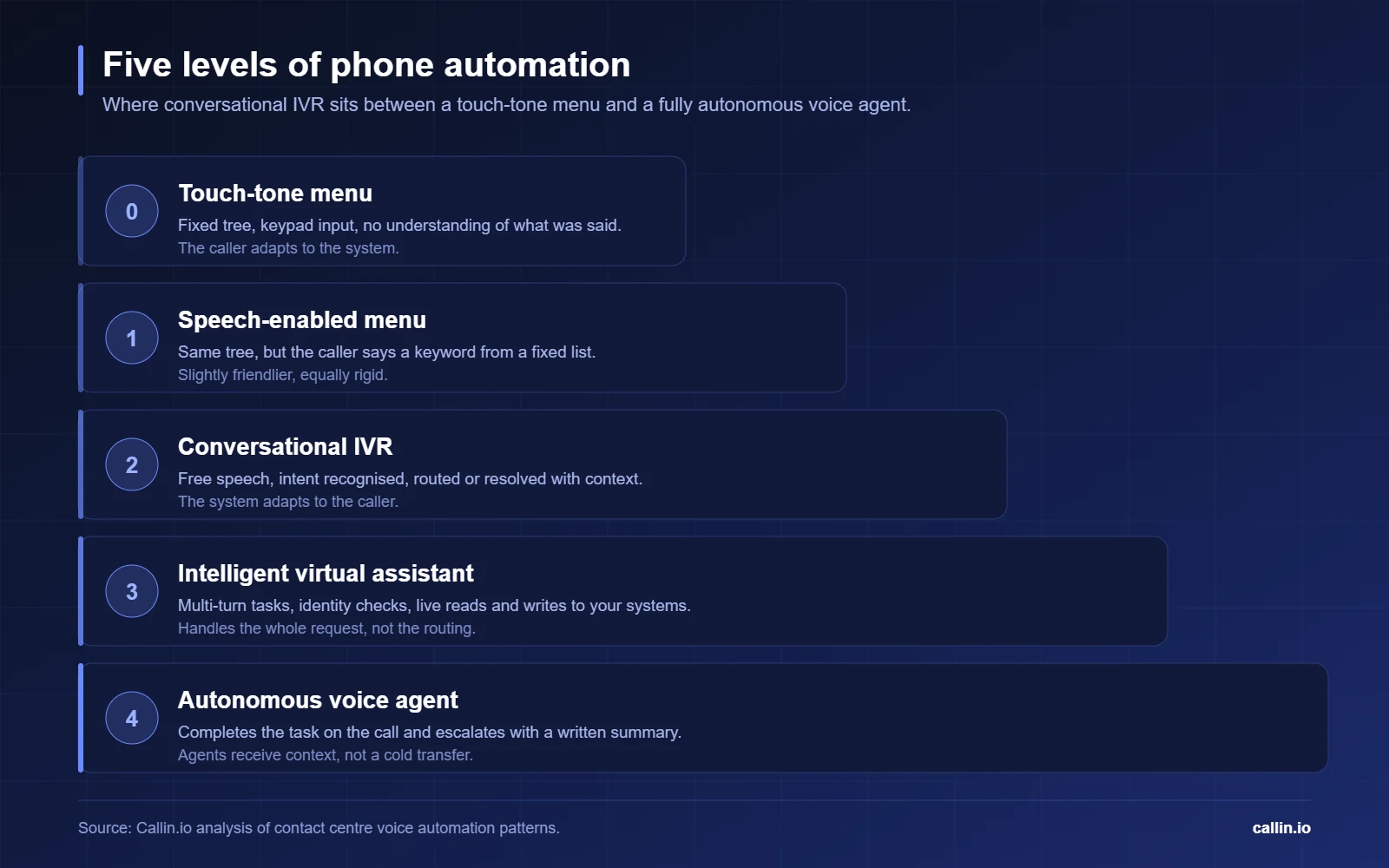
Levels of phone automation, from touch-tone menus to autonomous voice agents. Source: Callin.io analysis.
How the technology works, step by step
Under the hood a conversational IVR is a short pipeline, and every stage adds latency and risk.
1. Speech to text. Automatic speech recognition turns audio into words. This is where accents, background noise and poor line quality do their damage.
2. Intent and entity extraction. A language model reads the transcript and decides what the caller wants and which details matter: order number, date, policy reference, address.
3. Dialogue management. The system decides what happens next. It may ask a clarifying question, call your CRM or booking system through an API, or decide the request needs a human.
4. Text to speech. The answer is spoken back. Prosody matters more than people expect, because a flat delivery makes callers repeat themselves.
5. Logging and improvement. Every call produces a transcript, a confidence score and an outcome. Those three things let you fix the system next month instead of guessing.
For how this sits inside a wider support operation, our guide to voice AI for customer service covers the surrounding workflow.
Why context and speed decide the call
Traditional IVR transfers a call and forgets everything. The caller spends ninety seconds explaining a problem to a machine, then explains it again to a person.
Conversational IVR can pass a summary: what was asked, what was attempted, which account was verified, what the system could not do. The agent picks up mid-story rather than at the beginning.
This is the change customers notice most. It is also the easiest to skip during implementation, because it means work on the agent desktop, not just on the voice side.
Speed is the other half. Voice has no loading spinner, so silence reads as failure. In text chat a two second pause is invisible; on a call it is the moment the caller says "hello?" and talks over the system, which corrupts the turn.
Anything past roughly a second of turn latency erodes the illusion of a conversation, and that budget has to cover recognition, reasoning, any API call and speech synthesis.
The practical consequence surprises people: the slow part is usually your backend, not the model. A CRM lookup that takes three seconds will sink an otherwise excellent voice stack.

Contact centre floor. Photo by Arlington Research on Unsplash.
Conversational IVR versus traditional IVR
Input. Keypad selections versus natural speech, including callers who give you three pieces of information in one breath.
Maintenance. A tree needs reprogramming for every new case. A conversational system needs new instructions and examples, which a service manager can often write without an engineer.
Escalation. Blind transfer versus a handoff carrying context.
Failure mode. A tree fails loudly and predictably. A conversational system fails quietly, by misunderstanding, which is why reading transcripts matters.
Cost shape. Traditional IVR is mostly fixed cost. Conversational IVR is mostly per minute or per call, so the business case is sensitive to volume and to how many calls you actually contain.
The old technology is not disappearing. Verified Market Research put the interactive voice response market at USD 4.1 billion in 2021, projected to reach USD 6.6 billion by 2030. That is a market still growing.
Plenty of high-volume, low-ambiguity routing works perfectly well as a menu. Nobody needs a language model to press 1 for sales. The common pattern in the field is layered: keep the deterministic paths that work, put conversational understanding in front of the parts of the tree where callers get lost, and measure the difference. That approach also gives you a rollback. A full rip-and-replace does not.
IVR, IVA, conversational AI and voice agents
IVR is the category: any automated system that answers the phone.
Conversational IVR is an IVR that understands speech rather than key presses.
Intelligent virtual assistant usually means it goes past routing into multi-step tasks and verification.
Conversational AI is the umbrella term covering voice, chat, email and messaging.
AI voice agent emphasises autonomy: it completes the task on the call rather than collecting information for someone else. Our breakdown of the AI phone agent model covers what that means operationally.
Ignore the label on the box and test four things: multi-turn dialogue, live system integration, clean escalation, and whatever compliance regime your sector demands.
What callers and practitioners actually say
This is the part most vendor pages leave out, and it is the most useful signal you have.
On Reddit the recurring theme is not "AI bad". It is "let me out". A thread in r/LifeProTips about bypassing automated assistants collected hundreds of comments trading tactics for reaching a person. In r/usps_complaints, users swap precise scripts, including advice not to ask for an agent at the very start of the call.
Read that as product feedback. Callers build workarounds when the system gives them no honest exit.
The picture is not uniformly negative. In an r/ArtificialInteligence discussion on voice bots in support, the top reply says the experience has become much easier than waiting in a queue. Speed buys goodwill.
Operators have the mirror-image problem. A founder posting in r/startups asked why callers refused to engage with their AI assistant at all, and the answers pointed at trust and at never telling people how long a human would take.
On LinkedIn, under a Gartner post about self-service overtaking traditional channels, Chirag Shah, who describes two decades in contact centres at firms including JPMorgan Chase and HP, argued that the future is not bots taking over but automation integrated with human empathy, and called minimising access to humans a risky way to cut costs. Another commenter, Michiel t' Sas, predicted self-service will only grow if it is genuinely AI-driven rather than static FAQs.
Wharton professor Christian Terwiesch on how AI is reshaping customer service expectations. Source: Knowledge at Wharton.
The business case, with numbers that hold up
Start with the honest baseline. Gartner surveyed 5,728 customers and found that only 14% of customer service issues are fully resolved in self-service, even though 73% of customers try self-service at some point. For issues customers rated very simple, the figure was 36%.
That gap is the opportunity. It also means any vendor promising ninety percent containment in month one is describing a different planet.
In a separate Gartner survey of 265 service leaders, digital-first technologies are expected to surpass phone and email in value by 2027. Notably, the same survey found leaders still ranked AI agents outside their top ten most valuable technologies, a useful corrective to the hype.
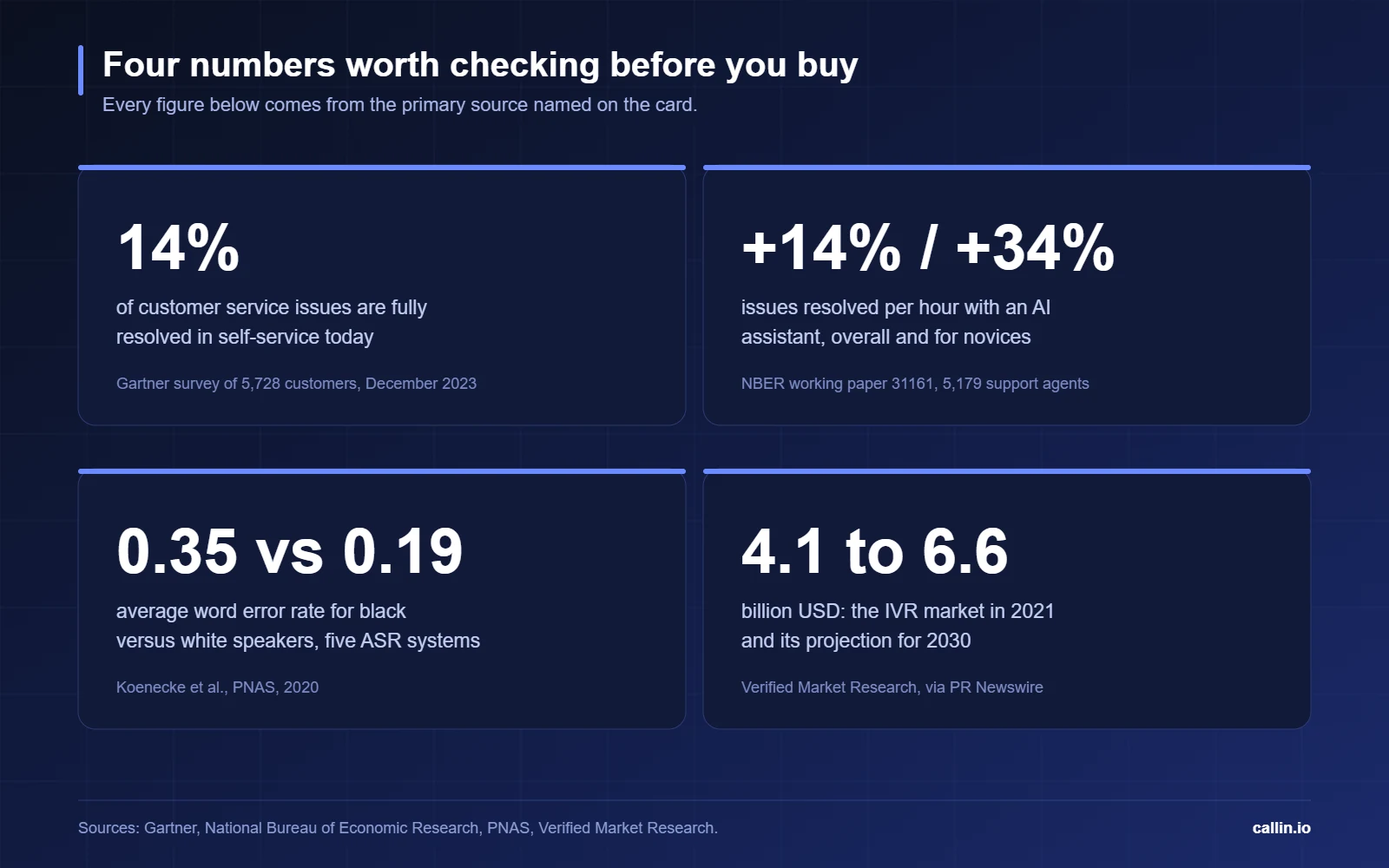
Verified figures on self-service, automation and speech recognition. Sources: Gartner, NBER, PNAS, Verified Market Research.
There is also a documented gain on the agent side. A National Bureau of Economic Research study of 5,179 support agents found that access to an AI conversational assistant increased issues resolved per hour by 14% on average, and by 34% for novice and low-skilled workers.
Read those findings together and the strategy writes itself: automate the repetitive front end, and use the same technology to make the humans behind it faster. If you are sizing the investment, our pricing page shows how per-minute economics work.
How to implement it without wasting six months
Start with transcripts, not a flow chart. Pull a few hundred real calls per use case and read what callers actually say. The vocabulary your team uses internally is almost never the vocabulary on the line.
Pick three intents, not thirty. The first release should cover the highest-volume, lowest-risk requests: opening hours, order status, balance, appointment changes. Our guide to AI appointment scheduling covers that last one in depth.
Wire the integrations before you polish the prompts. A voice agent that cannot read your booking system is an expensive answering machine.
Decide escalation rules in writing: which confidence score triggers a handoff, which intents always go to a human, what the system says when it gives up. Write it down before launch.
Test with the voices you actually serve, including regional accents, older callers, speakerphones and noisy rooms. Test on the worst phone in the office, not the best headset.
Instrument three metrics from day one: containment rate, transfer quality, and satisfaction on automated calls specifically. Containment alone will flatter you.
How to evaluate a vendor in one afternoon
Call the demo number and interrupt it. Talk over the greeting, change your mind mid-sentence, give a date in three different formats. Scripted demos never survive this.
Ask to see a live integration, not a slide, and ask what happens when your API times out. Ask for the escalation transcript, not the success transcript, because anyone can show you a call that worked.
Check the deployment model against your team. Our AI voice platform page sets out where each fits, and the phone agent page shows the deployed version.
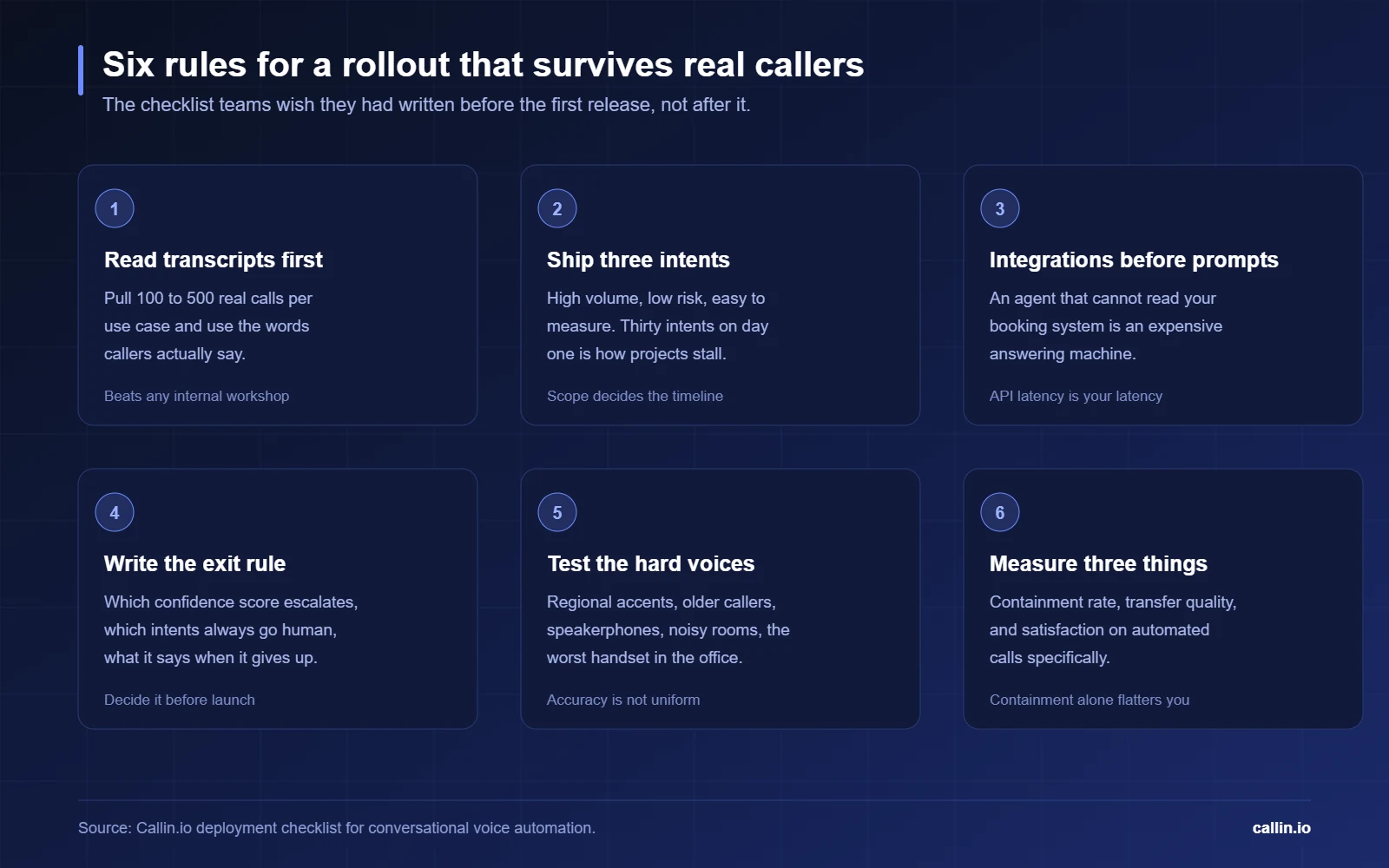
Rollout checklist for a conversational IVR that survives contact with real callers. Source: Callin.io.
Failure modes to plan for
Recognition bias. The one most teams underestimate. A study in the Proceedings of the National Academy of Sciences tested five major speech recognition systems and found an average word error rate of 0.35 for black speakers compared with 0.19 for white speakers. Models have improved since, but any system that behaves differently by accent needs a fallback that does not punish the caller.
Escalation friction. If the exit to a human is hidden, callers find the workaround and resent you for the detour. Offer it plainly.
Integration drag. Legacy telephony and old CRMs are where timelines go to die. Budget for it. Teams running their own stack may find our IT support notes useful.
Compliance gaps. Healthcare calls fall under HIPAA, card data under PCI DSS. Voice recordings contain personal data by default, so encryption, retention limits and redaction belong in the design, not a later phase.
Silent regressions. A prompt change that improves one intent can quietly break another. Keep a regression set of real calls and replay it before every release.
A note on headcount
What usually happens is a change in mix. Routine calls stop reaching agents, so the calls that do reach them are longer, harder and more valuable. Average handle time goes up, which looks like a problem on a dashboard and is actually the intended outcome. Teams that plan for this retrain and re-band their agents; teams that do not end up with the same headcount, harder work and no pay conversation.
Frequently asked questions
What exactly is IVR?
IVR stands for interactive voice response: any automated system that answers a call and interacts with the caller. It covers everything from a 1970s touch-tone menu to a modern voice agent that completes tasks.
Is IVR still relevant?
Yes. The market is still growing, and simple deterministic routing remains faster than any conversation for a two-option choice. What is fading is the deep, guess-based menu tree nobody could navigate.
What is an example of conversational AI on the phone?
A caller says "I need to reschedule Thursday's appointment to next week". The system verifies the caller, reads the calendar, offers two slots, books one and sends a confirmation, all inside the same call.
How much does conversational IVR cost?
Pricing is usually per minute or per call, plus integration work. Containment decides your real cost: a system that resolves half your routine calls pays for itself far faster than one that resolves a tenth. Model it against your current cost per handled call, not your current IVR licence.
Does it work for small businesses?
Yes, and often faster than for enterprises, because there is less legacy to integrate. A small clinic or agency can be live on two or three intents in days. See our notes on the AI receptionist pattern for the smaller-team version.
Are there privacy risks with voice data?
Yes. Recordings and transcripts routinely contain personal data, and sometimes payment or health information. Insist on encryption in transit and at rest, defined retention windows, automatic redaction of sensitive fields, and the certifications your sector requires.
Where to start
Conversational IVR is not a magic upgrade to your phone line. It is a way to stop making callers translate their problem into your org chart.
Pick the three requests that fill your queue, read a hundred real transcripts, build those three properly, and make the exit to a human obvious. That is a better first quarter than any hundred-intent rollout.
To see what that looks like on your own number, start at callin.io and build the first version this week.