AI Receptionist: What It Is, What It Costs and How to Set One Up in 2026
What an AI receptionist is, how it compares with auto-attendants and human receptionists, what it costs and a 30-day plan to set one up for your business.

An AI receptionist is a virtual front desk that answers your business phone with a natural voice, 24 hours a day. It greets callers, answers common questions, books and changes appointments, takes messages and transfers important calls to the right person. For a small business it replaces the voicemail box; for a larger one it absorbs the peaks your team cannot handle.
The phone still matters more than many people think. According to McKinsey, 71% of Gen Z customers agree that a live phone call is the quickest and most convenient way to resolve a customer service issue. Customers keep calling. The question is who picks up.
Key takeaways
An AI receptionist holds real conversations, unlike an auto-attendant that only routes calls with a menu.
Speed wins: businesses that respond within an hour are far more likely to convert a lead than those that wait.
Most AI receptionists cost between $25 and $300 a month, a fraction of a human answering service.
The setup, not the technology, decides the result: clear knowledge, clear escalation rules and weekly reviews.
What is an AI receptionist?
An AI receptionist is software that answers phone calls using voice AI. It listens to what the caller says, understands the intent, looks up the right information and replies out loud, in real time. Behind the scenes it combines speech recognition, a language model instructed with your business details and integrations with your calendar, CRM or booking system.
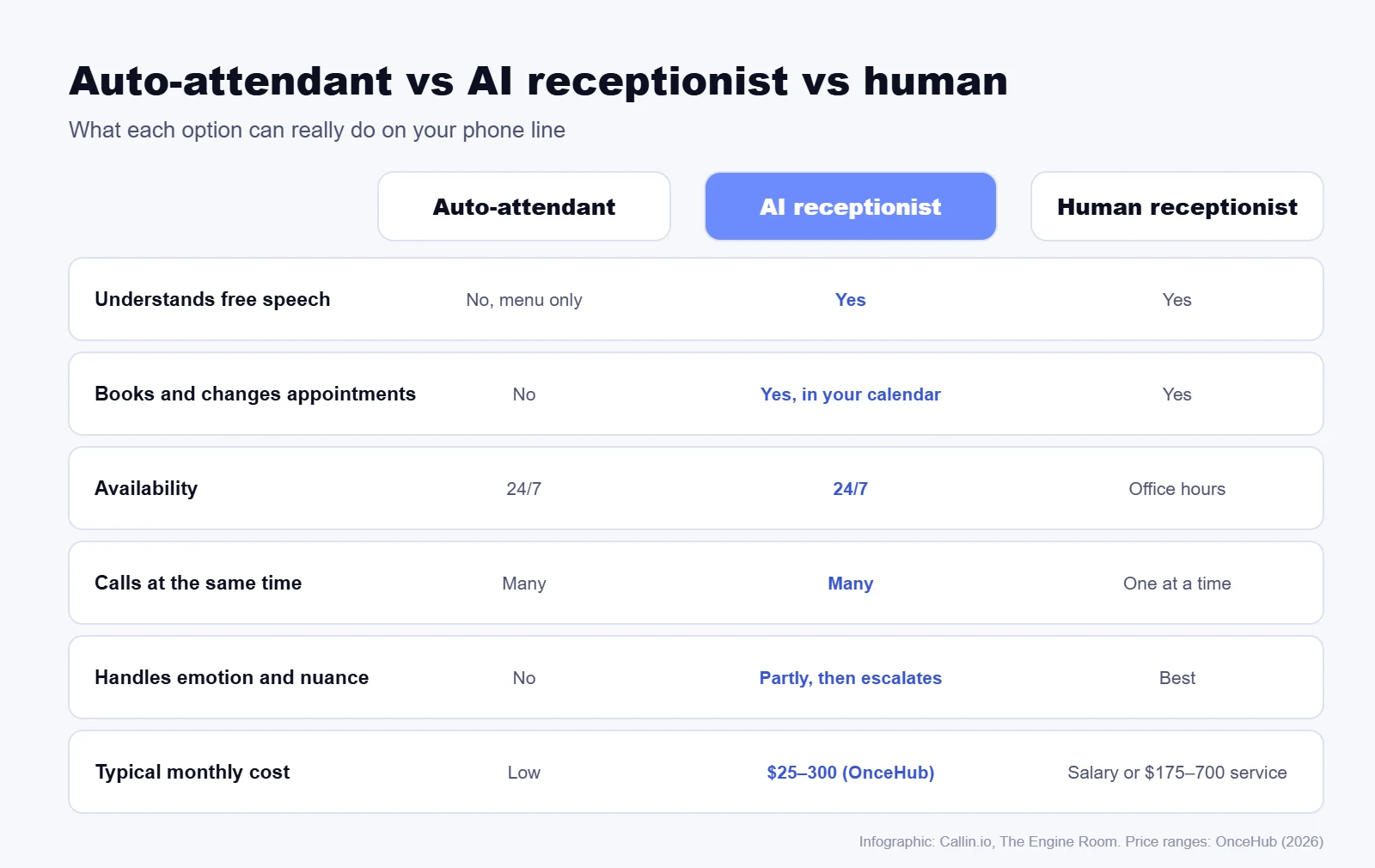
The best way to understand it is to compare it with the two options it replaces.
Infographic: Callin.io, The Engine Room
An auto-attendant is the classic "press 1 for sales" menu. It is cheap and predictable, but it cannot answer a question or book anything. A human receptionist handles nuance and emotion better than any machine, but works fixed hours and can only take one call at a time. An AI receptionist sits in the middle: always available, able to talk and act, and ready to hand over to a person when the conversation needs one.
How an AI receptionist works
When a call comes in, the AI answers on the first ring with your greeting and a short disclosure that the caller is speaking with an AI assistant. It then identifies why the person is calling: a question about opening hours, a new booking, a delivery problem or an urgent issue.
From there it follows the rules you have set. It can answer from your knowledge base, check availability and book a slot, collect the details of a new enquiry, or transfer the call to a colleague with a short summary. At the end of each call it saves a transcript and a summary in your systems, so nothing depends on memory or sticky notes.
On the phone, speed is everything. A natural conversation leaves very little time between turns, so a good AI receptionist must reply almost instantly. We explain the engineering behind it in our guide to reducing latency in voice agents.
Why speed to answer matters so much
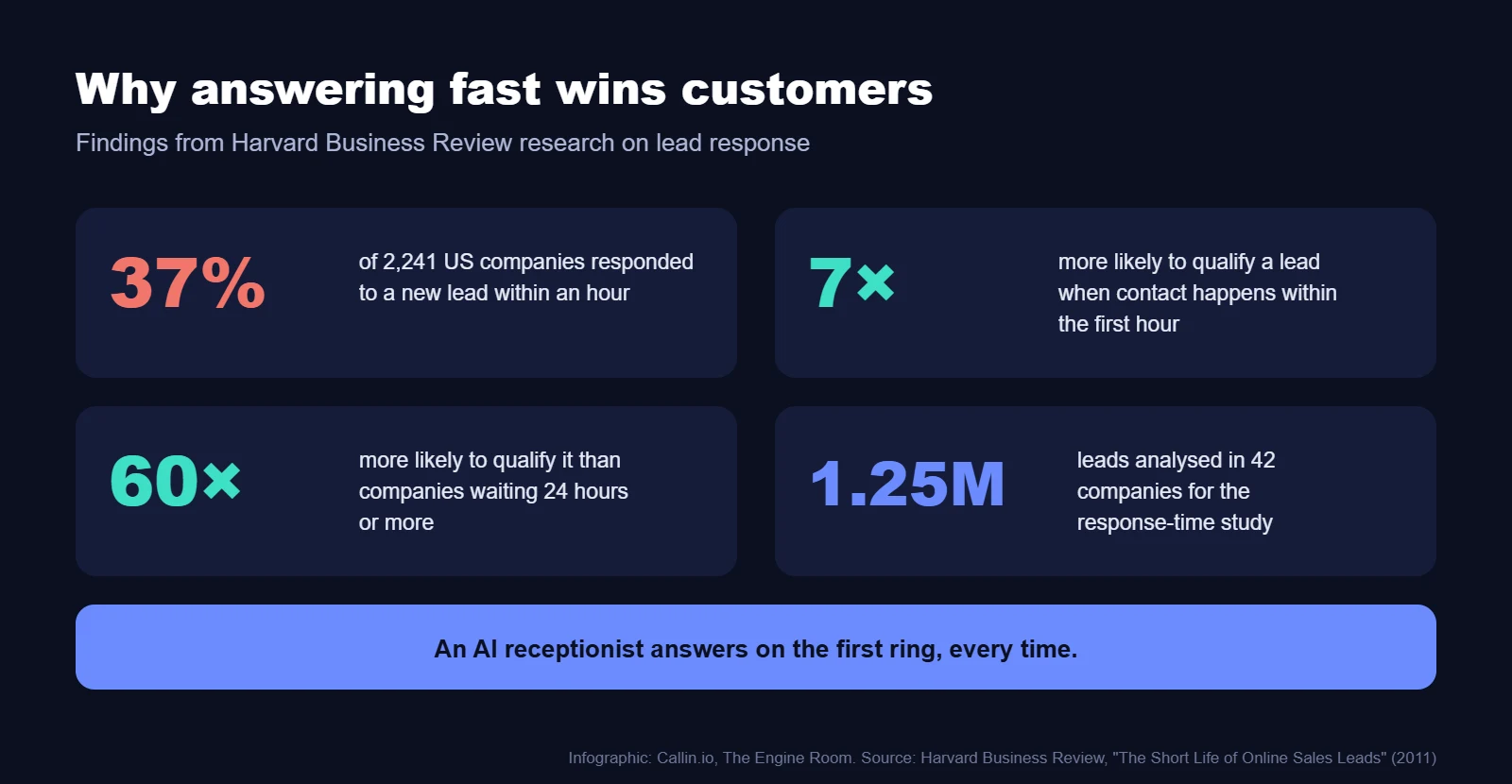
Every unanswered call is a customer deciding whether to wait or to call a competitor. Research published in the Harvard Business Review audited 2,241 US companies and found that only 37% responded to a new lead within an hour. In a separate analysis of 1.25 million leads, companies that made contact within an hour were nearly seven times as likely to qualify the lead as those that waited longer, and more than 60 times as likely as those that waited a day or more.
Infographic: Callin.io, The Engine Room. Source: Harvard Business Review, "The Short Life of Online Sales Leads"
An AI receptionist removes the delay completely: the lead is qualified while the caller is still on the line. We looked at the full cost of missed calls, with a simple formula to estimate your own loss, in our article on the AI answering service.
What an AI receptionist can do beyond answering
Book, move and cancel appointments directly in your calendar, with a confirmation by SMS or email.
Qualify new enquiries by asking the questions your sales team would ask, then routing hot leads to the right person.
Answer frequent questions about prices, services, opening hours, parking or documents to bring.
Take structured messages and create tickets or CRM records automatically.
Speak several languages, which matters for tourist areas and international customers.
Send follow-ups such as reminders, directions or payment links after the call.
How much an AI receptionist costs
Prices vary with call volume and features, but the market has settled into clear ranges. According to OnceHub's 2026 comparison, AI receptionists cost between $25 and $300 a month, with most full-featured options between $50 and $200. Human answering services at small-business volumes cost $175 to $700 a month.
Look closely at how each vendor counts usage. Nextiva's own guide lists plans billed per interaction (for example $99 for 100 interactions) and others billed per minute (for example $29 for 60 minutes plus $0.48 for each extra minute). The cheapest plan is rarely the cheapest once your real volume is included. Our guide to AI voice agent costs breaks down every layer, from telephony to models.
Who benefits most from an AI receptionist
Clinics, studios and personal services
Bookings and cancellations make up most of their calls. An AI receptionist fills the calendar at night and at weekends, and sends urgent medical or safety concerns straight to staff.
Real estate agencies and property managers
Viewing requests, tenant questions and maintenance reports arrive at all hours. See how an AI receptionist for property management handles them, and how AI phone agents qualify real estate leads.
Trades and home services
Plumbers, electricians and installers are often on a job when the phone rings. The AI captures the job details and books the visit, so the lead does not go to the next company on Google.
Hotels and hospitality
Reservations, late check-ins and questions about services can be handled in several languages, freeing the front desk for the guests in front of it.

Photo: Dylan Calluy on Unsplash. An AI receptionist covers the phone so the front desk can focus on the people in the room.
How to set up an AI receptionist in 30 days
Many vendors promise a setup in minutes, and a basic greeting really does take minutes. A receptionist that books correctly, knows your policies and escalates the right calls takes a little longer. This plan works for most small and mid-sized teams.
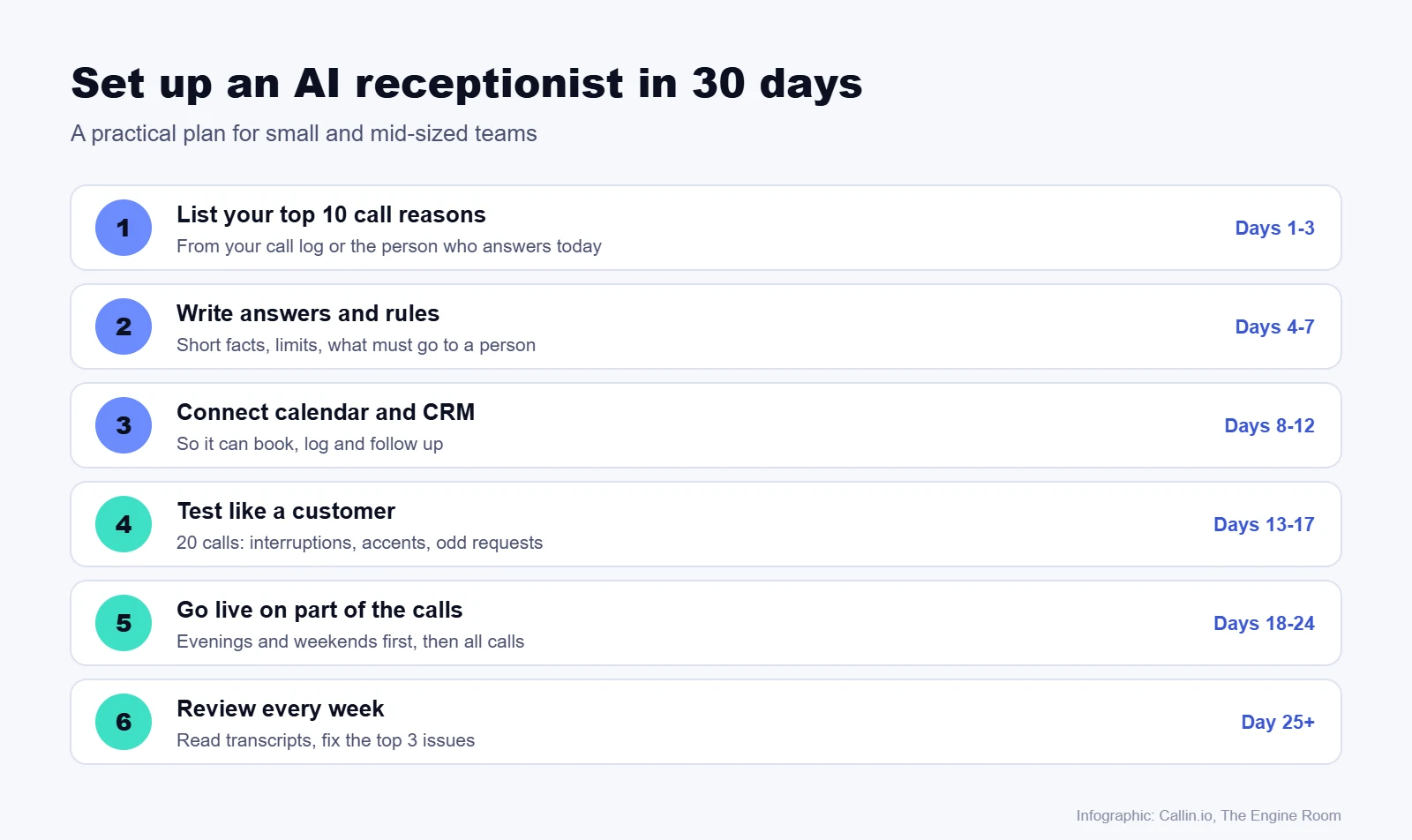
Infographic: Callin.io, The Engine Room
The most important step is the second one: writing clear, short answers and rules. Voice needs its own style, with no long lists or links, so read our guide to prompting AI voice agents before you write the instructions.
Limits and risks to consider
It can get facts wrong. A language model may give a confident but wrong answer if it lacks information. Limit it to verified content and teach it to say "I don't know, I'll take a message". We explain why in our article on LLM hallucinations.
Some callers want a person. Make the transfer to a human easy and immediate, especially for complaints and emotional situations.
Rules apply. In the European Union, the AI Act requires telling callers they are talking to an AI, and GDPR applies to recordings and personal data. Ask every vendor where data is stored and how long it is kept.
Watch: AI receptionists explained
This video from the AI Hustlers channel gives a practical overview of how AI receptionists work for small businesses and what to look for.
Frequently asked questions
Can an AI receptionist use my existing phone number?
Yes. Most services work by forwarding your number, or by connecting through your current carrier or SIP trunk, so customers keep calling the number they already know.
Will callers notice it is an AI?
Usually yes, and they should: in the EU a disclosure is required. With a natural voice and fast answers, most callers care more about getting helped than about who helps them.
Can it handle several calls at once?
Yes. Unlike a person, an AI receptionist answers many calls in parallel, which makes it ideal for peaks such as Monday mornings or campaign launches.
What happens if it cannot answer?
It should take a detailed message or transfer the call, depending on your rules. It should never invent an answer.
Is an AI receptionist worth it for a very small business?
Often it is where it pays off fastest. If even two or three missed calls a month would have become customers, the service usually covers its cost.
The bottom line
An AI receptionist gives every caller an immediate answer, at any hour, for a small monthly cost. Treat it like a new team member: give it clear knowledge, clear rules and regular feedback, and it will protect your revenue every time the phone rings.
Want to hear how it sounds on your own number? Try Callin.io for free.