AI Answering Service for Small Business: Costs and Setup
AI answering service for small business: how it works, what it costs and how to set one up so every call is answered and turned into a booking.

Every small business has a version of the same bad afternoon. The phone rings while you are under a sink, up a ladder, with a client, or driving between jobs. By the time you call back, the caller has already booked somebody else.
That is the gap an AI answering service is built to close. It picks up on the first ring, holds a real conversation, writes down what the caller needs, and books the job while the intent is still hot.
This guide covers what these systems do, what they cost against every alternative, what independent research says, and how to set one up without rebuilding your phone system.
Key takeaways
An AI answering service answers every call instantly, in parallel, at any hour, and hands you a written summary instead of a voicemail.
The honest comparison is not AI versus your receptionist. It is AI versus voicemail, which is what most callers actually reach.
The cost sits far below a full-time hire: the US median wage for receptionists was $38,010 in May 2025 according to the Bureau of Labor Statistics.
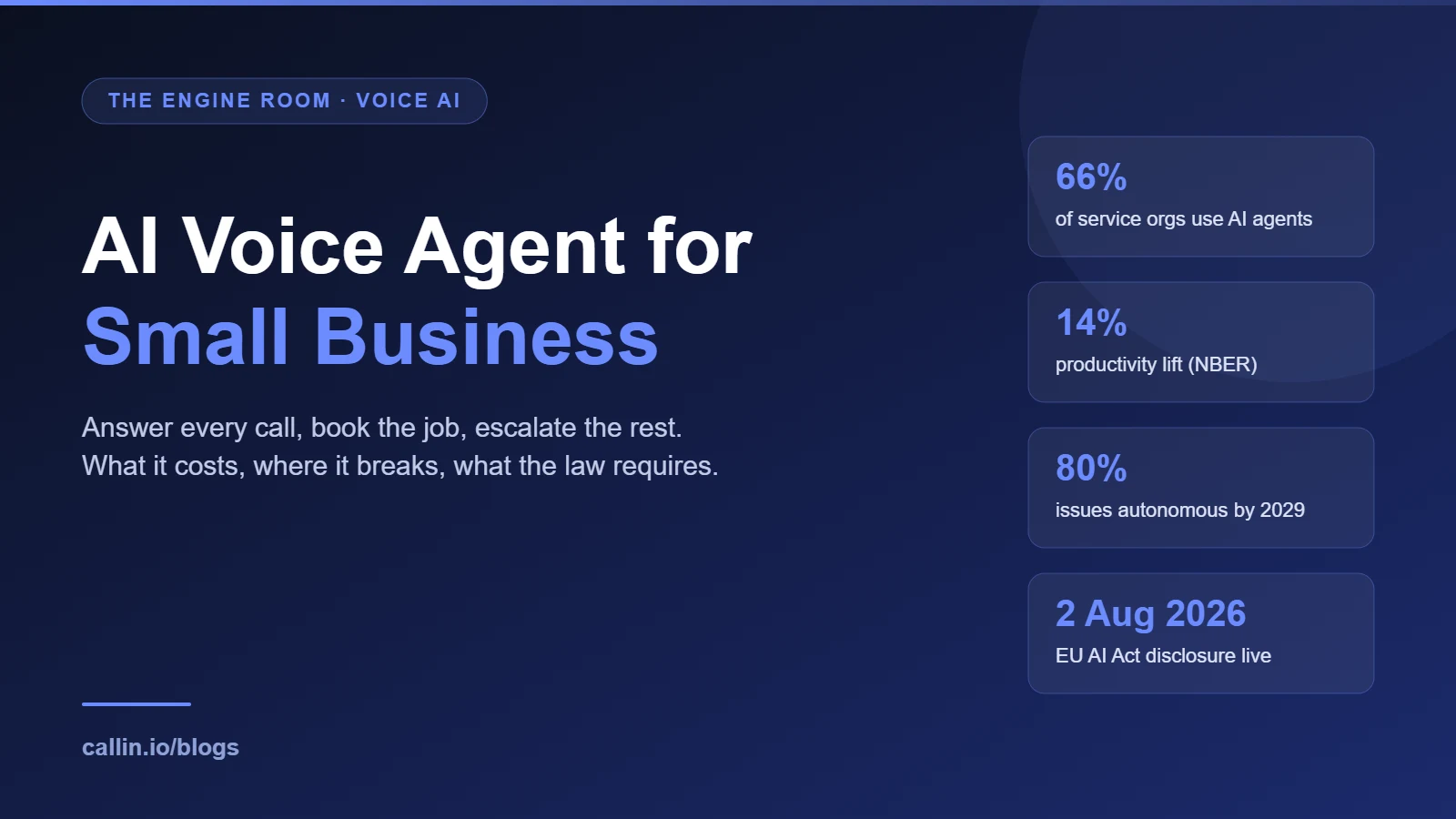
Gartner expects agentic AI to resolve 80% of common customer service issues without human intervention by 2029.
Setup takes hours, but the quality comes from the knowledge you feed the agent and the escalation rules you write.

From voicemail to an AI answering service: what each layer of phone coverage can and cannot do. Source: Callin.io analysis.
What is an AI answering service for small business?
An AI answering service is a voice agent that picks up your business line, talks with the caller in natural language, captures the details you need, and then does something with them: books a slot, sends a text, creates a record, or transfers a live human.
It is not a phone menu, which asks callers to classify themselves before they have explained anything, and it is not a recording, which collects nothing.
Underneath, four pieces do the work: speech recognition, a language model that understands intent, a knowledge base built from your own services and policies, and integrations that write the outcome into your calendar, CRM or voice platform. The useful mental model is a trained front desk assistant who never sleeps and never forgets to write the number down.
The missed call problem most owners never see
Missed calls are invisible in a way that missed emails are not. An unanswered email sits in an inbox. An unanswered call leaves no trace unless something is counting.
Most small businesses have no missed-call report at all, so the measurement ends at "the phone rings a lot". The cost is concentrated in the highest intent traffic. People who call rather than fill in a form usually want to buy now, and the ones calling about an emergency will try the next three numbers in the search results within minutes.
If you spend on local search or paid ads, every unanswered call is budget you already paid for and then threw away at the last step.
The structural problem is that the work and the phone compete for the same person. In a two-person shop, whoever is best at explaining the service is also the person holding the drill.
Callbacks look like a solution and rarely are. By the time you ring back at 6pm, the caller is cooking dinner, has already booked someone, or does not recognise the number.
How an AI answering service actually works
The mechanics are simpler than the marketing suggests. Five steps, every call, the same way.
1. Instant pickup
Calls route to the agent either as the main line or as an overflow after two rings. Nothing is on hold, and simultaneous calls are answered at the same time rather than queued.
2. Conversation, not classification
The agent greets the caller with your business name and asks what they need. Callers describe the problem in their own words instead of pressing 3 for service.
3. Qualification
The agent collects what you decided matters: name, callback number, address, the nature of the job, urgency, and anything specific to your trade such as the make of a boiler.
4. Action
Based on your rules, the agent books the appointment, sends an SMS confirmation, raises a ticket, or transfers the call live. Urgent cases can ring your mobile while routine ones go straight into the diary.
5. Handover
Every call ends as a written record: transcript, summary, captured fields, and outcome, pushed into the tools you already use. For a deeper look at the scheduling layer, see our guide to AI appointment scheduling.
Nothing is predetermined, which is the whole difference from a legacy phone tree. Compare it with a modern conversational IVR setup to see how far the gap has widened.
What a real call sounds like
Take a pest control company and a caller who has found a bat in a bedroom. A menu would offer four options, none of which is bat. A well-configured agent asks where the animal was seen, whether anyone touched it, whether children or pets are in the house, and whether the room can be closed off, then gives calm pre-approved safety instructions rather than improvising.
By the end of the call the business has an address, a risk level, a photo request sent by text and a slot booked, so the technician arrives with the right equipment. The same structure works for the unglamorous majority of calls: quotes, rescheduling, opening hours, whether you cover a postcode. Those pay the rent, and voicemail loses them fastest.

For an owner behind the counter, the phone competes with the customer in front of them. Photo: Louis Hansel on Unsplash.
What the evidence says about automated support
Two findings are worth more than any vendor claim. The first is experimental: in a study of 5,179 customer support agents, economists at Stanford and MIT found that access to a generative AI assistant raised productivity by 14% measured in issues resolved per hour, with novice and lower-skilled workers improving by 34% while experienced workers saw little change. The paper is Generative AI at Work, NBER Working Paper 31161.
The reading for a small business is specific: AI compresses the gap between your best communicator and your worst, which is exactly the variance that costs a small team jobs.
The second is directional. Gartner predicts that agentic AI will autonomously resolve 80% of common customer service issues without human intervention by 2029, alongside a 30% reduction in operational costs.
Adoption is still early, which is the opportunity. US Census Bureau Business Trends and Outlook Survey data showed AI use among firms with one to four employees rising from 4.6% to 5.8% between September 2023 and August 2024. In the EU, Eurostat recorded 19.95% of enterprises with 10 or more employees using at least one AI technology in 2025, and 17% among small enterprises.
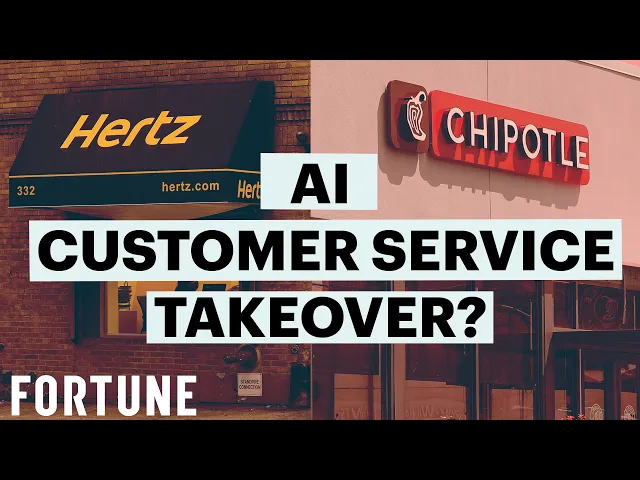
Fortune Magazine on the money flowing into automated customer service, the economics of autonomous voice agents at companies like Hertz, and the guardrails and trust gap that still apply. Source: Fortune Magazine on YouTube.
Seven signs your business needs one
You regularly cannot answer during your own peak hours.
Voicemail is your fallback, and almost nobody leaves a message.
Callbacks happen hours later, or the next morning.
Your team is small enough that the phone is always somebody's second job.
You work in a high-urgency trade: plumbing, HVAC, pest control, legal, dental, veterinary, property.
You have no idea how many calls you missed last month.
You pay for ads or local SEO that generate calls nobody picks up.
Three or more means your constraint is availability, not demand. That is a cheaper problem to fix than a marketing problem.
What it costs compared with every alternative
The comparison only makes sense when you price coverage, not headcount.
A full-time receptionist. The US median annual wage was $38,010 in May 2025 across about 947,500 jobs, with employment projected to decline 2% by 2035, according to the Bureau of Labor Statistics. Add payroll taxes, holiday and sickness, and you still cover only 40 hours of the 168 in a week.
A live answering service. Per-minute billing, a human who does not know your business, and a message that still has to be actioned by you. Quality swings with whoever is on shift.
A virtual receptionist. Better rapport, hourly rates, minimum commitments, and no real after-hours cover.
Voicemail. Free at the point of use, and the most expensive option on this list, because the people it loses are the ones who were ready to buy.
An AI answering service is typically a flat monthly fee with usage included, which makes it the only option on the list whose cost does not rise with the number of calls you receive. Our pricing page sets out how that works in practice.

The numbers worth quoting, each from a primary source. Sources: BLS, NBER WP 31161, Gartner, US Census Bureau, Eurostat.
A simple way to size the return
Skip the industry averages and use four numbers you already know: average job value, missed calls per week, the share of those callers who would have bought, and the monthly cost. A worked example: an average job of $400, six missed high-intent calls a month, and a conservative 50% close rate gives $1,200 of recoverable monthly revenue. Against a service in the low hundreds, the payback is one recovered job.
The secondary gains are less visible and often larger: same-day quotes, fewer rounds of phone tag, technicians arriving prepared. Measure one thing in month one, calls answered versus calls offered, and everything else follows from that ratio.
Four objections worth taking seriously
Search autocomplete is blunt about the real worries: how it works, how much it costs per month, whether a free option exists, and whether it beats plain AI voicemail. Community threads go further. A long-running r/Entrepreneurs discussion on choosing an AI answering service, with more than 130 comments, opens with a line most owners will recognise: the team is busy all day and "calls keep slipping through the cracks". Four objections come up every time.
It will sound robotic. Latency, not voice quality, is what gives an agent away now. Ask any vendor for a recording of a real call with interruptions in it, not a scripted demo.
It will annoy my customers. It will, if it loops. The fix is an explicit escalation rule: two failed attempts to understand, or any request for a human, triggers an immediate transfer. Write that rule before you launch.
It will replace my staff. In practice it absorbs the calls nobody was answering. The honest framing is that it replaces voicemail, which is why AI receptionist deployments tend to sit alongside existing staff rather than instead of them.
It cannot handle emergencies. It can triage them, which is the part that matters: establish urgency, apply your safety script, ring a human immediately. What it must never do is improvise a clinical, legal or safety answer, and your configuration should forbid exactly that.
How to choose one
Look for: natural turn-taking with interruption handling, unlimited simultaneous calls, calendar booking, CRM write-back, SMS follow-up, training on your own documents, call recordings and transcripts, a missed-call dashboard, multilingual support if your area needs it, and clear data handling terms.
Walk away from: anything that is a decision tree wearing an AI label, platforms with no integrations, systems you cannot give custom intake questions, vendors who will not show you a failure case, and per-minute pricing that punishes a good month.
When calls arrive in bursts, architecture matters more than voice. Our breakdown of AI call center software covers how concurrency is handled.

A ten-point checklist to run against any vendor before you sign. Source: Callin.io analysis.
Setting one up in a week
Day one: write down the ten questions you are asked most and the answers in your own words. This single document determines most of the final quality.
Day two: decide the rules. Who gets transferred, what counts as urgent, what the agent must never answer, what happens outside opening hours.
Day three: connect the number as overflow after two rings rather than as the main line, so nothing breaks while you test.
Day four: call it yourself twenty times, badly. Interrupt it, mumble, ask for a human, ask something irrelevant, then fix what breaks.
Day five: connect the calendar and CRM, let it take real after-hours calls over the weekend, and read every transcript on Monday. Then expand gradually, from after-hours only to overflow to primary line. Our phone agent page walks through the stack and the AI phone agent guide covers configuration in depth.
The fit is strongest in service trades where a call is an emergency, in clinics where front desk interruptions cost clinical hours, and in multi-location operations that want one consistent script instead of nine front desks improvising. The same logic applies to property management teams fielding maintenance calls across a portfolio.
The worst fit is a business whose calls are long, unstructured and emotionally delicate from the first second. Those deserve a human, and the agent's job there is to find one fast.
FAQ
What is an AI answering service for a small business?
A voice agent that answers your line, holds a natural conversation, captures caller details, books or routes the call, and leaves you a written record.
How much does an AI answering service cost per month?
Most sit between a few tens and a few hundred per month depending on volume and integrations, well below the $38,010 US median annual receptionist wage reported by the BLS for May 2025.
Is there a free AI answering service?
Free tiers exist and are fine for testing a handful of calls, but they generally lack calendar booking, CRM write-back and recordings, which are the features that produce the return.
Is it better than AI voicemail?
Yes, for one reason: voicemail transcribes a monologue, while an answering service runs a conversation and books the job before the caller hangs up.
Can it transfer calls to a human?
It should, on demand and on your rules. Any vendor who treats a transfer request as an edge case is selling a phone menu.
How long does it take to set up?
Basic answering can be live in an afternoon. A week is realistic for one trained on your services, connected to your calendar and tested properly.
The practical conclusion
The question is not whether an AI answering service beats your best employee on their best day. It is whether it beats the voicemail greeting that currently handles a large share of your calls. On availability, consistency, record-keeping and cost, that is not a close contest: an answered call has a chance of becoming revenue and an unanswered one never does.
Start with after-hours, measure the answer rate, and expand from there. You can set up a voice agent for your own line at callin.io.