AI receptionist for insurance agency calls
AI receptionist for insurance agency calls: answer every quote, claim and service call 24/7, qualify the caller and book the follow up automatically.

Your agency does not lose policies because the quote was wrong. It loses them because nobody picked up at 5:40pm on a Friday, and the caller dialled the agency three doors down.
An AI receptionist for an insurance agency is a voice agent that answers your main line, speaks like a trained front desk, captures the information a quote or a claim actually needs, books the follow up and writes everything back into your systems. It is not a phone tree with better audio. It is the layer that decides whether a caller becomes a file or a voicemail.
This guide covers what the technology does well in an agency, where it must stop because of licensing, what it costs against the alternatives, and how to roll it out in thirty days without breaking the relationships you spent years building.
Key takeaways
Independent agencies using AI jumped from 15% in 2024 to 46% in 2026, while the number of agencies fell from 39,000 to 37,000.
An AI receptionist should handle intake, triage and booking. Advice, coverage recommendations and binding stay with licensed people.
Concurrency matters more than voice quality: a hailstorm produces fifty simultaneous calls, and no human front desk absorbs that.
Calls placed with an AI generated voice are treated as artificial under the TCPA, so outbound needs consent and inbound needs disclosure.
Measure booked appointments, captured first notices of loss and completed intakes, not answer rate.

The five levels of phone automation in an agency, from voicemail to full write back. Source: Callin.io analysis.
What an AI receptionist actually does on an agency line
Strip away the marketing and the job is narrow and specific. The agent answers on the first ring, identifies why the person is calling, and routes the call down one of a handful of paths.
A caller asking for a quote gets an intake: lines of business, vehicles or property details, current carrier, renewal date, best callback time. A caller reporting damage gets a first notice of loss: policy number, date and time of loss, what happened, whether anyone is hurt, whether the property is safe. A caller who needs an ID card or a certificate of insurance gets identified and the request logged. A caller who needs a licensed human gets transferred, with the context already gathered, rather than starting over.
The difference from a traditional menu is that nobody presses anything. The caller says why they are calling and the agent adapts. If you want the mechanics of that shift, our guide to conversational IVR explains how intent replaces keypads.
Why agency phones break in the first place
Agency phones fail in predictable patterns, and all of them are structural rather than lazy.
The first is the lunch and drive time gap. Personal lines callers phone when they are not at work, which is exactly when your staff is also not at work. The second is the single threaded front desk: one person, one line, and every additional caller hears ringing. The third is seasonality. Renewal season, open enrollment and catastrophe events do not scale your staffing, they just arrive.
The staffing trend makes this worse rather than better. The U.S. Bureau of Labor Statistics puts the median wage for receptionists at $38,010 a year as of May 2025, with employment projected to fall 2% through 2035. The role is getting more expensive and less available at the same time.
Meanwhile the Big "I" and Future One Agency Universe Study, reported in September 2026, found independent agencies averaging 9.9 staff, up from 8.2 in 2024, across 1,376 respondents. Agencies are adding people and still drowning in calls, which tells you the problem is distribution of call volume, not headcount.
Round the clock coverage without an on call rota
The obvious win is after hours. A quote request at 9pm either gets captured tonight or gets shopped tomorrow. A water leak at 2am either gets a structured first notice of loss or gets a voicemail nobody hears until Monday.
What separates a useful after hours agent from an expensive voicemail box is what it does with the call. Capturing a name and number is table stakes. Capturing a complete, carrier ready intake so the first thing your producer does in the morning is quote, not interview, is the actual value. We go deeper on the trade offs in our comparison of after hours answering service options.
Concurrency: the test nobody runs until it is too late
Ask any vendor how many calls the agent answers at once. This is the question that separates software from staffing.
A human front desk handles one call. An answering service handles as many as it has operators free. A voice agent handles every simultaneous caller, which only matters on the days it really matters: a hailstorm across your territory, a carrier rate action hitting a renewal block, a local news story about a recall.
On an ordinary Tuesday concurrency is invisible. On the four days a year that generate a disproportionate share of your claims and your complaints, it is the whole game.

Agency phone traffic concentrates in the hours nobody is at the desk. Photo: Vitaly Gariev on Unsplash.
The five call types to automate first
1. New business and quote intake
Highest value, lowest risk. The agent collects the facts, confirms the spelling of names and emails, asks for the current renewal date and books a producer slot. Nothing said is advice. See our breakdown of AI lead qualification for the scoring logic behind this.
2. First notice of loss
Structured, scripted and time sensitive, which makes it a good fit. The agent gathers policy number, loss date and time, location, description, injuries and immediate safety needs, then escalates anything urgent to a human on the spot rather than leaving a message.
3. Documents: ID cards, certificates, declarations pages
This is the volume that eats your service team. Identity verification, the specific document requested, the holder for a certificate, and the delivery method. Most of these never need a person at all.
4. Routine policy service
Billing dates, address changes, adding a driver, lienholder updates. The agent collects the request and the supporting detail, and a licensed person approves the change.
5. Renewal and review booking
Outbound, consent permitting, or inbound when the client calls about a rate increase. The agent books the review into real calendar availability instead of promising a callback. Our guide to AI appointment scheduling covers the calendar mechanics.

What the published research actually says about AI on the front line. Sources: Big "I" and Future One Agency Universe Study (2026), NBER Working Paper 31161, U.S. Bureau of Labor Statistics, Gartner.
Where the licensing line sits
This is the part vendors skip and compliance officers care about most. An AI receptionist in an insurance agency can gather, confirm, route and schedule. It should not recommend coverage, interpret a policy, quote a premium as a commitment, or say anything that reads as an opinion about whether a loss is covered.
The practical rule: if answering the question requires a licence, the agent says it will get a licensed team member and either transfers live or books a specific time. Write that boundary into the prompt explicitly, then test it. Call your own number and ask "am I covered for this?" and "should I raise my deductible?" If the agent answers either one with anything other than a handoff, it is not ready.
Compliance: disclosure, consent and recordings
In February 2024 the U.S. Federal Communications Commission issued a Declaratory Ruling confirming that calls using AI generated voices are "artificial" under the Telephone Consumer Protection Act. For an agency this has two consequences.
Inbound is the easy case: the caller dialled you, so consent is not the issue. Disclosure still is. Say clearly, in the first sentence, that the caller is speaking with an automated assistant and that a person is available.
Outbound is where agencies get into trouble. Renewal campaigns, cross sell calls and win back calls placed with a synthetic voice sit squarely inside TCPA territory and need prior express consent. Treat your consent records as the gating item, not an afterthought. Our notes on AI outbound calling go through the consent checklist.
Recording rules vary by state, so if you record, disclose it and keep retention policies written down. Ritter Insurance Marketing makes the same point about AI generally in agencies: be transparent with clients, keep human review in place, and treat personal data carefully.
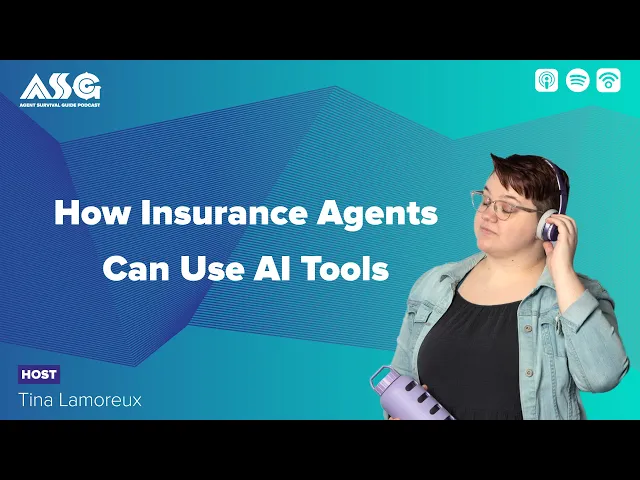
The Agent Survival Guide Podcast from Ritter Insurance Marketing on the practical pros and cons of AI tools for insurance agents.
Integrations: the difference between useful and decorative
A voice agent that answers beautifully and writes nothing back has moved the work, not removed it. Somebody still retypes the intake into the agency management system.
Ask three questions of any vendor. Can it write to your AMS or CRM, directly or through a documented API or automation layer? Can it read live calendar availability rather than proposing slots it cannot hold? Can it transfer a live call to a named person with the gathered context attached, and what happens when that person does not answer?
That last failure path matters more than the demo. A warm transfer that drops the caller when nobody picks up is worse than never transferring at all. For how the pieces fit together, see our overview of the AI voice platform and the phone agent itself.
What it costs against the alternatives
Three options, three cost shapes.
A part time receptionist is a salary plus payroll taxes, benefits and the cost of cover when they are ill or on holiday. Using the BLS median as the base, a full time equivalent sits near $38,000 before anything else. Coverage is business hours only and concurrency is one.
A traditional answering service is usually priced per call or per minute, with coverage around the clock and concurrency limited by how many operators are free. The operators are not licensed and typically take a message rather than a structured intake.
A voice agent is usually priced per minute or per bundle of minutes, with unlimited concurrency and the same script at 3am as at 3pm. The variable you control is call length, so a tight script is a cost lever, not just a quality one. Current rates are on the pricing page.
The honest caveat: none of these is free of human cost. Somebody has to write the prompt, test it, review transcripts weekly and fix what the agent gets wrong. Budget that time or the deployment decays.
What the research says, including the uncomfortable part
The strongest evidence for AI on a support line comes from a field study of 5,179 customer support agents by Brynjolfsson, Li and Raymond, published as NBER Working Paper 31161. Access to a generative AI assistant raised issues resolved per hour by 14% on average, with novice workers gaining 34% and experienced workers gaining almost nothing. The lesson for an agency is that AI compresses the gap between your newest CSR and your best one.
The counterweight is worth reading too. Gartner reported in February 2026 that only 20% of customer service leaders had actually reduced agent staffing because of AI, and predicted that by 2027, 50% of companies that attributed headcount reduction to AI will rehire. Gartner's Emily Potosky put it plainly: AI is not mature enough to fully replace the expertise, empathy and judgement human agents provide.
Read those two findings together and the agency conclusion is clear. Deploy the voice agent to absorb volume and create capacity, not to cut the team that handles the hard calls.

A vendor evaluation checklist for agency phone automation. Source: Callin.io.
A thirty day rollout that does not scare anyone
Week one: point only after hours and overflow calls at the agent. Nothing during business hours. Review every transcript daily and fix the script.
Week two: add document requests and routine service during business hours, keeping new business and claims with humans. Watch the transfer path specifically.
Week three: add quote intake and first notice of loss, with a hard escalation rule for anything involving injury or an urgent coverage question.
Week four: connect the write back to your AMS or CRM and stop the double entry. Only now is it worth looking at outbound, and only with consent records in place.
If you want an even smaller first step, start with missed call text back and prove the capture before you automate the conversation.
Metrics that matter
Answer rate flatters everyone and means nothing. A machine answering 100% of calls badly scores perfectly.
Track completed intakes per week, first notices of loss captured outside business hours, appointments booked that the client actually attended, transfer success rate, and the share of calls that reached resolution without a human. Then track the one that keeps you honest: complaints or callbacks specifically about the automated experience. If that number is rising, the script is wrong, regardless of what the dashboard says.
For the broader framing of what an agent does across industries, our main guide to the AI receptionist covers the fundamentals.
Frequently asked questions
How much does an AI receptionist cost for an insurance agency?
Most platforms price per minute or in minute bundles, so the real driver is average call length multiplied by monthly volume. Compare that against a receptionist salary, which the BLS puts at a $38,010 median for 2025, and against per call answering service pricing. Run your own numbers on three months of call records rather than trusting a generic ROI calculator.
Is an AI receptionist HIPAA compliant?
HIPAA certification does not exist as a thing a vendor can hold. What exists is a signed Business Associate Agreement plus documented controls. If your agency handles health or group benefits lines, ask for the BAA in writing before anything goes live, and ask where recordings and transcripts are stored and for how long.
Can an AI receptionist quote a policy?
It can collect everything needed to quote and it can read back a previously generated figure if your workflow allows. It should not present a premium as a commitment or recommend coverage, because that crosses into activity requiring a licence in most jurisdictions.
Will clients know they are talking to AI?
They should, and you should tell them in the opening line. Agencies that disclose clearly see far fewer complaints than agencies that let callers work it out. Transparency also makes the handoff to a human feel like a feature rather than a rescue.
What happens when the agent cannot handle a call?
It should transfer live with context, and if nobody answers, take a structured message and create a task rather than dropping the caller. Test this path before launch, because it is the one that generates complaints.
Does an AI receptionist replace my service team?
On current evidence, no. Gartner's data shows most organisations keeping headcount steady while serving more customers, and predicts widespread rehiring among those that cut too fast. Treat the agent as capacity for the routine 60% so your licensed people own the complex 40%.
Where to start
Pull your last ninety days of call records. Count the calls that went to voicemail, the ones that arrived outside business hours, and the ones that were a document request or a billing question. That number is your automation opportunity, and in most agencies it is larger and more boring than anyone expects.
Then run three test calls against any vendor you are considering: a deductible question, a certificate request, and a claim report. How the agent handles the first one, by declining to advise and handing off, tells you more than any demo.
If you want to hear what that sounds like on your own agency line, you can set one up and test it at callin.io.


