White Label AI Voice Agent: How It Works, What It Costs and How to Resell It
White label AI voice agents explained: how they work, who they are for, real reseller economics, questions to ask providers, risks and a launch plan.

A white label AI voice agent is an AI phone agent built on someone else's technology but sold, branded and delivered as your own. Your client sees your logo, your dashboard, your domain and your invoices. The provider behind it stays invisible and takes care of telephony, speech recognition, language models, synthetic voices and hosting.
For agencies, telecom resellers, managed service providers and software companies, this is one of the fastest ways to add AI voice to their offer without building a platform from scratch. As Crescendo's guide to white label AI agents puts it, the goal is support that feels like it comes directly from your own team. This article explains how white label voice agents work, who they are for, how the economics really look, what to check before you sign with a provider and which risks to manage.
Key takeaways
White label means the provider's technology under your brand, across calls, dashboards and billing.
The model fits agencies, MSPs, telecom resellers and SaaS companies that already own client relationships.
Technology is cheap at the margin; support and onboarding are what decide profitability.
Brand risk is yours: if the agent fails, your client blames you, not the provider.
What is a white label AI voice agent?
It is a voice agent that answers or makes phone calls for your clients, delivered on a platform you can fully rebrand. In practice you get a ready-made technology stack, a multi-client admin area and the right to set your own name, prices and plans. You sell the service; the provider runs the engine.
White label AI agents come in three main forms, according to Crescendo: chat agents embedded in websites and apps, voice agents for phone support and email agents that reply with your client's signature and tone. This guide focuses on voice, where the technical barrier is highest and the value for local businesses is most visible: every missed call is a missed customer.
How white label voice AI works
Think of it as three layers. At the bottom is the infrastructure: phone numbers and carriers, speech-to-text, the language model and text-to-speech. In the middle is the platform: agent builder, integrations, multi-tenant accounts, analytics and billing. On top is your brand: logo, colours, custom domain, client dashboard, pricing and support.
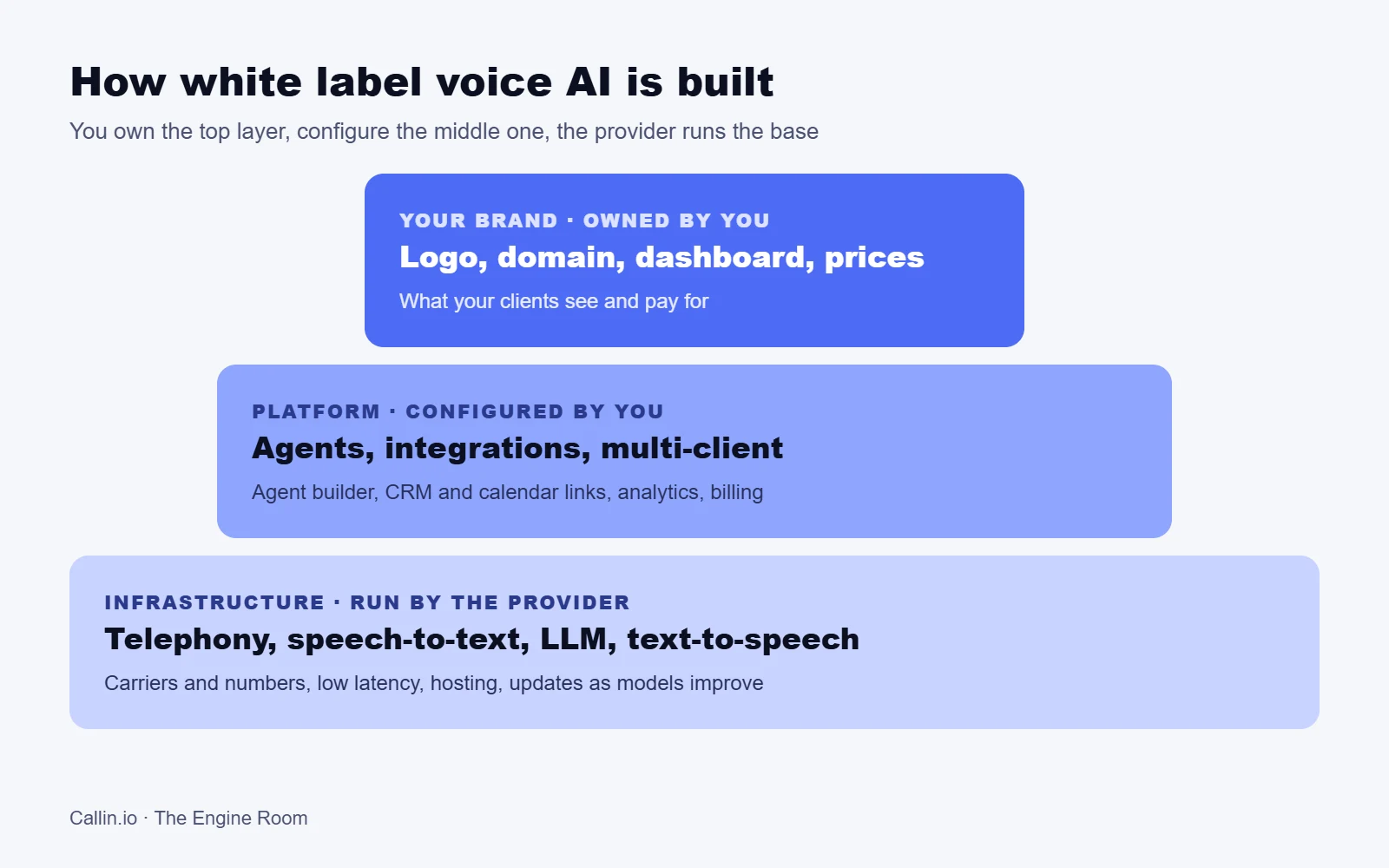
Infographic: Callin.io, The Engine Room
A good white label platform lets you control the top layer completely and configure the middle one, while the provider keeps the bottom layer fast, reliable and up to date. Response speed matters a lot on the phone: people usually reply to each other within about 200 milliseconds, as a cross-language study in PNAS showed, so latency is part of what you are reselling.
Who white label voice agents are for
Marketing and lead generation agencies that already manage campaigns and want to capture and qualify the calls those campaigns generate.
AI automation agencies that build workflows for clients and need a reliable voice layer.
MSPs and telecom resellers that sell phone systems and can add AI answering to existing lines.
SaaS companies and vertical software, such as CRMs for real estate or clinics, that want voice inside their own product.
Consultants and system integrators who deliver projects and want recurring revenue after the project ends.
What they have in common is an existing relationship with clients. White label works best when you sell into a market you already know, not when you start from zero.
Build, assemble or white label?
There are three ways to offer AI voice to clients. Building your own platform gives full control but needs a specialised engineering team, months of work and constant maintenance as models change. Assembling components, such as a voice API plus telephony plus a billing tool, is flexible but leaves you with several vendors, several invoices and the job of making them work together. White label gives you a complete platform from day one, with less control over the core technology.
For most agencies and resellers, white label is the right starting point. Your advantage is knowing the client's business, not writing speech pipelines. Many companies start white label and build their own components only where they see a real edge.
How the economics work
Voice AI is a usage-based cost with a service on top, so it pays to understand both parts.
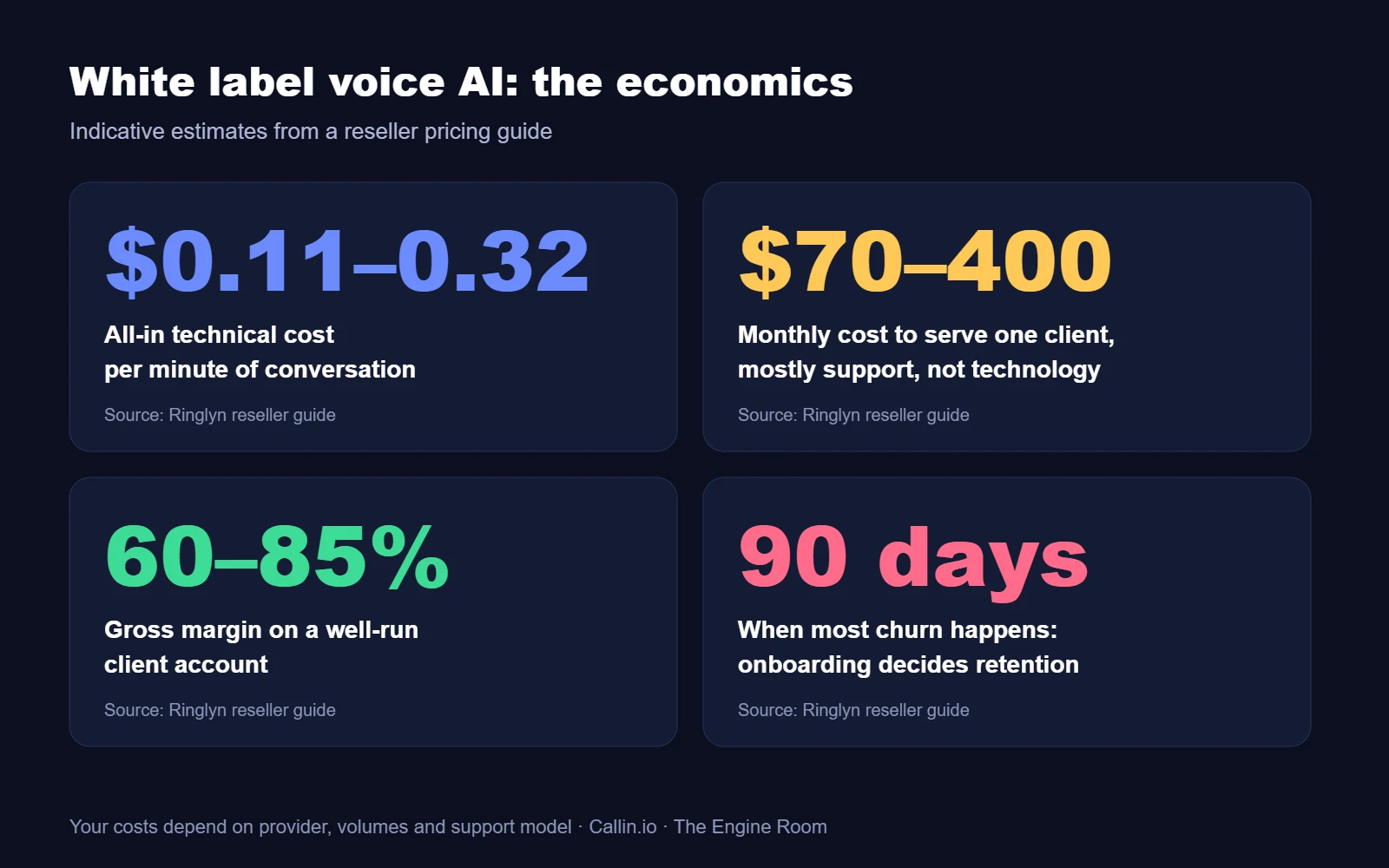
Infographic: Callin.io, The Engine Room. Estimates from Ringlyn's reseller pricing guide; your costs will vary
A reseller pricing guide by Ringlyn estimates the all-in technical cost at about $0.11 to $0.32 per minute, with text-to-speech as the most variable part. It puts the monthly cost to serve one client at roughly $70 to $400, and notes that support and account management, not technology, make up most of it. As the guide puts it, the software is nearly free at the margin; the human is expensive.
On the selling side, the same guide describes a common structure: a one-time setup fee to build the agent and connect the systems, then a monthly plan with included minutes and a clear overage rate. Plans are usually tiered by capability, for example after-hours answering, then full answering with booking and CRM sync, then multi-location and outbound campaigns. Clients understand "what the agent does" better than "how many minutes it uses". Our AI voice agent pricing guide explains the cost layers in detail.
Pricing by vertical: sell value, not minutes
The price a client accepts depends on what a captured call is worth to them. A missed call for a personal injury law firm or a car dealership can be worth thousands; for a hair salon, much less. That is why resellers price by vertical and by outcome: calls answered, appointments booked, leads qualified.
Speed of response is often the strongest selling point. A study published in the Harvard Business Review found that companies contacting leads within an hour were nearly seven times as likely to qualify them as those that waited longer. An AI agent that answers every call and calls back new leads in seconds turns that finding into a service you can sell.
What to check before choosing a provider
Demos all look good. The real differences appear when you run twenty clients on the platform. These are the questions that matter.
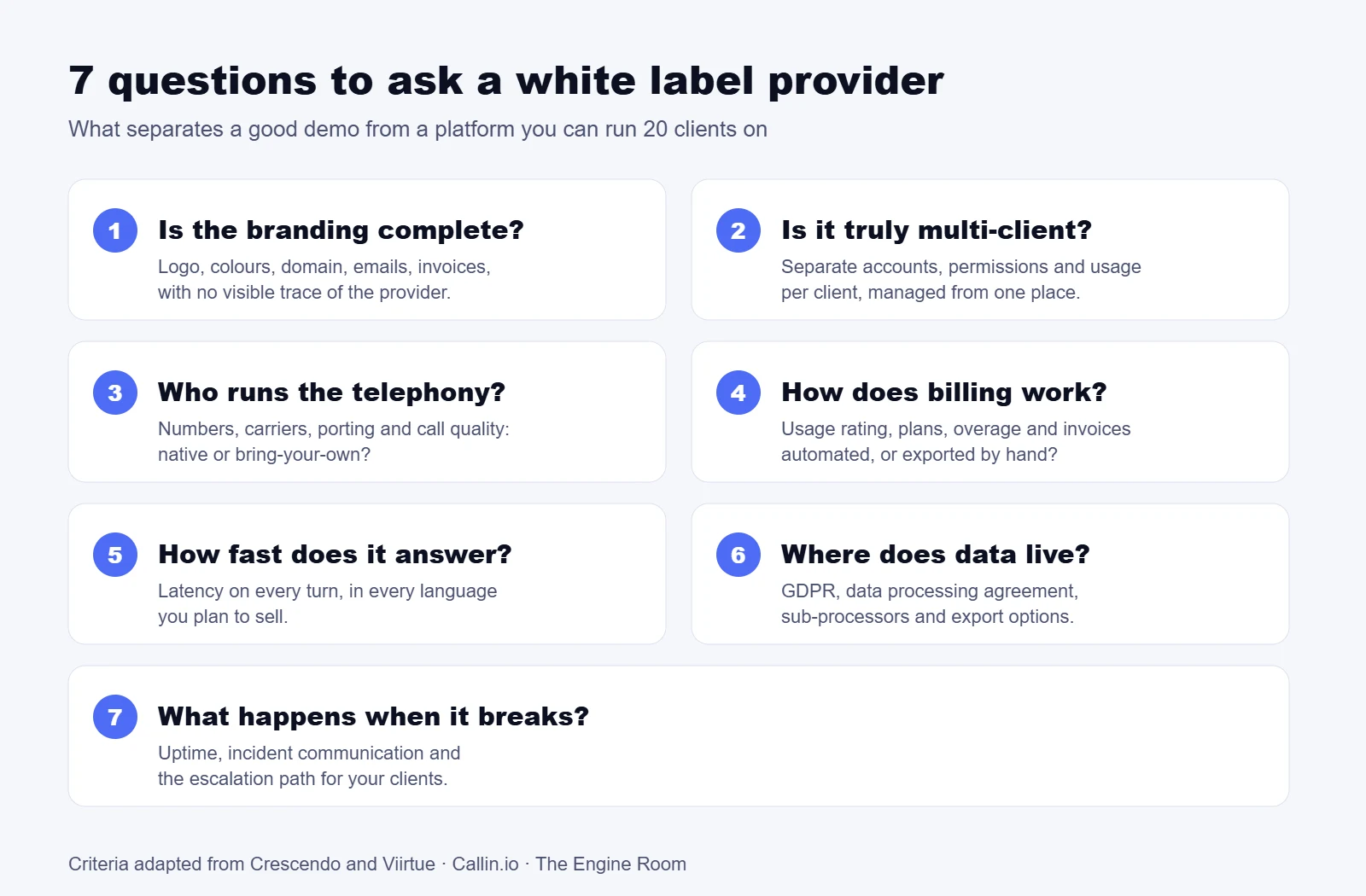
Infographic: Callin.io, The Engine Room. Criteria adapted from Crescendo and Viirtue
Crescendo stresses completeness of branding: logo, colours, domain, email signatures and no visible trace of the provider. Viirtue, which focuses on MSPs and telecom resellers, adds criteria that are often forgotten: multi-tenant management, native telephony, integrated billing and compliance, so you can run AI voice as a repeatable monthly service without stitching separate tools together. In Europe, add data protection: where calls and transcripts are stored, which sub-processors are involved and whether the provider signs a data processing agreement.

Photo: Jud Mackrill on Unsplash. For an agency, the value is the client relationship; the platform should stay invisible.
The risks nobody puts in the demo
Brand risk. With white label, there is no third party to blame. If the agent gives a wrong answer or sounds robotic, your client sees your name. Test every agent like a real customer before it goes live, and read our guide to LLM hallucinations to understand how to limit wrong answers.
Vendor dependency. Your whole service runs on one provider. Ask about uptime commitments, incident communication, how you can export agents, transcripts and client data, and what happens if the provider changes prices or closes.
Support scope creep. Clients expect you to fix everything, from a wrong greeting to their CRM. Define what each plan includes and how changes are billed, otherwise support eats the margin.
Compliance. In the EU you and your provider process personal data on behalf of your clients, so roles and contracts must be clear under the GDPR. Under Article 50 of the AI Act, callers must be told they are speaking with an AI unless it is obvious. Outbound campaigns also need a legal basis and respect for national opt-out rules. This is general information, not legal advice.
Security. Agents connected to calendars, CRMs or payment systems can be targeted by manipulation attempts. Limit what each agent can do and read about prompt injection before you connect sensitive actions.
How to launch your white label voice offer
Pick one vertical. Real estate, clinics, home services or legal: one market, one clear promise, one set of templates.
Build a reference agent. Script, knowledge base, transfer rules and integrations for that vertical. Follow our guide to prompting AI voice agents.
Define your plans. Setup fee, monthly tiers by capability, included minutes, overage rate and support limits.
Run two or three pilot clients. Measure calls answered, bookings and transfers, and turn the results into case studies.
Report every month. A branded report with calls answered, after-hours leads and appointments booked makes an invisible service visible, which is the best defence against churn.
Monitor in production. Most problems appear after launch, as we explain in AI voice agents in production.
Ringlyn's guide notes that churn is concentrated in the first 90 days. A disciplined onboarding and a first monthly report that shows results are the two things that keep clients after the trial period.
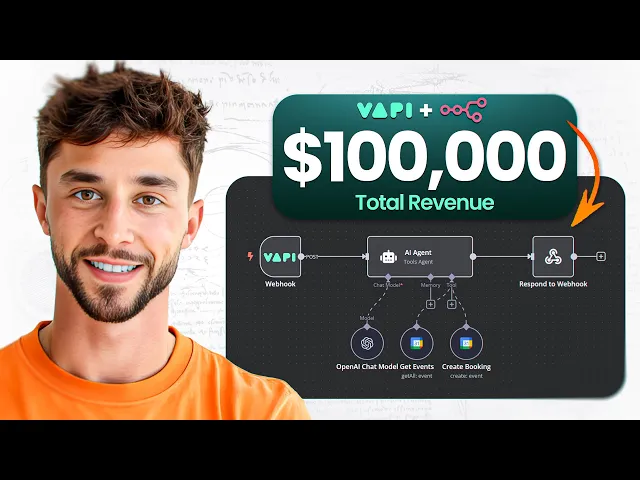
Watch: how to build a voice AI business
In this video Liam Ottley, founder of the AI agency Morningside AI, explains how he would build a voice AI business today: which niche to choose, how to package the offer and how to find the first clients. It is a useful complement to the numbers in this guide.
Frequently asked questions
What does white label mean for AI voice agents?
It means you resell a provider's voice AI under your own brand. Your clients see your name, dashboard and invoices, while the provider runs the technology in the background.
Do I need developers to resell voice agents?
Not necessarily. Most white label platforms offer no-code agent builders and templates. Technical skills help for integrations with CRMs and calendars, which is often where you add the most value.
How much can I charge clients?
It depends on the vertical and what a captured call is worth. Resellers typically combine a setup fee with a monthly plan tiered by capability, rather than selling minutes.
Can clients tell the agent comes from another company?
With complete white labeling, no. The domain, dashboard, emails and invoices carry your brand. The agent must still tell callers they are speaking with an AI, as required by the EU AI Act.
Who is responsible for GDPR compliance?
Responsibilities are shared along the chain: your client, you and the provider. Put data processing agreements in place at each step and check where data is stored.
Is white label better than building my own platform?
For most agencies and resellers, yes, at least at the start. It lets you sell in weeks instead of months and focus on clients rather than infrastructure.
The bottom line
A white label AI voice agent lets you turn client relationships into recurring revenue without building a voice platform. The technology is the easy part. The winners pick a niche, price by value, set clear support limits, report results every month and choose a provider they can trust with their brand.
Want to launch AI voice agents under your own brand? Discover the Callin.io white-label AI voice platform or try Callin.io for free.