AI Voice Platform: How to Choose One in 2026 (Architecture, Real Costs and 8 Platforms Compared)
What an AI voice platform is, how it works, what it really costs per minute and how 8 leading platforms compare, with a 6-point checklist to choose the right one.
An AI voice platform is the software layer that lets a business put an AI agent on a real phone line. It listens to the caller, understands the request, looks up the right data, takes an action and answers out loud, in a few hundred milliseconds. In 2026 the category has exploded: Market.us values the voice AI agents market at $2.4 billion in 2024 and projects $47.5 billion by 2034, a 34.8% annual growth rate.
Most "best platform" lists rank tools on a demo. This guide goes further. It explains how these platforms are built, why the advertised price is rarely what you pay, and which platform fits which kind of team. Full disclosure: Callin.io is a voice platform too, so we publish our evaluation criteria below, so you can check every claim yourself.
Key takeaways
Voice platforms fall into three families: developer toolkits, no-code builders and managed enterprise services. Pick the family first, then the vendor.
Latency is the make-or-break metric. Test it on a real phone line, not in a browser demo.
The per-minute price on the homepage usually covers only one layer. Add speech recognition, the language model, the voice and telephony to get the real cost.
In Europe, GDPR, data residency and the AI Act transparency rule belong in your first vendor call, not your last.
What is an AI voice platform?
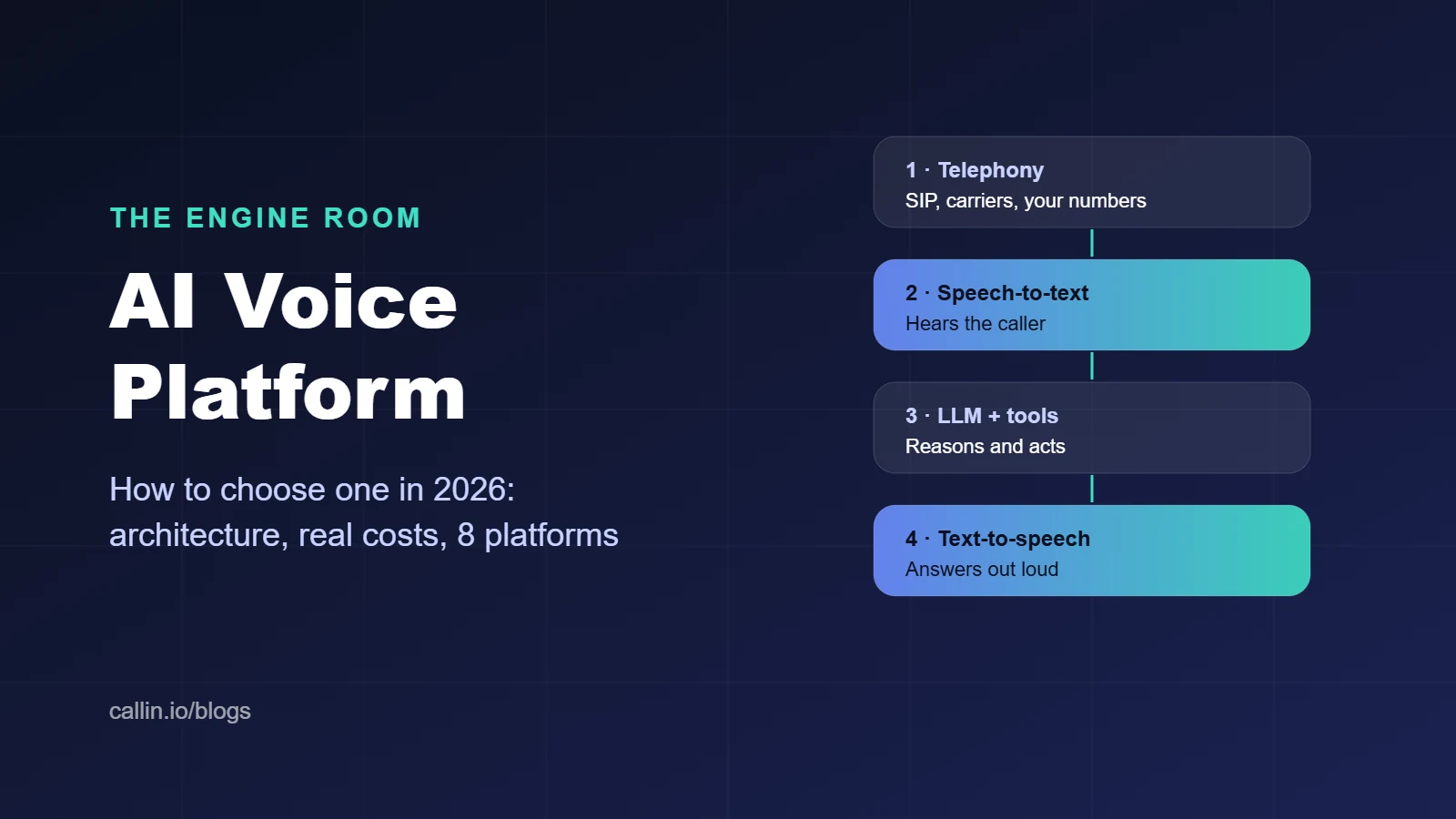
An AI voice platform combines several technologies into one service: telephony to receive and place calls, speech-to-text to transcribe the caller, a large language model to reason, text-to-speech to reply, and integrations to act on your systems. On top sit the tools you need to run it in production: a builder for prompts and flows, testing, analytics and call recordings.
The term is often confused with two neighbouring categories. An AI voice generator, such as a text-to-speech tool for videos or audiobooks, creates audio but does not hold a conversation. A contact center suite manages human agents and queues, and may add AI on top. A voice platform sits in between: its job is to run autonomous phone conversations that end with something done.
In practice, you will meet three families of platforms:
Developer toolkits give engineers full control over every component through APIs. Maximum flexibility, maximum responsibility.
No-code builders let operations teams design agents visually and go live in days. Faster to start, less room to customise.
Managed services design, deploy and operate the agents for you. Ideal for large contact centers, with longer projects and higher minimum budgets.
How an AI voice platform works under the hood
Almost every production platform today uses a cascaded architecture: speech-to-text, then the language model, then text-to-speech, each as a separate step. A newer approach, speech-to-speech, uses a single model that listens and speaks directly. Both can sound natural, but they behave very differently once you go live.
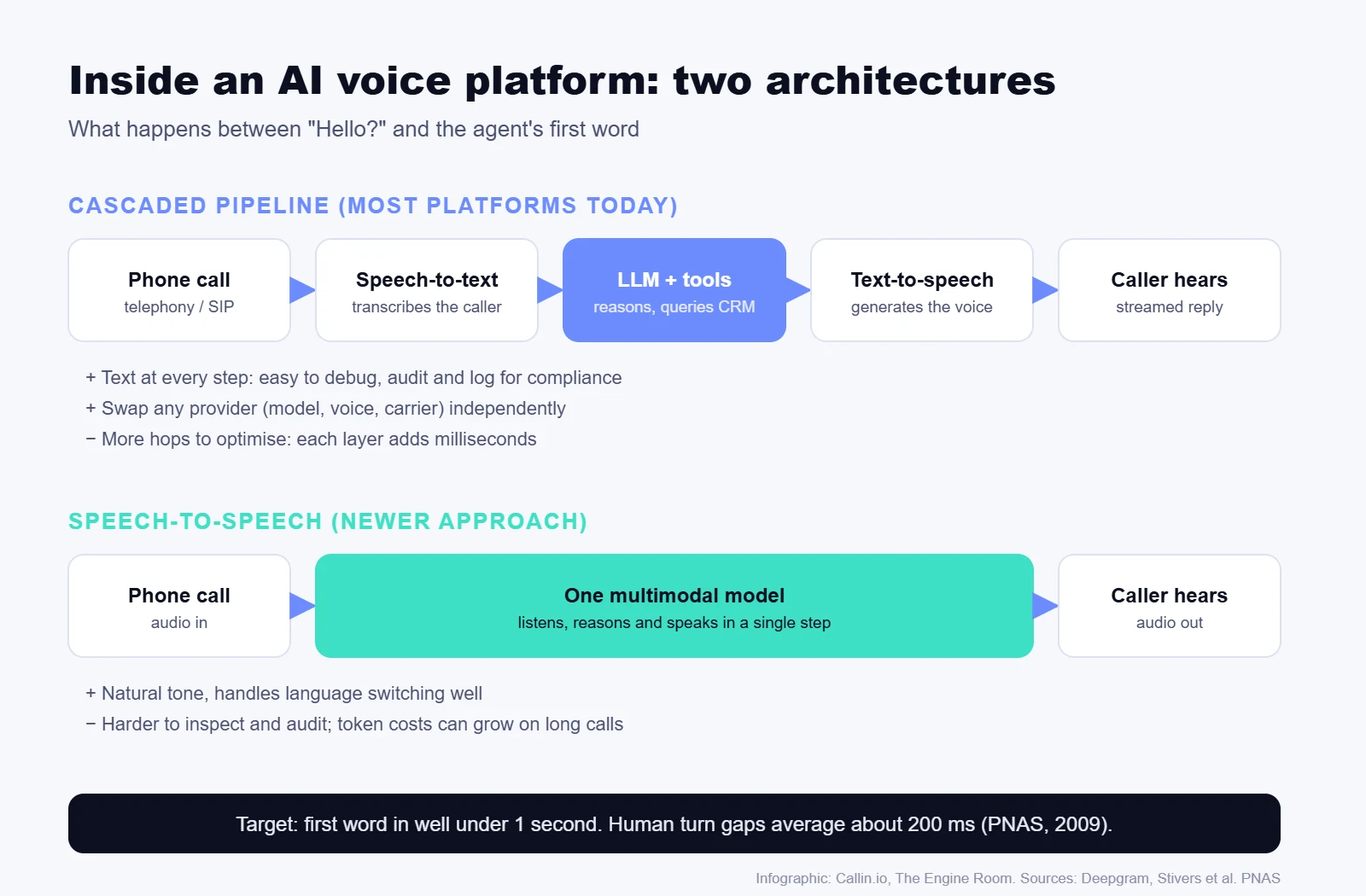
Infographic: Callin.io, The Engine Room. Architecture comparison based on Deepgram's analysis
As Deepgram explains, the cascaded model produces text at every step. That makes it easier to debug, to audit for compliance and to swap one provider for another. Speech-to-speech handles tone and language switching more naturally, but it is harder to inspect, and token-based pricing can grow quickly on long calls. Neither wins on latency by default: network hops, voice activity detection and codecs often matter more than the architecture itself.
Whatever the design, the goal is the same. Human conversation leaves only about 200 milliseconds between turns, according to a study published in PNAS. Every layer of the stack eats into that budget, which is why the best platforms stream audio and text between steps instead of waiting for each one to finish. We covered the engineering tricks in how to reduce perceived latency in voice agents.
How to evaluate an AI voice platform: 6 criteria
Retell AI's own ranking, one of the most complete on the web, tests five dimensions: latency, telephony flexibility, production readiness, compliance and total cost. We agree with all five and add a sixth that European buyers cannot skip.
Latency under real conditions. Measure time to first word on a mobile line at peak hours. Anything that regularly goes past one second feels broken to callers.
Telephony freedom. Can you bring your own numbers and carrier through SIP, or are you locked into one provider?
Production readiness. Interruptions, silences, background noise, callers who change their mind. Test off-script, not just the happy path.
Observability. Transcripts, recordings, analytics, alerts and the ability to stop an agent instantly. Our article on voice agents in production explains why this decides most projects.
True cost per resolved call. Include every layer, plus setup and maintenance time.
European compliance. GDPR, a data processing agreement, EU data residency, call recording consent and, since August 2026, the AI Act transparency obligation to tell callers they are talking to an AI.
8 AI voice platforms compared
The platforms below appear most often in 2026 shortlists. Prices change frequently, so treat them as a starting point and always ask for a quote based on your own call volumes.
Retell AI: balanced all-rounder
Retell combines a visual builder with a full API, supports several language models and voices, and handles interruptions well. Its pricing page starts at $0.07 per minute for the voice infrastructure, while a typical setup with a mid-range model and telephony adds up to around $0.13 per minute. A good fit for support teams that want speed without giving up control.
Vapi: maximum flexibility for developers
Vapi lets engineers pick and swap every component: transcription, model, voice and carrier. According to Vapi's pricing, the platform fee is $0.05 per minute, with providers passed through at cost. That transparency is welcome, but the final bill depends on the stack you assemble, and you need developers to maintain it.
Bland AI: high-volume outbound
Bland focuses on API-driven calling at scale, with deep control over outbound campaigns. It suits technical teams running large call volumes. Plan for developer time, since configuration happens mostly in code.
ElevenLabs Agents: best-in-class voices
ElevenLabs built its reputation on expressive, human-sounding speech in dozens of languages, and now offers a conversational agents product on top. It is the natural choice when voice quality and brand identity come first. Check telephony options and concurrency limits for large deployments.
Synthflow: no-code for small teams
Synthflow lets non-technical teams build an appointment-booking agent in an afternoon, with many ready-made integrations. The trade-off is less control over the underlying models and more effort when conversations leave the script.
PolyAI: managed service for large contact centers
PolyAI designs, deploys and runs voice agents for enterprises, with strong results on transactional calls and deep contact center integrations. Expect an enterprise contract, a project of several weeks and less freedom to change things yourself.
Cognigy by NICE: omnichannel orchestration
Cognigy powers voice, chat and messaging from a single flow and connects to the major contact center suites. NICE completed its acquisition of Cognigy in September 2025, so it now fits most naturally inside the NICE ecosystem.
Callin.io: enterprise-grade and white-label, built in Europe
Callin.io is our platform, so read this with that in mind. It targets SMEs and enterprises that need production reliability, GDPR by design and the option to resell agents under their own brand. It supports multiple carriers and SIP trunks, native CRM and calendar integrations, and a white-label AI voice platform for agencies and SaaS companies. In our own cost analysis, an outbound call to a European mobile costs about $0.09 to $0.10 per minute all-in.

Photo: Vitaly Gariev on Unsplash
The real cost of an AI voice platform
The most common surprise in voice AI is the invoice. A platform that advertises $0.05 per minute can end up costing three times as much once you add every component. The chart below shows how the layers stack up in a typical cascaded setup.
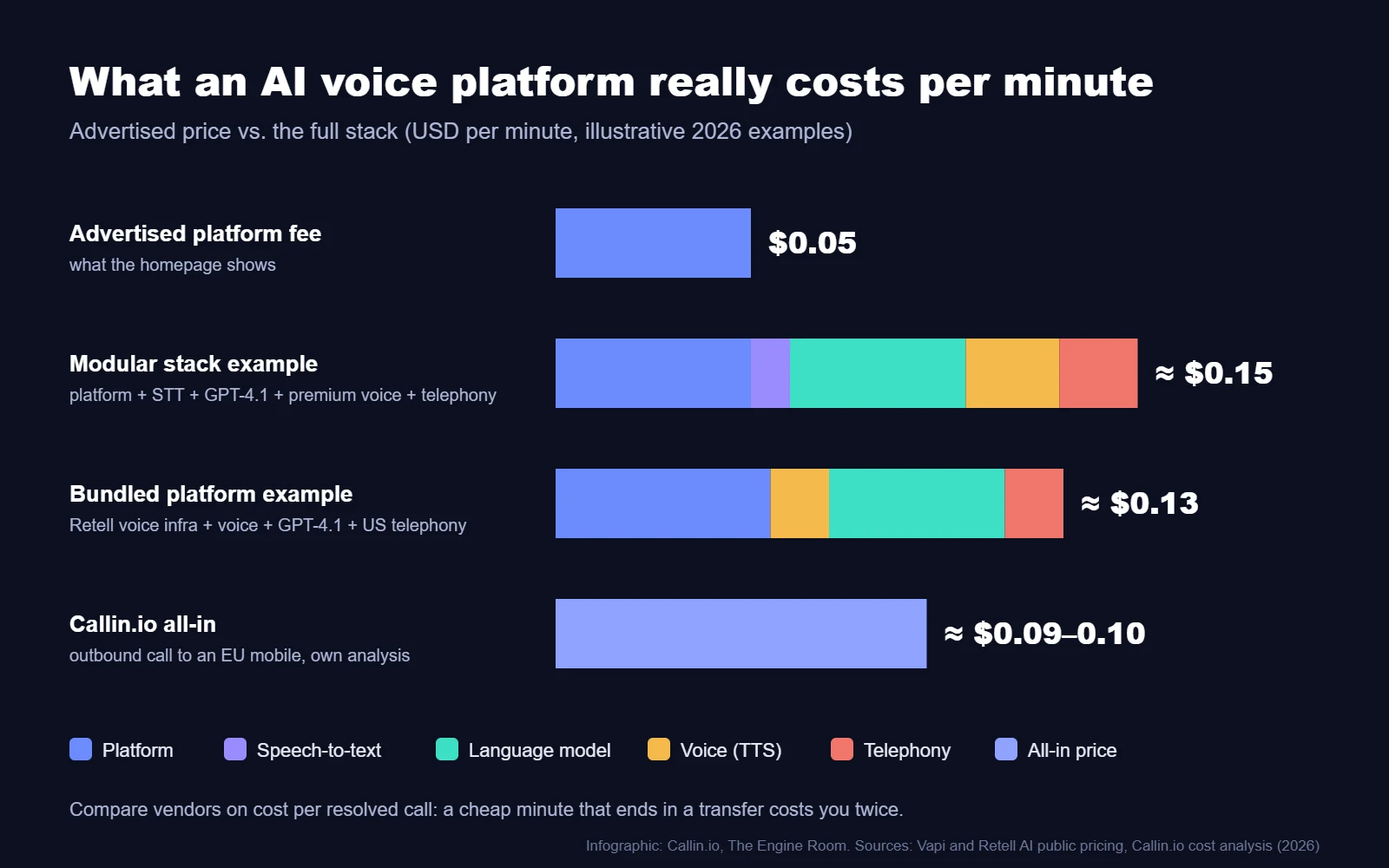
Infographic: Callin.io, The Engine Room. Figures from Retell AI and Vapi public pricing and Callin.io's cost analysis (2026)
Two more costs rarely appear in comparisons. The first is engineering time: a modular stack needs someone to monitor providers, update prompts and fix integrations. The second is failed calls: an agent that transfers half its calls to humans costs you twice. That is why the only number worth comparing is the cost per resolved call.
Which platform fits your team?
Instead of asking which platform is best, ask which family matches your resources. The matrix below sums up the choice.
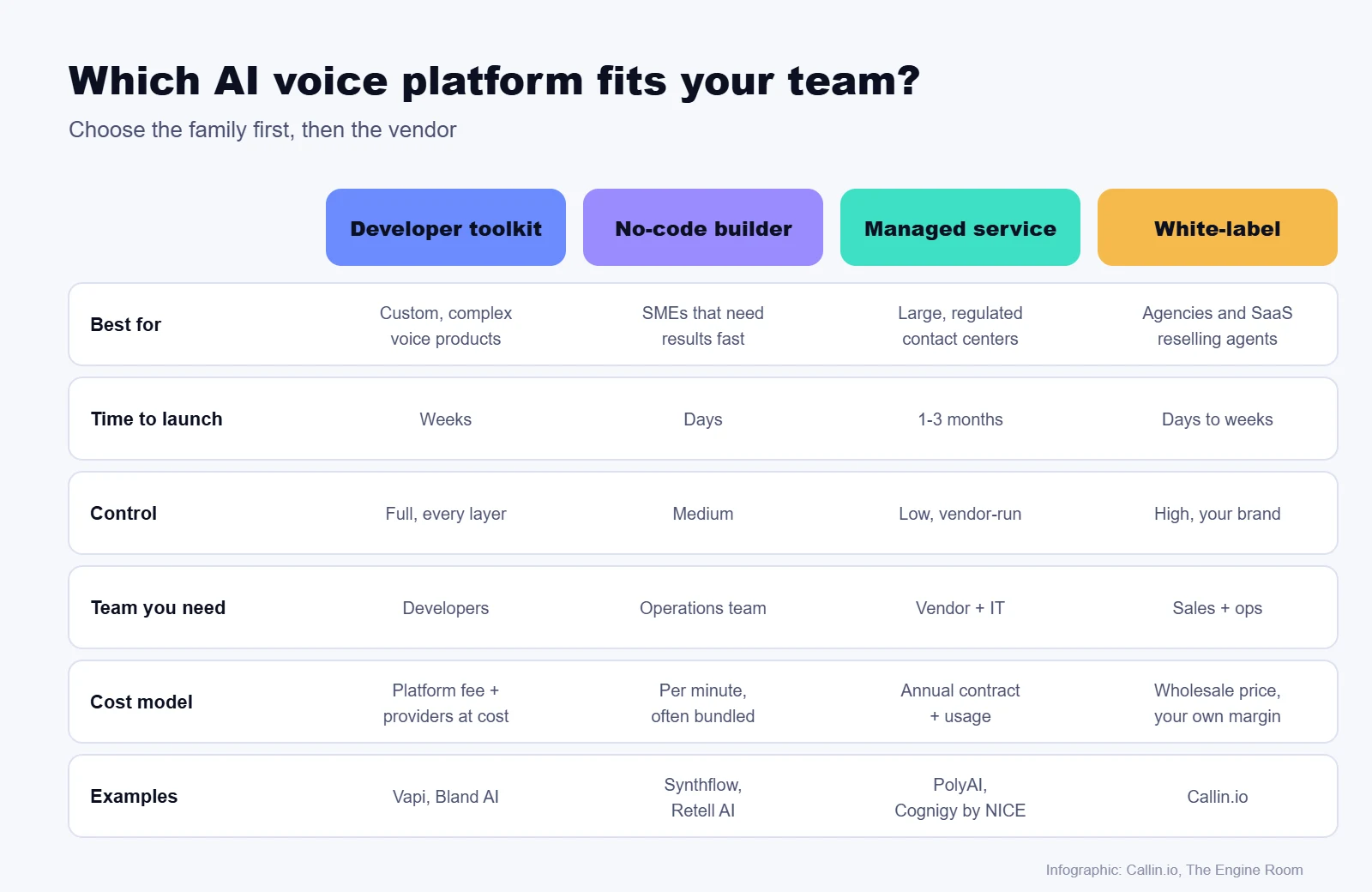
Infographic: Callin.io, The Engine Room
If you have a strong engineering team and unusual requirements, a developer toolkit gives you the most freedom. If you need results this month and have no developers, a no-code builder is the fastest path. If you run a large, regulated contact center, a managed service reduces risk. And if you want to sell voice agents to your own clients, look for true white-label features: custom domains, your branding and your own pricing.
Limits you should know before you sign
Customers still value people. A 2026 Metrigy study found that 84.7% of consumers prefer a human agent, while many accept AI for routing, order updates and bookings. Design your agent for those tasks and make the transfer to a person effortless.
Language models can invent answers. On the phone there is no screen to double-check, so a confident mistake is costly. Ground every answer in verified data, as we explain in our article on LLM hallucinations, and protect sensitive actions against prompt injection.
Voice needs its own prompting. Long lists, links and complex numbers work in chat but fail when spoken. Our guide to prompting AI voice agents covers the rules that make agents sound natural.
Watch: real-time voice agents, explained
This short video from Google Cloud Tech walks through the building blocks of a real-time voice agent. It is a useful primer before your first vendor demo.
Frequently asked questions
What is the difference between an AI voice platform and an AI voice generator?
A voice generator turns text into audio, for videos or narration. A voice platform runs full phone conversations: it listens, understands, acts on your systems and replies in real time.
How much does an AI voice platform cost per minute?
All-in costs usually range from about $0.09 to $0.30 per minute, depending on the language model, the voice, the carrier and the call direction. Always ask for a quote that includes every layer.
What latency is acceptable for a phone agent?
Aim for a response that starts well under one second, measured on a real phone line. Human conversation leaves about 200 milliseconds between turns, so every saved millisecond makes the agent feel more natural.
Can I keep my existing phone numbers?
Usually yes, if the platform supports SIP trunking or your current carrier. Ask about number porting and call transfer to your existing team before you commit.
Is an AI voice platform GDPR compliant?
It depends on the vendor. Ask for a data processing agreement, where data is stored, how long recordings are kept and how the platform informs callers that they are speaking with an AI.
The bottom line
The best AI voice platform is the one that matches your team, your volumes and your regulatory context. Test latency on a real line, calculate the cost per resolved call and check compliance before you look at voices and features. The rest is configuration.
Want to hear a production-grade agent on a real call? Try Callin.io for free or explore our white-label AI voice platform.