AI Receptionist for Real Estate: Never Miss a Buyer Call
AI receptionist for real estate answers every buyer and seller call around the clock, qualifies leads, books showings and routes them to the right agent.
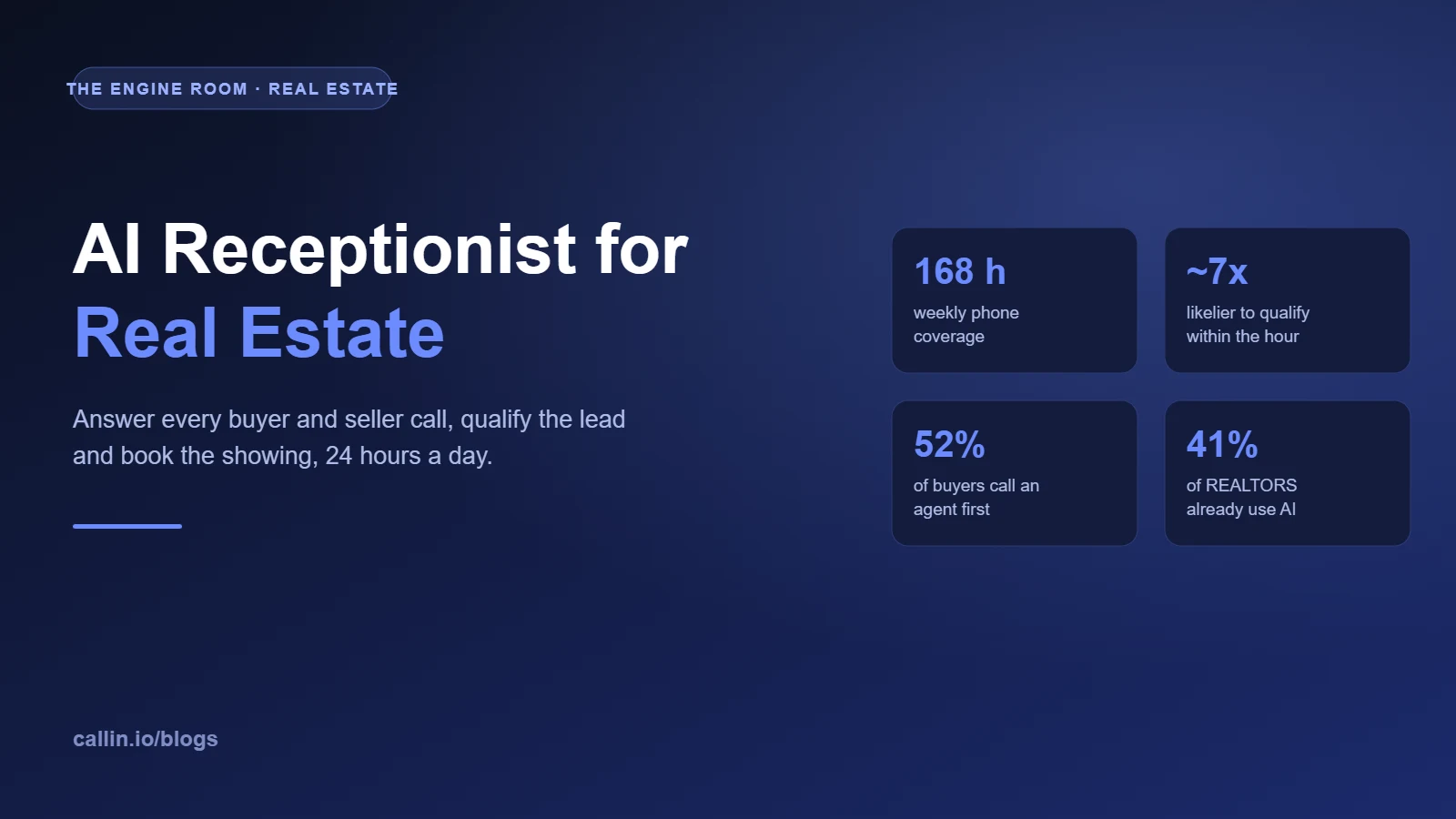
A buyer scrolls a listing at 9:40 in the evening, taps the number on the sign, and gets a voicemail greeting. Ten seconds later that same buyer taps the next agent in the search results. Nothing dramatic happened. A lead simply moved to whoever picked up.
That is the gap an AI receptionist for real estate is built to close. It answers the phone on the first ring, at any hour, asks the questions a good front desk would ask, books the showing, and drops a clean summary into your CRM before you have finished dinner.
This guide covers what the technology does well, where it breaks, what it costs, and how to roll it out across a brokerage without annoying the people you are trying to win.
Key takeaways
An AI receptionist answers every buyer and seller call around the clock, so inquiries never land in an unchecked voicemail box.
Speed matters more than polish: firms contacting a lead within the hour were nearly seven times likelier to qualify it, according to Harvard Business Review research.
Qualification logic, not voice quality, is what separates a useful system from an expensive novelty.
Calendar booking and automated confirmations cut no shows on showings and valuations.
Costs sit far below a salaried front desk, and capacity scales with listing volume instead of headcount.
Consent, recording disclosure and a clean human handoff are non negotiable parts of the setup.
What an AI receptionist for real estate actually does
An AI receptionist is a voice system that picks up your business line, understands what the caller wants in natural speech, and completes a task rather than just taking a message.
In a real estate context that usually means four jobs. It identifies whether the caller is a buyer, a seller, a tenant or a vendor. It answers questions about a specific listing. It captures contact details and intent. It books something in a calendar, or routes the call to a person.
The difference from an old phone tree is that nobody presses 1 for sales. The caller says "I'm calling about the townhouse on Maple, is it still available", and the system answers from your live listing data.
If you are new to the category, our primer on what an AI receptionist is and how it works covers the mechanics in more depth.
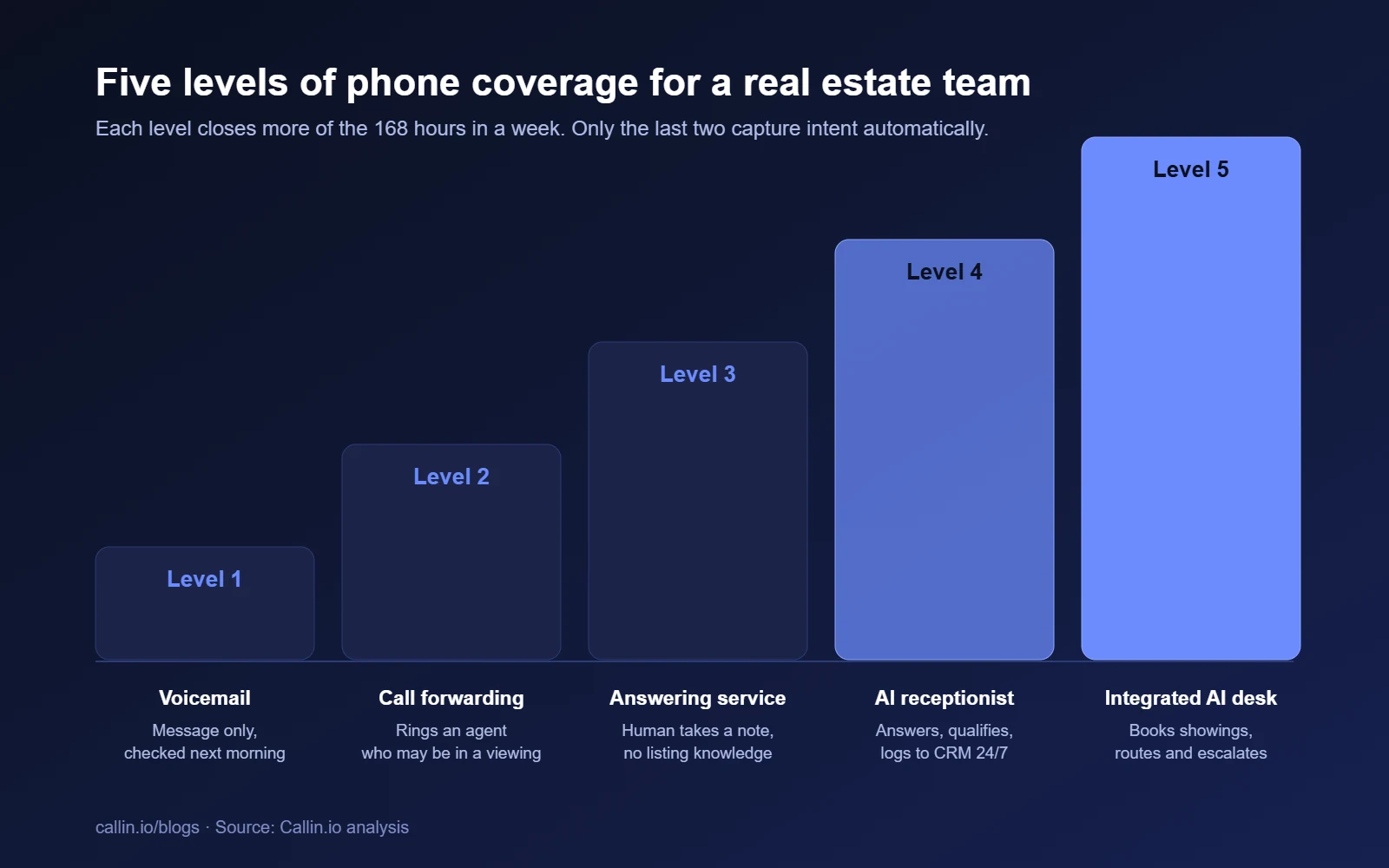
Five levels of phone coverage for a real estate team, from voicemail to a fully integrated AI front desk. Source: Callin.io.
Why the first five minutes decide who gets the listing
Real estate is one of the few industries where the prize goes to whoever answers first, not whoever is best.
Harvard Business Review research by James Oldroyd, Kristina McElheran and David Elkington audited 2,241 US companies and then analysed 1.25 million sales leads. Firms that tried to reach a prospect within an hour of the inquiry were nearly seven times as likely to qualify that lead as firms that waited one hour longer, and more than sixty times as likely as those that waited a day. The average first response time among companies that replied at all within thirty days was 42 hours.
Now layer on how buyers behave. Zillow's 2025 Consumer Housing Trends Report found that contacting a real estate agent was the single most common first step in the buying journey, named by 52% of buyers, and that 80% of buyers listed it among their first three actions.
So the call is the front door. If it goes unanswered, the rest of your marketing spend is heating an empty room.
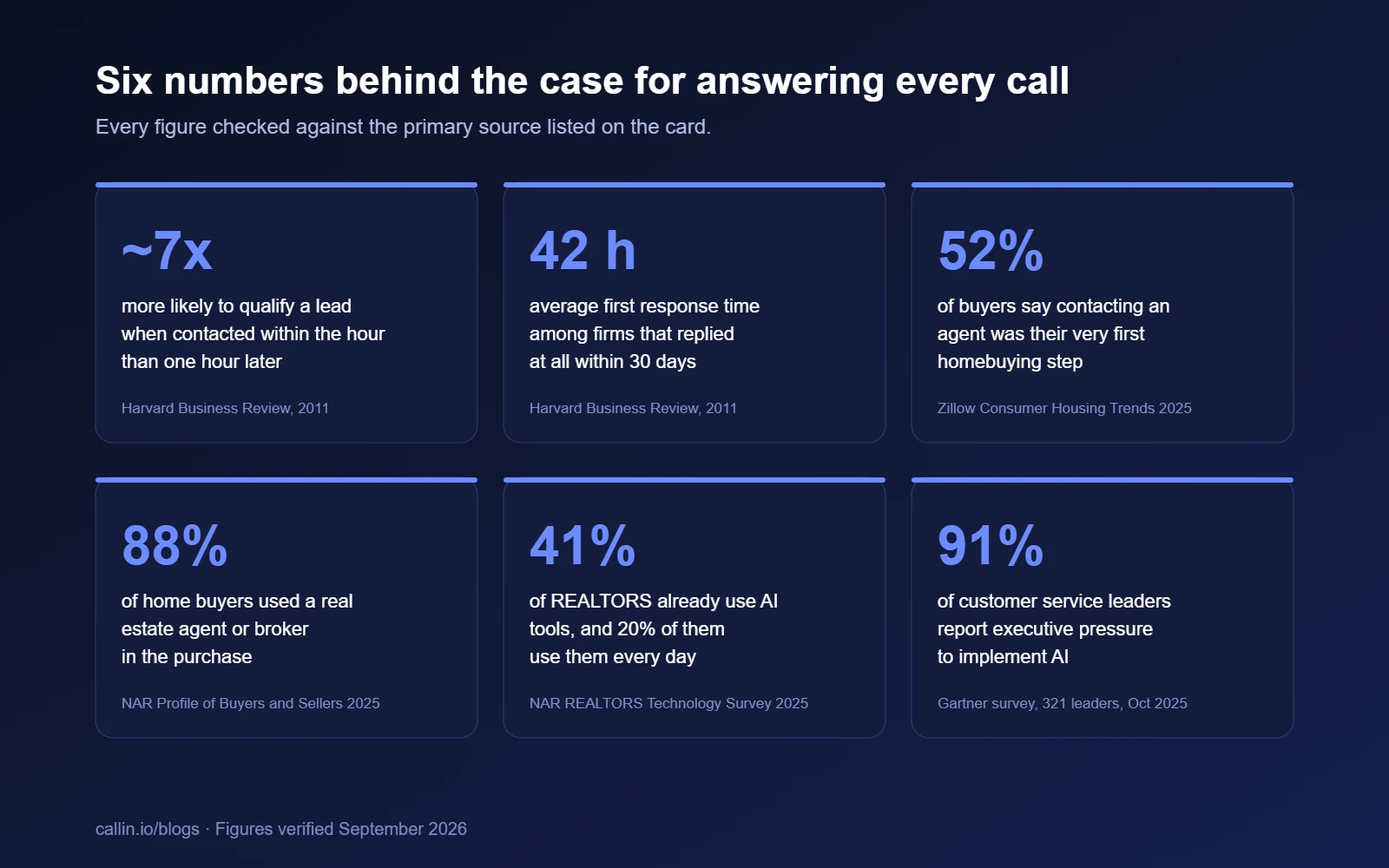
Verified figures on response speed and agent contact. Sources: Harvard Business Review (2011), Zillow Consumer Housing Trends Report 2025, National Association of REALTORS 2025 reports.
Read the original Harvard Business Review write up and Zillow's buyer research if you want the full methodology.
Answering around the clock without adding headcount
Property searches do not respect office hours. People browse listings on the train, after the kids are asleep, and on Sunday mornings when your office is shut.
A human front desk covers roughly forty hours a week. There are 168 hours in a week. That leaves 128 hours where your phone number is decoration.
An AI receptionist covers the whole 168. It also handles simultaneous calls, which matters on the day a new listing goes live and eleven people ring within twenty minutes.
What it does out of hours is not just message taking. It can confirm whether a property is under offer, share the asking price and square footage, explain your viewing policy, and book a Saturday slot on the spot.

The inquiry that arrives after hours is still an inquiry. Photo by Jon Tyson on Unsplash.
Qualifying buyers and sellers before the call ends
Volume is not the goal. A hundred captured calls that all need re-screening by a human is just a slower voicemail.
The useful version asks the questions that separate a serious prospect from a browser: timeline, financing status, whether they have a property to sell first, which neighbourhoods they are actually considering, and whether they are already working with an agent.
Practitioners in the r/AIReceptionists community who have shipped these systems for agents make the same point repeatedly: the qualifying logic mattered more than the conversation quality. A slightly stiff voice that asks the right five questions beats a beautiful voice that collects a name and a callback number.
Scoring follows naturally. A caller who is pre approved, selling nothing, and wants to view this weekend is not the same lead as someone six months out. Your agents should see that difference before they open the CRM.
The same qualification pattern applies well beyond sales calls. See how it works in voice AI for customer service.
Booking showings and valuations straight into your calendar
Scheduling is where the time actually goes. Three messages to agree a Tuesday slot, one to confirm, one when the buyer forgets.
An AI receptionist connected to your calendar checks live availability, offers two or three real slots, books the one the caller picks, and sends a confirmation. It respects travel time between viewings if you set that rule, and it blocks double bookings because it is reading the same calendar you are.
Automated reminders the day before are the unglamorous part that pays for the whole system. No shows on viewings waste an agent's afternoon and a vendor's patience.
For listing appraisals the same flow works in reverse: the system captures the address, the reason for selling and the timeline, then books a valuation visit with whichever agent covers that postcode.
Our guide to AI appointment scheduling goes deeper on calendar rules, buffers and cancellation handling.
NewsNation looks at how AI is reshaping the home buying experience and where human agents still matter. Source: NewsNation on YouTube.
Routing, escalation and the human handoff
Not every call should be finished by software, and a system that pretends otherwise will cost you relationships.
Good routing sends the caller to the right person the first time. A question about a specific listing goes to the listing agent. A tenant with a leak goes to property management. A vendor chasing an invoice goes to accounts.
Escalation rules matter just as much. Define the triggers: an angry caller, a legal question, an offer being made, a repeat caller who has already spoken to the AI twice. Those go to a human immediately, with the transcript already attached so nobody has to start over.
Out of hours, escalation usually means a warm summary rather than a live transfer. The call is handled, the urgency is flagged, and the agent wakes up to context instead of a voicemail beep.
Call data is the quiet bonus here. Patterns in what callers ask show you which portals send serious buyers and which send tyre kickers. Platforms like AI call center software expose that data as reporting rather than guesswork.
Phone, text and web chat in one system
Buyers do not commit to one channel. The same person calls about a listing on Monday, texts a question on Wednesday, and uses the website chat on Friday.
Running three disconnected tools means three versions of the same lead and three chances to repeat a question the prospect already answered.
A single system that handles voice, SMS and web chat keeps one thread per contact. The agent who finally picks up the conversation sees everything that came before, including the property the caller asked about at midnight.
Text is particularly useful in real estate because links travel well: floor plans, virtual tours, energy certificates and directions to a viewing all land better as a message than as a spoken address.
Making the AI sound like your brokerage
A boutique agency selling period homes and a high volume rental operation should not sound the same on the phone.
Customisation runs on three layers. The voice and pace. The script, meaning which questions get asked and in what order. And the knowledge, meaning what the system actually knows about your listings, your areas and your fees.
The knowledge layer is the one most teams underinvest in. If the system cannot say whether the apartment has a lift or what the service charge is, callers notice immediately and trust evaporates.
Multi office groups and franchises usually want their own branding on the whole thing, which is what a white label AI voice agent setup is designed for. The Callin.io voice platform supports that structure directly.
What actually breaks, according to people running these systems
The marketing pages rarely mention failure modes. The practitioner threads do, and they are consistent.
Speech recognition on proper nouns is the first problem. Street names, surnames and email addresses are where transcription goes wrong, and a mistyped email address is a lead you never contact again. Fix it with confirmation prompts and spelling readback for anything you will use later.
Background noise is the second. Callers ring from cars, building sites and windy pavements. Test your system under those conditions before you judge it on a quiet office call.
Over scoping is the third. Teams that ask the AI to handle everything on day one end up with a system that handles nothing well. Start with after hours and overflow, prove it, then expand.
The fourth is a silent one: nobody reads the transcripts. A system left unreviewed for three months drifts away from how your market actually talks. Budget an hour a week for someone to read calls and adjust.
Consent, recording and the compliance basics
Answering inbound calls with an AI receptionist is low risk. Using the same technology to dial out is a different regulatory question entirely.
In the United States, the Telephone Consumer Protection Act restricts artificial and prerecorded voice calls, and since 2012 telemarketers need prior express written consent before placing them, plus an automated opt out mechanism during each call. The FCC overview of telemarketing and robocall rules is the primary reference.
Recording rules vary by state and country, so disclose recording at the start of the call and store transcripts under the same policy you apply to any other client data.
Disclosure is also a trust issue rather than only a legal one. Telling callers they are speaking with a virtual assistant, and offering a person on request, consistently performs better than pretending. This is not legal advice, and brokerages should confirm requirements with their own counsel.
Costs, scaling and a 30 day rollout plan
A salaried receptionist carries wages, payroll taxes, holiday cover, training and a desk. An AI receptionist is typically a monthly subscription plus usage, and it does not take December off.
The scaling maths is the real argument. Listing volume in real estate is lumpy. A human front desk sized for your busiest week is idle most of the year, and one sized for an average week collapses when a development launches.
Pricing models differ, so compare on cost per handled call rather than headline monthly fee. Our pricing page shows how minute based plans work in practice.
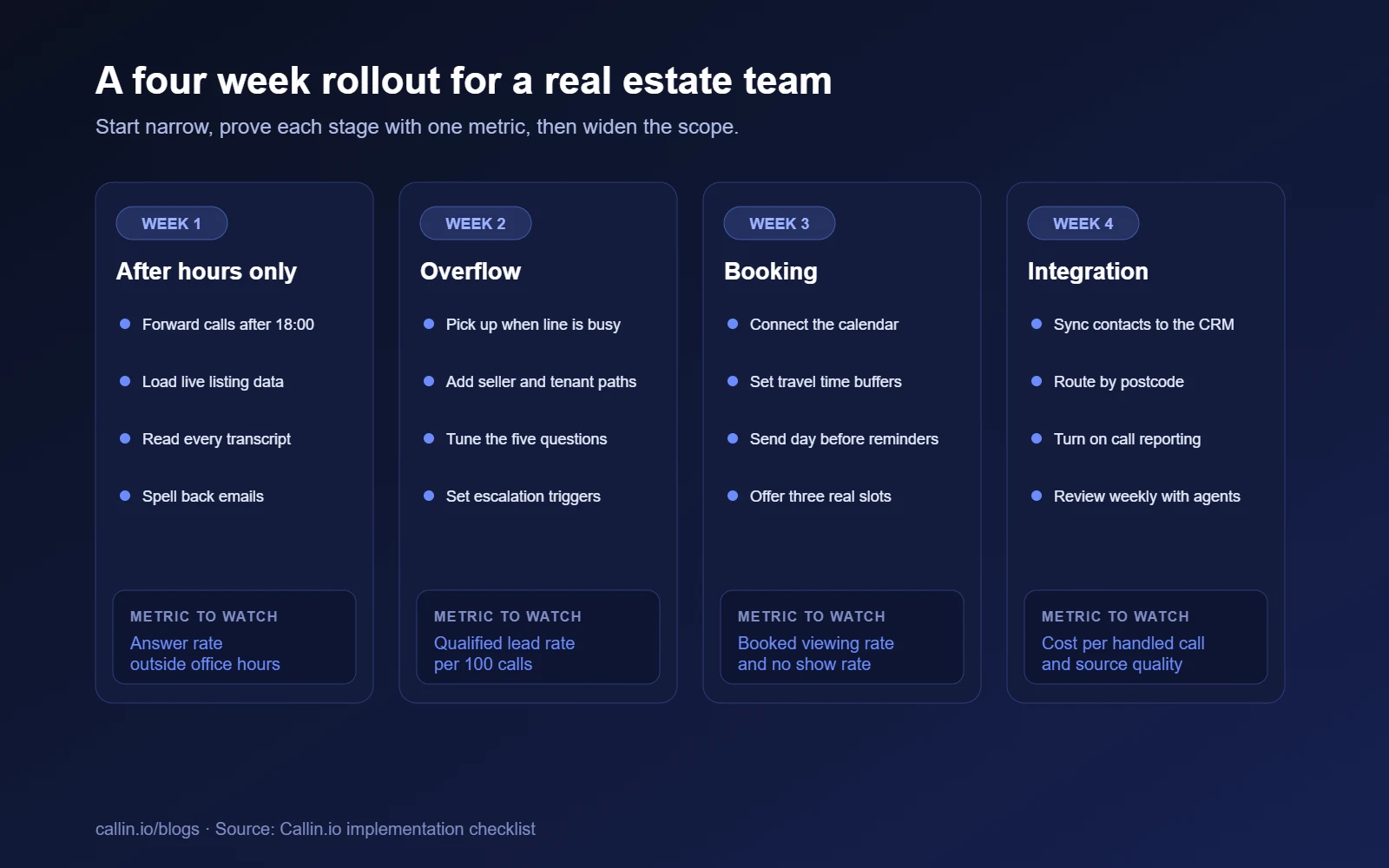
A four week rollout checklist for a real estate team, with the metric to watch at each stage. Source: Callin.io.
A sensible rollout looks like this. Week one, point the AI at after hours calls only and read every transcript. Week two, add overflow during business hours when the line is busy. Week three, switch on calendar booking for viewings. Week four, connect the CRM and turn on reporting.
Track four numbers: answer rate, qualified lead rate, booked viewing rate, and no show rate. If answer rate goes up while qualified lead rate falls, your script is capturing noise rather than intent.
Agencies with a lettings arm should look at property management call handling, where after hours maintenance calls follow a different logic, and at IT support call handling for back office coverage.
Frequently asked questions
Does an AI receptionist work for a solo agent, or only for large brokerages?
It arguably works better for solo agents, because a solo agent has nobody covering the phone during a viewing. The system answers while you are inside a property, captures the inquiry, and books the next appointment without interrupting the client in front of you.
Will callers know they are talking to a machine?
Most will work it out, and that is fine. Modern voice systems handle interruptions and natural speech well, but the goal is competence rather than deception. Disclose it, keep the conversation short, and offer a person when the caller asks.
Can it answer questions about specific properties?
Yes, provided you connect it to live listing data. Without that connection it can only take messages. With it, the system can confirm availability, price, size and viewing times, which is what most inbound callers ring about.
What happens when a caller asks something it cannot answer?
It should say so plainly and hand off, either by transferring live during office hours or by flagging an urgent callback out of hours. A system that invents an answer about a property is worse than no system at all.
How long does setup take?
A basic after hours configuration can run within a day. A full deployment with listing data, calendar booking, CRM sync and routing rules across several offices is realistically two to four weeks, most of which is data and process work rather than technology.
Is AI adoption in real estate actually happening, or is it hype?
The National Association of REALTORS 2025 Technology Survey found 41% of REALTORS already using AI tools, with 20% using them daily. Separately, a Gartner survey of 321 customer service leaders in October 2025 found 91% reporting executive pressure to implement AI. Adoption is real; the differentiator is execution.
The bottom line
An AI receptionist for real estate does not replace an agent. It replaces the voicemail box that was quietly losing you business at 9:40 on a Tuesday evening.
The agencies getting value from it are not the ones with the most impressive voice. They are the ones who wrote sharp qualifying questions, connected the calendar, disclosed the technology honestly, and read the transcripts every week.
Start narrow, measure four numbers, and expand only when the data says to.
If you want to see how this works on your own listings and your own phone number, explore the Callin.io AI phone agent or start building at callin.io.
Sources: Harvard Business Review, The Short Life of Online Sales Leads; Zillow Consumer Housing Trends Report 2025; NAR Profile of Home Buyers and Sellers; NAR 2025 REALTORS Technology Survey; Gartner customer service survey; FCC, Telemarketing and Robocalls.