AI Receptionist for Law Firms: Intake That Never Sleeps
AI receptionist for law firms: answer every call, run compliant intake and book consultations 24/7, without adding headcount to your front desk.
A prospective client with a real case calls your firm at 7:40 in the evening. Nobody picks up. They do not leave a voicemail. Ninety seconds later they are on the phone with the firm listed below yours on Google.
That scenario is not a sales story. It is the most repeatable finding in legal marketing research, and it is the reason an AI receptionist for law firms has moved from novelty to line item in the operations budget.
Key takeaways
Most firms are unreachable by phone more often than they think, and the gap has widened since 2019.
An AI receptionist is an intake layer, not a lawyer. It collects, routes and books. It never advises.
Confidentiality duties reach prospective clients too, from the first ring, not from the engagement letter.
Disclosure that the caller is speaking with an AI system is becoming a legal requirement in the EU, not a courtesy.
The measurable win is speed to first response, not headcount reduction.

Maturity levels for legal phone intake, from simple answering to triage with attorney escalation. Source: Callin.io.
Why law firms lose revenue to calls nobody answers
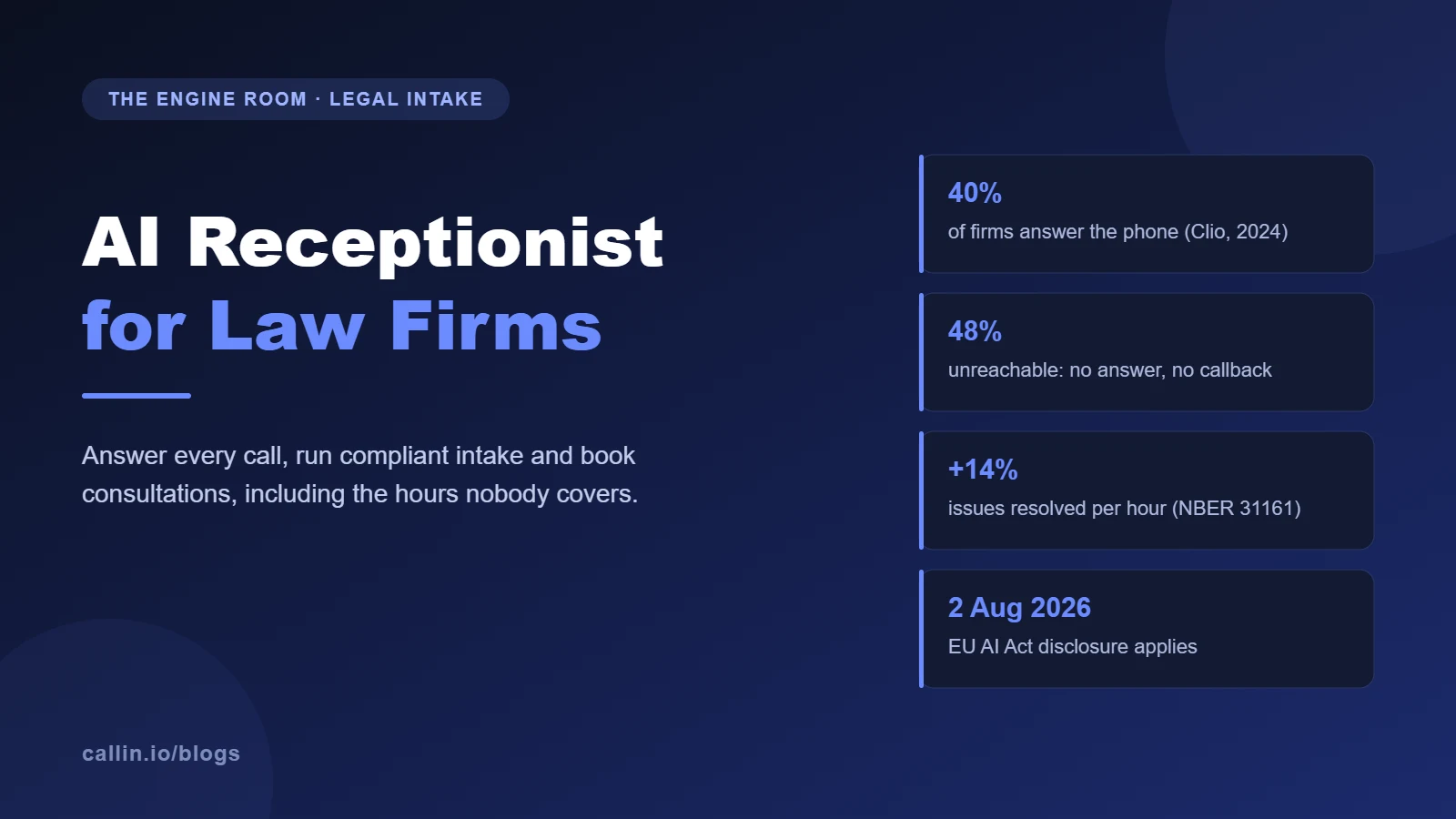
Clio ran a secret shopper study in 2024, contacting 500 firms by phone and email with realistic client inquiries. Only 40 percent of firms answered the phone, down from 56 percent in the same exercise in 2019.
Worse, 48 percent of firms were effectively unreachable by phone: no answer, and no callback either. Email did not compensate. Just 33 percent replied to the email inquiry, down from 40 percent five years earlier.
The economics are unforgiving in contingency practice areas. A single personal injury or employment matter that walks to a competitor can be worth more than a year of front desk salary.
For reference, the U.S. Bureau of Labor Statistics puts the median pay for receptionists at 38,010 dollars a year, or 18.27 dollars an hour. One lost case usually dwarfs that number, and the front desk still cannot cover nights, weekends and holidays.
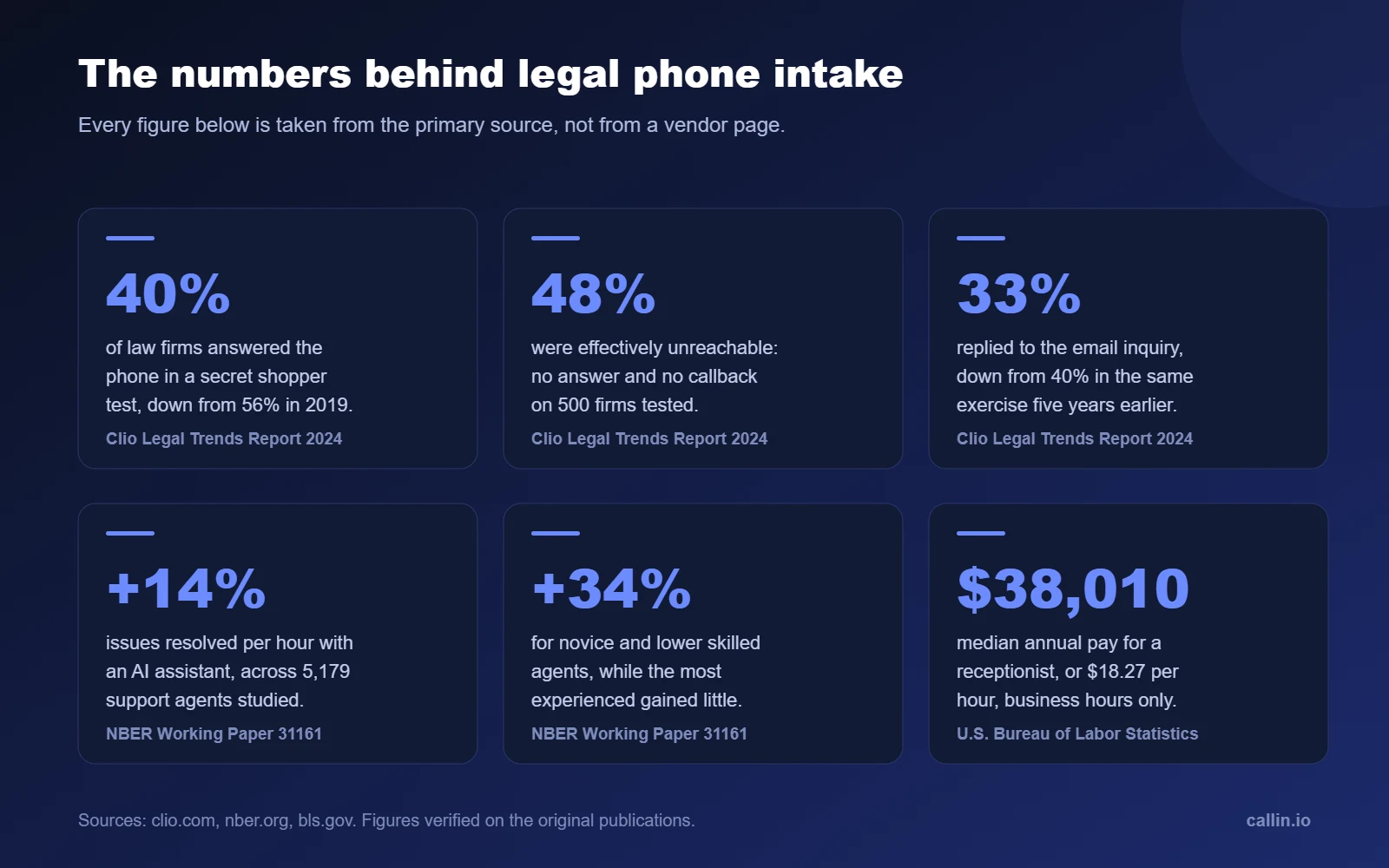
Verified figures on firm responsiveness, AI productivity effects and front desk cost. Sources: Clio Legal Trends Report 2024, NBER Working Paper 31161, U.S. Bureau of Labor Statistics.
What an AI receptionist for law firms actually does
Strip away the marketing and the job is narrow. The system answers on the first or second ring, identifies why the person is calling, collects a defined set of facts, and then does one of three things: books a consultation, transfers to a human, or creates a task with a full transcript.
A well built AI phone agent handles that entire sequence in a single conversation, in the caller's language, without a menu tree.
The practical value sits in three places: coverage outside office hours, consistency of the questions asked, and speed of the handoff to the person who can actually help.
AI receptionist, answering service or voicemail
Voicemail is the weakest option. Callers with an urgent legal problem tend to hang up and dial the next number rather than record a message, and a voicemail that sits until morning has already lost the race.
Human answering services solve coverage but bring their own friction. On r/LawFirm, solo practitioners describe a real lift in retention after a live service started asking intake questions and booking directly into the calendar, which is a useful benchmark for what good intake is worth.
AI sits in the middle. It is always available, it asks the same questions every time, and it costs the same on a Tuesday afternoon as it does on Christmas Eve. It is weaker than a skilled human on emotionally charged calls, which is exactly why escalation rules matter more than voice quality.
Most firms end up hybrid: AI answers everything, humans take anything flagged as urgent, distressed or high value. We covered the same pattern for other regulated verticals in our guide to the AI receptionist and in our breakdown of AI answering services.
The intake fields that actually matter
Generic intake scripts are where most deployments quietly fail. A family law call and a commercial dispute call need different questions, and a single script serving both collects nothing useful.
Build the script per practice area. At minimum, every call should capture the caller's full name, best callback number, the county or jurisdiction, a one line description of the problem, and the date the problem occurred.
Add the fields that decide whether you can take the matter at all: opposing party names for the conflict check, any court date already scheduled, whether the caller has already retained another firm, and how they found you.
The opposing party question is the one firms forget to automate, and it is the one that saves the most wasted attorney time. A conflict flagged at 8 p.m. by the intake system is a conflict you do not discover in a consultation three days later.
Structured capture also feeds everything downstream. Once the data lands in your practice management system as fields rather than a free text note, follow up sequences and AI appointment scheduling can run without anyone retyping anything.
Urgency triage: the calls that cannot wait
Some legal calls have a clock on them. An arrest in progress, a restraining order hearing tomorrow, a statute of limitations expiring this week, a workplace injury that happened an hour ago.
Define those triggers in writing before launch. For each one, name the attorney who gets called, the maximum minutes allowed before escalation, and the minimum facts the AI must collect before transferring.
Then decide what happens when that attorney does not pick up. A triage rule without a fallback is a triage rule that fails on the night it matters.
Routing logic of this kind is where conversational IVR outperforms a press one, press two menu: the caller describes the emergency in their own words, and the system routes on meaning rather than on a keypress.

Intake is the first hour of the client relationship, long before anything gets signed. Photo: Vitaly Gariev on Unsplash.
Ethics, confidentiality and the duty that starts on the first ring
Two points trip up firms that treat the phone as a marketing channel rather than a professional responsibility surface.
First, ABA Model Rule 1.6(c) requires a lawyer to make reasonable efforts to prevent the inadvertent or unauthorized disclosure of information relating to the representation of a client. Handing call recordings to a vendor with vague data terms is not a reasonable effort.
Second, Model Rule 1.18 extends protection to prospective clients. The caller who never signs anything still shared facts under a duty of confidentiality. Your intake stack inherits that duty from the moment the line connects.
In July 2024 the ABA issued Formal Opinion 512, its first ethics guidance on generative AI, covering competence, confidentiality, client communication and fees. It is short, readable, and worth putting in front of every attorney in the firm before you configure anything.
So before you sign with any vendor, get written answers on whether call content is used to train shared models, how customer data is separated, what encryption is applied in transit and at rest, how long recordings and transcripts are retained, who at the vendor can access them, and which subprocessors are involved.
Ask for the audit log too. If you cannot reconstruct who listened to a prospective client's call and when, you cannot demonstrate reasonable efforts to anyone who asks.
Disclosure is now a legal requirement, not a nicety
Firms with EU clients or EU operations have a second layer to handle. Article 50 of the EU AI Act requires providers to design AI systems that interact directly with people so that those people are informed they are interacting with an AI system.
Those transparency obligations apply from 2 August 2026. In practice it means a short, clear line at the start of the call rather than a disclaimer buried in a privacy policy.
There is a practical benefit hiding inside the compliance requirement. Callers told upfront that they are speaking with an assistant tend to adjust: they speak in shorter sentences, they answer the questions asked, and the transcript that reaches your attorney is cleaner.
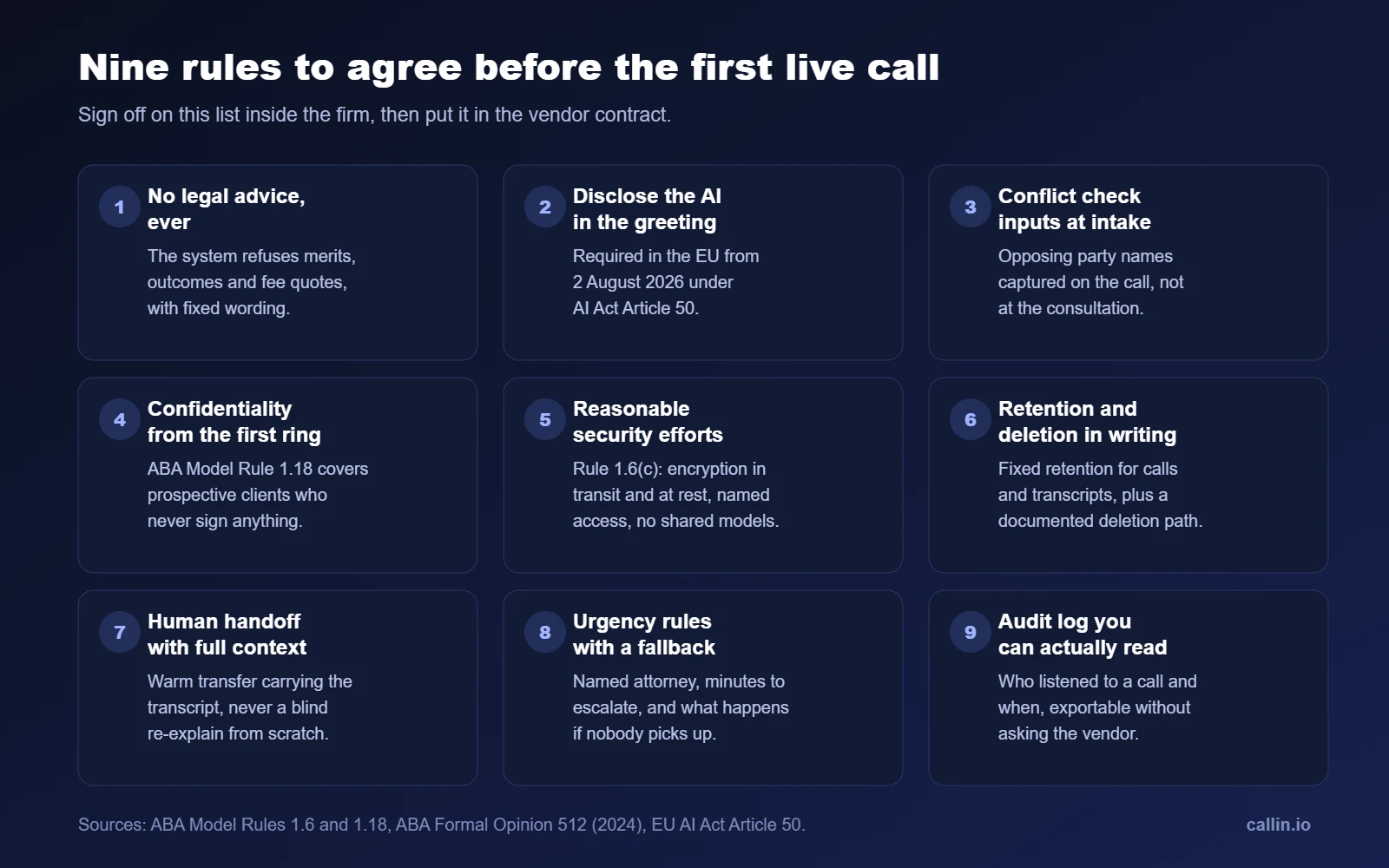
Configuration and compliance checklist to agree with the firm before the first live call. Sources: ABA Model Rules 1.6 and 1.18, ABA Formal Opinion 512, EU AI Act Article 50.
What lawyers themselves say about it
The objection worth taking seriously does not come from vendors. It comes from practitioners.
In a widely read r/Ask_Lawyers thread on whether lawyers would let AI take their calls, the sharpest reply argued that replacing a law firm receptionist is an endgame rather than a starting point, in an era when the most famous AI systems still invent case citations. The stakes in a legal intake call, the argument goes, are not the stakes of booking a haircut.
That criticism lands, and it points to the right deployment order. Start with after hours only. Let the system prove itself on the calls that currently go to voicemail, where the alternative is nothing at all.
The other recurring worry across those discussions and LinkedIn threads from intake managers is caller reaction. Some prospective clients do resist an automated voice. The fix is a fast, visible path to a human, not a more convincing robot.
What the research says about AI and support work
The most useful evidence does not come from legal tech at all. It comes from a study of 5,179 customer support agents by Brynjolfsson, Li and Raymond, published as NBER Working Paper 31161.
Access to an AI conversational assistant raised issues resolved per hour by 14 percent on average. The distribution matters more than the average: novice and lower skilled workers gained 34 percent, while the most experienced agents gained close to nothing.
Translated to a law firm, that is a strong argument against the headcount narrative. AI lifts the floor of your intake quality. It does not replace the person who is already excellent at calming a frightened caller.
How to test before a real client hears it
Write the approved script first: greeting, AI disclosure, the questions by practice area, the topics the system must refuse, and the exact wording used to hand off to a human.
Then attack it. Call in and refuse to give your last name. Change subject halfway. Ask directly whether you have a case, which the system must decline to answer. Mumble a street name. Ask for a lawyer by name who does not work there.
Read every transcript from the pilot, not a sample. Two weeks of full review costs a few hours and catches the configuration errors that a dashboard average will hide for months.
Run the pilot on evenings and weekends for thirty days before touching daytime calls. Our notes on running AI voice agents in production cover the failure modes that only appear under real traffic.
Metrics that prove it is working
Answered call rate is the vanity metric. It goes to 100 percent on day one and tells you nothing.
Track speed to first human contact, consultations actually booked, the share of transcripts an attorney judged complete enough to act on, escalation accuracy on urgent triggers, and conflicts caught at intake rather than at consultation.
Then compare the cost against the alternative you were actually going to buy. Our breakdown of AI voice agent pricing and the Callin.io pricing page give the per minute maths in full.
Lawyerist Podcast episode 607: host Stephanie Everett and legal industry analyst Jordan Furlong on how AI shifts lawyers from producing work toward supervising systems and exercising judgment. Source: Lawyerist.com on YouTube.
Frequently asked questions
How much does an AI receptionist cost?
Pricing usually runs either as a flat monthly plan or per minute of conversation. Compare it against the fully loaded cost of coverage you would otherwise buy, including overflow fees and the hours your paralegals spend on calls that are not billable.
Is an AI receptionist a good idea for a law firm?
It is a good idea for the hours you currently do not cover, and for structured, repeatable intake. It is a poor idea as a wholesale replacement for a skilled human on emotionally difficult calls.
Can an AI receptionist complete legal intake on its own?
It can complete the data collection portion: identity, jurisdiction, facts, deadlines, conflict inputs and scheduling. Case assessment, fee quotes and any form of legal advice must stay with a licensed attorney.
Do we have to tell callers they are speaking to an AI?
In the EU, Article 50 of the AI Act requires people to be informed they are interacting with an AI system, applicable from 2 August 2026. Outside the EU, disclosure is still the safer practice and it usually improves transcript quality.
What is the difference between an answering service and an AI receptionist?
An answering service takes messages and passes them on. A receptionist, human or AI, runs a defined process: qualifies, books, routes and updates your systems. Judge vendors on what they do, not on the label.
Will it integrate with our practice management software?
Depth varies a great deal. Ask for a live demonstration that creates a contact and a matter with populated fields, not a Zapier screenshot. Our AI voice platform page lists the integration approach in detail.
Where to start
Pick the narrowest possible first deployment: one practice area, after hours only, with a written script and a named attorney on the escalation path.
Run it for thirty days, read every transcript, and measure speed to first human contact rather than call volume. If it does not shorten that number, the configuration is wrong, not the technology.
The firms winning this are not the ones with the best voice. They are the ones answering while everyone else is unreachable.
If you want to see what that looks like on your own numbers, start at callin.io and build the intake script for a single practice area first.