AI in Healthcare in 2027
AI in healthcare has moved from pilots to infrastructure: voice agents, clinical documentation, drug discovery, and what the EU AI Act now requires.
On 7 January 2026, OpenAI announced ChatGPT Health, a version of the assistant that connects to a person's lab results, visit summaries and clinical history, plus data from apps like Apple Health. By July it had rolled out to adults across the United States.
It is not available in the European Economic Area, Switzerland or the United Kingdom.
That one detail tells you most of what you need to know about where healthcare AI stands going into 2027. The technology is real and shipping. The regulatory ground it lands on is not the same everywhere, and Europe is deliberately a different country.
This piece looks at what is actually working, what the rules actually require, what the money is actually funding, and what any of it means for a clinic in Milan, Madrid or Manchester rather than Mountain View.
Key takeaways
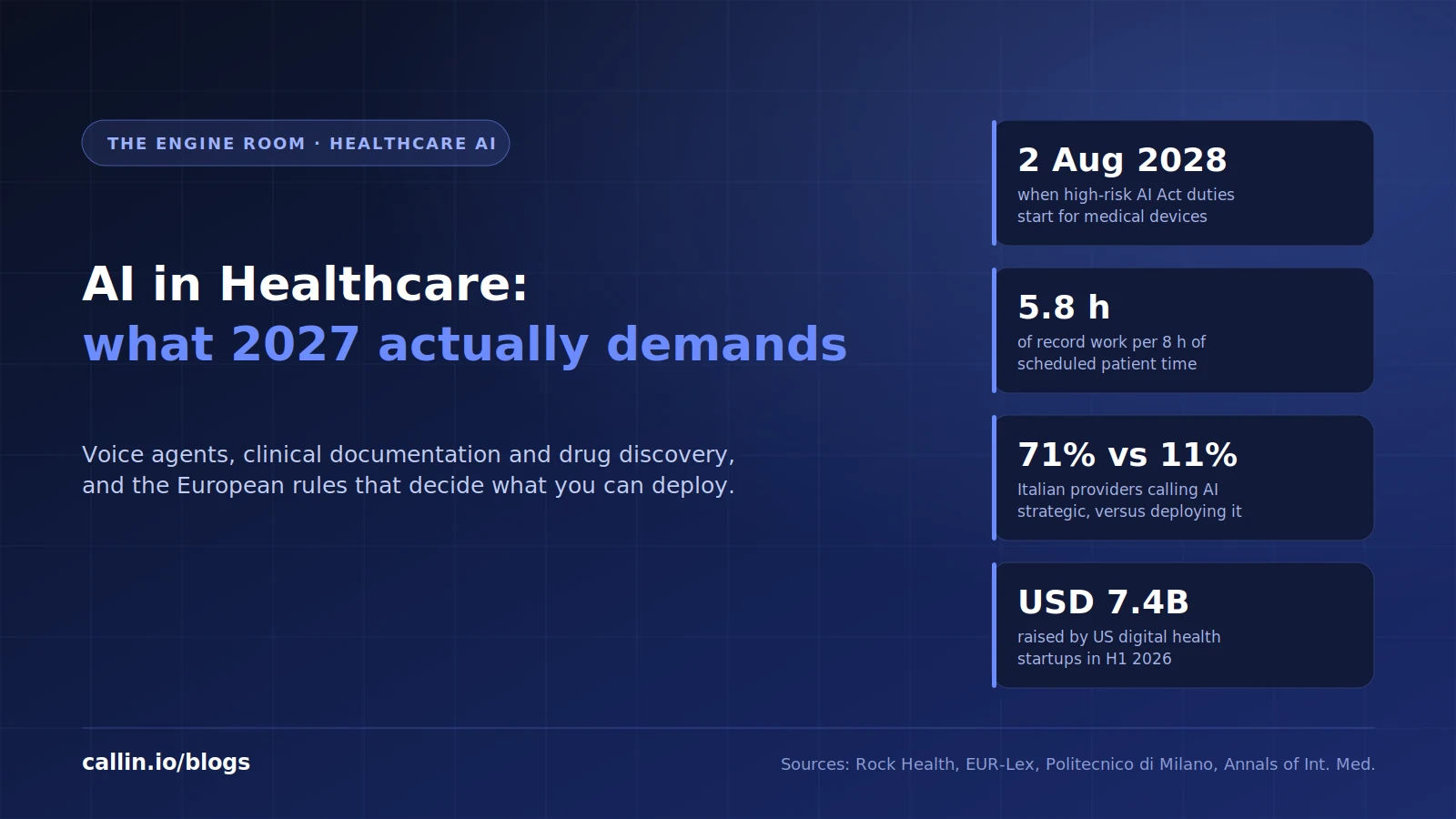
AI in healthcare has moved from pilots to infrastructure, but adoption is far shallower than the headlines suggest. In Italy, 71% of healthcare organisations call AI a rising strategic priority while diagnostic-support AI is live in only 11% of facilities.
The EU AI Act's transparency duties bit on 2 August 2026. The high-risk obligations for AI that is a medical device were postponed to 2 August 2028, which changes European roadmaps considerably.
The clearest measurable win is administrative, not diagnostic. Physicians average 5.8 hours of electronic record work per 8 scheduled patient hours.
Drug discovery is the loudest funding story and the least proven. Isomorphic Labs has raised USD 2.7 billion and, as of mid-2026, had nothing in clinical trials.
Europe's constraint is also its opening: compliance built in from the start is a product feature, not overhead.
The moment AI stopped being a pilot
If 2023 and 2024 were about experiments, 2026 was the year budgets moved. Grand View Research sizes the global AI-in-healthcare market at USD 36.7 billion in 2025, projected to reach USD 505.6 billion by 2033 at a 38.9% compound annual growth rate.
Treat that with care. MarketsandMarkets puts the same market at roughly USD 110 billion by 2030. When two credible firms differ by an order of magnitude, the honest reading is that nobody knows the denominator yet. What we can measure is deployment, and deployment is patchier than the forecasts.
Funding is easier to count. Rock Health recorded USD 7.4 billion across 244 deals for US digital health startups in the first half of 2026, up from USD 6.4 billion across 245 deals a year earlier. Fewer, larger cheques: twenty rounds of USD 100 million or more took 45% of all capital.
One detail in that report matters more than the total. Rock Health stopped breaking out "AI-enabled" as a separate category, on the grounds that AI is now ubiquitous enough that the label no longer sorts anything. That is what the end of a hype cycle looks like from the inside.
What the rules actually say now
This is where most coverage gets it wrong, so it is worth being precise.
The EU AI Act became generally applicable on 2 August 2026. From that date, Article 50 requires that anyone interacting directly with an AI system be told so, clearly and from the first interaction, unless it is obvious. A patient phoning a clinic and reaching an AI agent has to be told they are speaking to one. That obligation is live today.
The high-risk regime is a different story. Regulation (EU) 2026/1744, the Digital Omnibus on AI, in force since 27 July 2026, pushed those dates back. Chapter III obligations now apply from 2 December 2027 for Annex III systems, and from 2 August 2028 for AI that is a medical device or a safety component of one under Article 6(1) and Annex I.
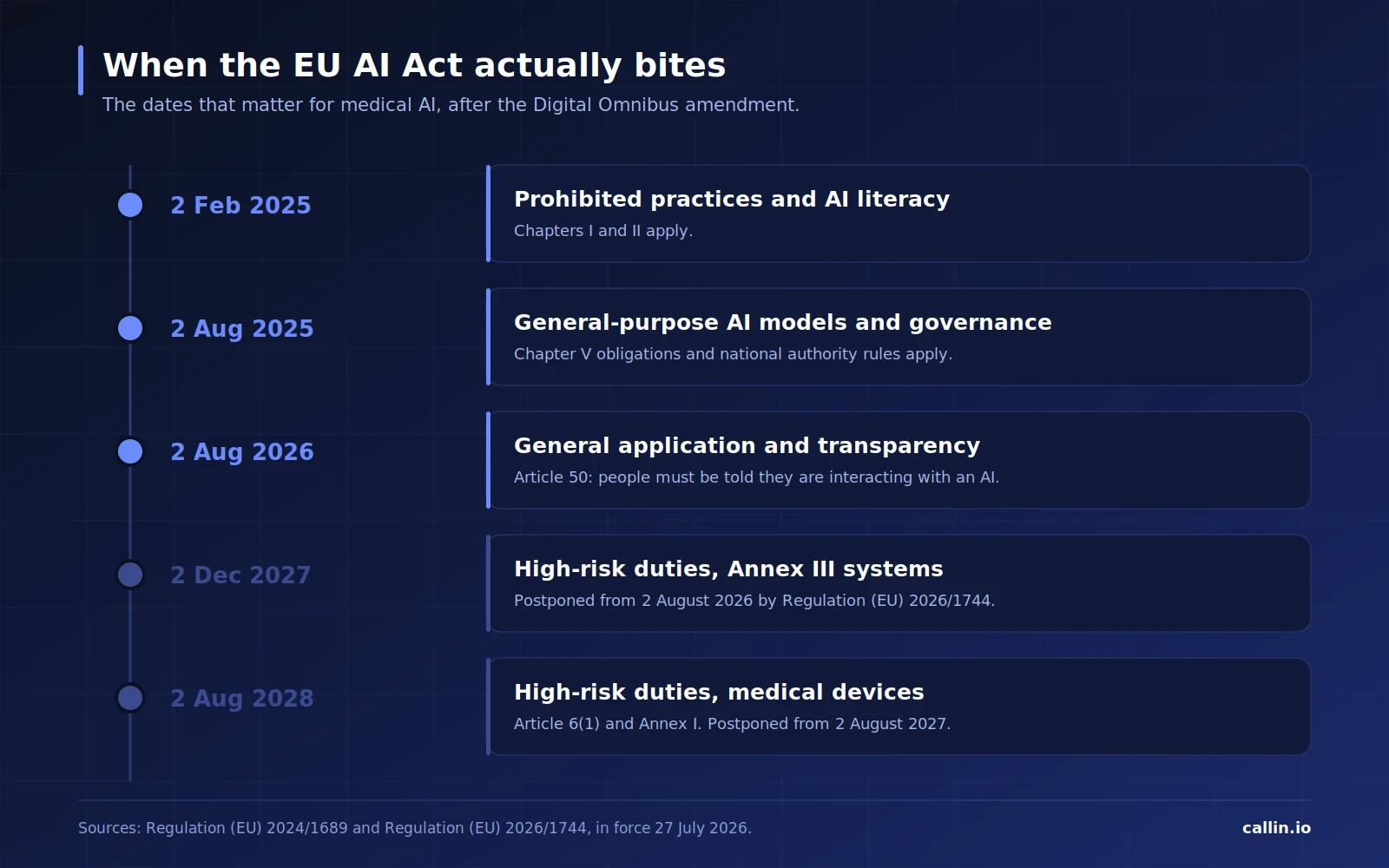
EU AI Act application dates after the Digital Omnibus amendment. Sources: Regulation (EU) 2024/1689 and Regulation (EU) 2026/1744.
Two practical consequences. First, if a vendor tells you their medical AI is already subject to the Act's high-risk obligations, they are either confused or reading an outdated page, and some official pages were still showing the old dates months after the amendment. Second, the extra time is not a reprieve: conformity assessment, bias mitigation and post-market monitoring take longer to build than to legislate.
The American rules loosened, but less than reported
The FDA issued final Clinical Decision Support Software guidance on 29 January 2026, extending enforcement discretion to clinician-facing software that recommends a single clinically appropriate option, which the 2022 position had treated as a regulated device.
The guidance is silent on generative AI, large language models and chatbots. Software still has to meet all four statutory criteria, including that a clinician can independently review the basis of a recommendation rather than simply rely on it, which is precisely the criterion opaque models struggle with. Patient-facing symptom checkers are expressly outside the new discretion. This is a loosening, not an exit from oversight.
Trend one: voice agents at the front door of care
The paradox of modern healthcare is that clinical technology has advanced for two decades while the experience of getting through the door has not.
The honest evidence base here is thinner than vendors pretend. There is no published national figure for front-desk turnover, and the widely circulated claim that patients wait 4.4 minutes on hold traces back to a vendor page with no underlying source. We have left both out.
What is measured: NSI's 2026 retention report, covering 527 acute-care hospitals and 965,886 workers, put overall hospital turnover at 18.5% for 2025. MGMA's May 2026 poll of 303 practices named front-desk and administrative roles among the highest-churn positions without attaching a rate. In Italy, the nursing federation FNOPI puts the structural shortfall at around 65,000 nurses.

Hospital reception desk. Photo by Martha Dominguez de Gouveia on Unsplash.
So the case for voice automation is not that it fixes a precisely quantified 4.4-minute problem. It is that the people answering phones are the scarcest, most replaceable-in-theory and least replaced-in-practice part of the operation, and that every call they cannot take is a patient who does not book.
The work that automates cleanly is narrow and repetitive: appointment booking and rescheduling, opening hours and directions, prescription renewal requests, insurance and coverage questions, billing explanations, and after-hours capture. Our guide to AI appointment scheduling covers the booking flow in detail, and the conversational IVR piece covers what replaces the phone menu.
The work that does not automate is anything where the caller is frightened, confused or clinically deteriorating. Designing the exit to a human is the whole job.
Trend two: clinical documentation, where the money went
If voice is the patient's interface, documentation is the clinician's tax, and the evidence here is unusually solid.
The landmark time-and-motion study by Sinsky and colleagues in Annals of Internal Medicine found that ambulatory physicians spent 49.2% of the office day on electronic record and desk work against 27.0% on direct clinical face time with patients, roughly two hours of administration for every hour with a patient.
The largest modern measurement agrees. Holmgren, Sinsky, Rotenstein and Apathy, analysing 200,081 ambulatory physicians across 396 organisations in the Journal of General Internal Medicine, found a mean of 5.8 hours of active record work per 8 hours of scheduled patient time, with over 40% of it outside clinic hours.
Add the paperwork that is not documentation at all. The American Medical Association's December 2025 survey of 1,000 physicians found practices completing 40 prior authorisations per physician per week and spending 13 hours a week on them, with 40% employing staff who do nothing else.
That is why ambient documentation attracted the cheques it did. Abridge raised USD 250 million in February 2025, USD 300 million that June at a USD 5.3 billion valuation, and a further USD 316 million in April 2026. Ambience Healthcare raised USD 243 million in July 2025.
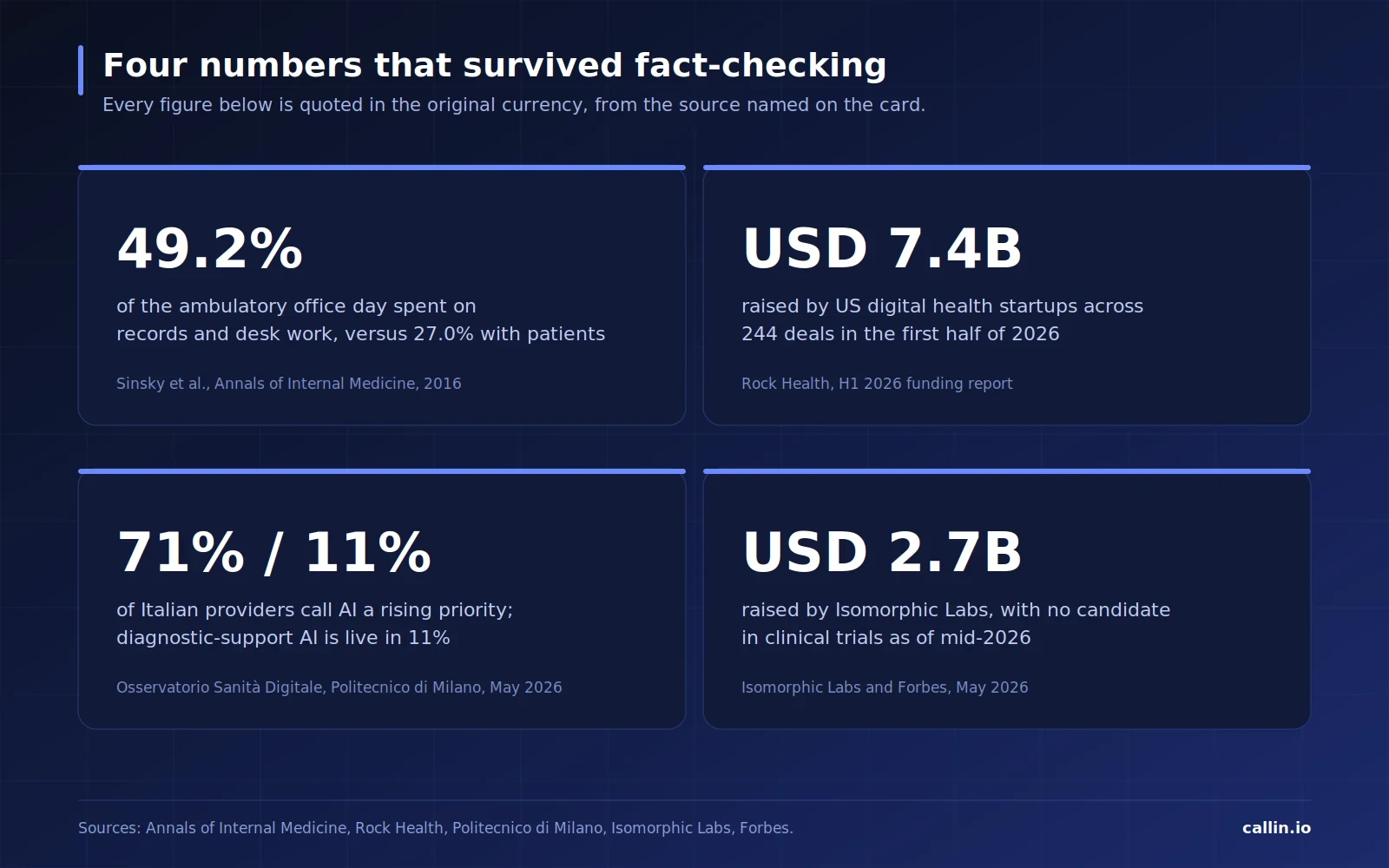
Four verified figures on the state of healthcare AI. Sources: Rock Health, Annals of Internal Medicine, Osservatorio Sanità Digitale, Isomorphic Labs.
The return is legible in a way diagnostic AI's rarely is: hours returned to clinicians, measurable next month, on a number the finance office already tracks.
Trend three: drug discovery, loud and unproven
Computational drug design is the best-funded and least settled part of the field.
Isomorphic Labs, the Alphabet spin-out built around AlphaFold, raised USD 2.1 billion in May 2026, taking its total to USD 2.7 billion. Forbes reported at the time that it had no candidates in clinical trials, and its own newsroom has announced none since.
The picture at its peers is more modest than the marketing. Iambic Therapeutics' Form S-1, filed 23 September 2026, describes one clinical-stage asset, IAM1363, in a Phase 1/1b basket trial, with two further programmes at the IND-enabling stage. Generate Biomedicines has three clinical candidates, one of them in Phase 3.
That is genuine progress. It is also a long way from the "AI designs drugs" framing, and the honest way to read 2027 is as the first year where these programmes produce human data that either supports the thesis or does not.
Two speeds: the United States and Europe
The American pattern is many specialised point solutions competing hard, deployed first and validated afterwards, with the January 2026 FDA guidance widening what can ship without premarket review.
Europe is going the other way, and the funding mix shows it. Galen Growth's HealthTech 250 Europe 2026 cohort had raised USD 737 million cumulatively as of February 2026, weighted toward research solutions (32%), health management (22%) and medical diagnostics (16%).
Administrative automation is close to absent from that mix. European capital is funding scientific validation; the operational layer that makes a clinic work is comparatively unbuilt.
There is also a sobering read on how good any of this is. The Stanford and Harvard ARiSE network's State of Clinical AI report, published January 2026, reviewed more than 500 medical AI studies and found nearly half used exam-style questions while only 5% used real patient data. When researchers altered the multiple-choice questions, accuracy fell sharply, in some cases by more than a third.
A discussion of where clinical AI actually stands. Source: Stanford Medicine.
Italy: what the data actually shows
The Osservatorio Sanità Digitale at Politecnico di Milano published its 2026 research in May, and it is the most useful picture of the Italian market anyone has.
Digital health spending reached EUR 2.7 billion in 2025, up 9%. AI was named a rising strategic priority by 71% of healthcare organisations, eight points more than the year before.
Then the gap. Diagnostic-support AI is actually in place in 11% of facilities. Generative AI was used in the past year by 61% of medical specialists, 61% of general practitioners and 37% of nurses, but in almost all cases these were general-purpose consumer platforms, not tools designed for clinical use. Only 30% of doctors have had any AI training, and 2% of specialists rate as competent across the four areas assessed.
Read those numbers together and the Italian situation is clear: clinicians are already using AI, mostly unofficially, mostly on tools nobody procured, while their organisations are still deciding. That is a governance problem before it is a technology problem.
Demand, meanwhile, is rising. AGENAS's first waiting-list bulletin, published July 2026, recorded bookings rising from 13.3 million in the first half of 2025 to 14.9 million in the first half of 2026.
Italian startups worth knowing
Serenis grew out of online psychotherapy into a licensed digital medical centre. It raised a EUR 12 million Series A in September 2025 led by Angelini Ventures and CDP Venture Capital, reported EUR 25 million of revenue in 2024, and says gross revenue grew 66% in 2025.
MedQuestio is a generative AI reference tool for general practitioners and paediatricians, integrated into CompuGroup Medical's FPF, PROFIM, INFANTIA and CGM STUDIO record systems, drawing on literature validated by the SIICP primary care society.
CoAImed, spun out of the Assistive Robotics Lab at Scuola Superiore Sant'Anna, builds WEARnCARE: wearable sensors and AI that give neurologists an objective measurement of Parkinson's motor symptoms in place of subjective visual rating.
What is missing from that list is anyone doing administrative and telephone automation for small and mid-sized providers. That space is close to empty in Italy.
Where Callin.io fits
Callin.io builds AI voice and email agents for European healthcare providers, and the reason that framing matters is regulatory rather than rhetorical.
A platform designed against HIPAA and then adapted for the GDPR and the AI Act inherits its assumptions from the wrong jurisdiction. Building the other way round means EU data residency, AI disclosure that satisfies Article 50 by default rather than by configuration, full auditability of every conversation, and real multilingual operation that understands the Servizio Sanitario Nazionale rather than translating American scripts into Italian.
It also means integrating with the record systems European providers actually run, which is the difference between an agent that can book an appointment and one that can only take a message. Our integrations and security pages set out how that works, and the AI receptionist for medical offices guide covers the clinical front-desk case specifically.
For clinic groups that want to offer this under their own brand rather than build it, the white label AI voice agent model is how most of our healthcare partners deploy.
The problems nobody has solved
Security is not a feature. Voice systems in healthcare handle protected health information by default. US enforcement gives a sense of scale: HHS's Office for Civil Rights resolved 22 investigations totalling USD 9,944,612 in 2024, after USD 7,735,000 across 14 in 2023. In Europe, the GDPR exposure on special-category data is larger still. Encryption in transit and at rest, defined retention, redaction and complete audit logging are entry requirements.
Escalation is unmeasured. A widely repeated claim holds that patient satisfaction stays high if a caller reaches a clinician within thirty seconds. We could not find any study behind it, and we are not going to repeat it. What is defensible: the thirty-second target appears across vendor design guidance as a goal, not a finding, and no published research tests escalation latency against satisfaction. If you deploy, measure it yourself.
Shadow adoption. The Politecnico figures show most clinical AI use in Italy happening on consumer tools outside any procurement process. Banning it does not work. The realistic response is to give clinicians a sanctioned tool that is better than the one they are already using unsupervised.
Pilots that never scale. The organisations that got past pilot stage share one thing: clinical leadership involved from the first week. Automation of the front desk is a patient care project that happens to involve software, and treating it as an IT procurement is the most reliable way to stall it.
Frequently asked questions
Is AI in healthcare regulated in Europe?
Yes, on two tracks. The AI Act's transparency obligations apply now, including the duty to tell people they are talking to an AI. High-risk obligations for AI that is a medical device apply from 2 August 2028 under the amended timetable. Separately, the GDPR and the Medical Device Regulation apply as they always did.
Does a patient have to be told they are speaking to an AI?
Yes. Article 50(1) of the AI Act requires providers to inform people they are interacting with an AI system, clearly and from the first interaction, unless it would be obvious to a reasonably observant person.
What is the fastest thing to automate in a clinic?
Inbound calls about appointments: booking, rescheduling, cancellations and confirmations. High volume, low clinical risk, easy to measure, and the after-hours share is pure recovered demand. Start with three intents, not thirty.
Can AI write clinical notes safely?
Ambient documentation is the most mature category in the field and the evidence on time saved is real. It still needs clinician review before anything enters the record, and the clinician remains responsible for what is signed.
Will AI reduce healthcare headcount?
Mostly it changes the mix. Routine calls stop reaching staff, so the contacts that do reach them are longer and harder. Physician burnout is falling but remains high: the AMA measured 41.9% of physicians reporting at least one burnout symptom in 2025, down from 48.2% in 2023. Returning time to existing staff is a better goal than reducing them.
Is a US platform usable by a European clinic?
Sometimes, with work. The questions to ask are where the data physically sits, whether the AI disclosure is built in or configured, whether there is a data processing agreement that survives scrutiny, and whether the system understands your national health service rather than translating an American workflow.
What to do next
The interesting question stopped being whether to adopt AI in healthcare somewhere in 2025. In 2027 it is narrower and more useful: which specific human problem are you solving, and can you show the result on a number you already report.
If your clinicians are spending most of the clinic day in the record, documentation is your problem. If your phones ring out after five and nobody calls back, access is your problem. Those are different projects with different vendors and different evidence.
Whatever you pick, choose a partner who knows which regulation applies to you and when. In Europe that is not a detail, it is the design constraint.
To see what an AI voice agent built for European healthcare sounds like on your own number, start at callin.io.