AI Voice Agent for Car Dealerships: Answer Every Call
AI voice agent for car dealerships: answer every sales and service call, book straight into your live calendar and hand off to advisors with context.

A dealership can spend a fortune on digital advertising and still lose the cheapest lead it has: the person already holding a phone, already decided to call, already asking for an appointment.
The money behind that line is not small. The NADA 2025 Annual Financial Profile puts service and parts sales across the 16,990 franchised US stores at $164.6 billion, about $9.7 million per rooftop.
Yet dealership call data analysed by Car Wars and reported by CBT News puts the share of inbound calls that reach an employee at about 63% to 65%. Roughly one caller in three speaks to nobody.
That gap is what an AI voice agent is meant to close. Here is how to judge whether a given one will: checklists, vendor questions, honest benchmarks and the compliance rules that now apply to synthetic voices.

Where dealership phone revenue leaks, built from NADA 2025 and Car Wars call data reported by CBT News.
Key takeaways
About a third of inbound dealership calls never reach a person, while service and parts revenue averages close to $9.7 million per franchised store per year.
Most dealer scepticism comes from menu-driven systems bought between 2021 and 2023, which were never conversational.
The non-negotiables are live calendar booking, multi-turn conversation, transcripts, warm handoff with context and a real write-back into your scheduler or DMS.
Published dealer results are almost all vendor-reported. Treat them as hypotheses and measure your own baseline first.
Since February 2024 the FCC treats AI-generated voices as artificial voices under the TCPA, which changes what you may do on outbound.
Stores that succeed define the phone process first, then automate it.
Why dealership phones leak money
Inbound callers are the highest-intent traffic a store gets. They want one of three things: a price, an appointment, or an update on a car in the shop.
The problem is arithmetic, not attitude. Call volume peaks when the drive is busiest, exactly when advisors cannot pick up. Lunch, Saturday morning and the hour after closing all generate calls nobody is staffed to take.
Car Wars also found the average 2025 service scheduling call ran about four and a half minutes from pickup to booked appointment. A few hundred calls a week explains why a small BDC drowns.
Speed matters more than most stores assume. The Harvard Business Review study on the short life of online sales leads found firms contacting a prospect within the first hour were far more likely to reach a decision maker than those who waited only an hour longer.
Competition for the bay has stiffened too. The Cox Automotive 2023 Service Industry Study found dealerships handled 30% of service visits, down from 35% in 2021, while general repair shops became the preferred provider for the first time, 33% against 31%.
The same study found 48% of owners were frustrated by at least one part of a recent dealership service visit, and trouble scheduling was on the list. A phone that rings out is a scheduling problem with a price tag.
Why "AI voice" earned a bad name
Plenty of general managers hear the phrase and picture the system they bought three years ago: the one that asked callers to say "service" and then failed on whatever a human said next.
Those products were decision trees. The moment a caller said "same noise as last time, the light came on again" the tree collapsed and the call went to voicemail.
That technology still has a place, and we cover where it works in our guide to conversational IVR. What it never did was hold a conversation.
So the scepticism is earned, and also out of date. The real risk has moved: not whether the agent understands the caller, but whether it finishes the job inside your systems.
What actually changed
Modern agents run on large language models rather than keyword rules, so they track intent across a whole call. A caller can change subject twice and still land the right appointment.
They also write. A good agent books against a live service calendar, respects op codes and bay capacity, sends a confirmation text and leaves a transcript on the record.
And they hand off properly. When a call needs a human, the advisor gets the context, not a cold transfer that makes the customer start again.
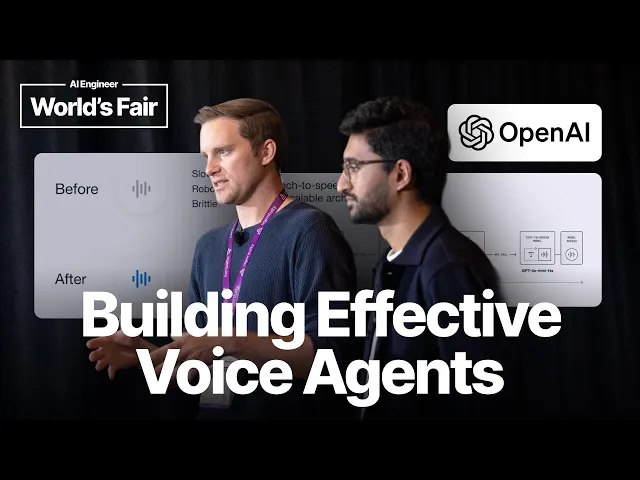
The talk below from the AI Engineer conference is a clear, vendor-neutral explanation of how production voice agents are built and where they break.
Building Effective Voice Agents, Toki Sherbakov and Anoop Kotha of OpenAI, AI Engineer conference. Source: YouTube.
Those architecture choices decide how the agent feels on the phone, which we unpack in our piece on reducing perceived latency in AI voice agents.
The non-negotiable capability checklist
Before comparing prices, compare capability. Miss any of these and you have bought a call router with a nicer voice.
Answers inbound calls end to end, with no human in the loop for routine requests.
Books against live calendar availability, not a static template of slots.
Holds multi-turn conversations, including corrections and changes of subject.
Produces a transcript and a task record for every call.
Escalates to a named person with the context already attached.
Writes the appointment into your scheduler, DMS or CRM, where advisors actually look.
Works after hours and weekends with no separate configuration.
Handles the service types you really sell, including diagnostics and recalls.
Our overview of what an AI phone agent does covers each in detail, and the Callin.io phone agent page shows how they fit in one deployment.
Differentiators worth paying for
Second-language coverage
Spanish across much of the United States, Italian or German in parts of Europe. The test is not whether the agent speaks the language, but whether it can switch mid-call without losing the booking.
Heat detection
Repeat visits for the same complaint, a caller mentioning a warranty dispute, anything that smells like a CSI problem. A good agent flags it instead of cheerfully booking a slot.
Structured outbound
Reminders, declined-service follow-up, recall campaigns and no-show recovery. Our guide to AI outbound calling explains how to run these without becoming a nuisance.
Reporting by rooftop
Answer rate, after-hours capture, conversion and escalation, split by store and department. Without it you cannot prove the agent works, or coach around what it reveals.

Capability tiers for a dealership voice agent, from baseline answering to measurable fixed-ops impact.
Red flags that should end the demo
No transcripts, or transcripts only on request.
Refusal to play a call that went wrong. Every system fails sometimes, and a vendor who hides failures has not studied them.
Appointment templates that ignore real bay capacity.
An agent that only routes while humans do the talking, sold as full automation.
Vague answers on limitations, pricing or contract length.
Go-live in a few days with no integration work. Instant usually means the integration is not real.
Seven questions to ask every vendor
How does the agent behave when it does not understand? Show the fallback, not the happy path.
How does it integrate with our scheduler or DMS, and how fast does it learn a new op code?
How does it decide to escalate, and what exactly does my advisor see?
What is the go-live timeline, and who does the work?
Can it report answer rate, conversion, escalation and after-hours capture per rooftop?
Is there a performance-based exit in the contract?
Can you give me references from dealers running this for twelve months in a market like mine?
Pricing deserves its own conversation: per-minute, per-call and per-seat models produce very different bills at dealership volumes, as we show in our analysis of AI voice agent pricing.
Benchmarks: what good looks like
Be careful here. Nearly every published benchmark in this category comes from a vendor's own book of business and none of it is independently audited. Use the numbers as negotiating targets, not facts.
The only figure you can fully trust is your own baseline. Pull four weeks of call records first: total inbound calls, answered calls, calls answered outside business hours, voicemail rate, and appointments set per hundred calls.
For a store starting from the industry connect rate of roughly 63% to 65%, a reasonable ambition is answering more than nine calls in ten, voicemail in single digits, and escalation limited to the genuinely complex quarter of calls.

Baseline and target call metrics for a dealership deployment. Baseline connect rate from Car Wars data reported by CBT News; targets are planning figures to validate against your own records.
Measure the same way before and after. The commonest error is comparing a vendor dashboard against a phone report that counted calls differently.
What dealers and customers actually report
Most buyer's guides go quiet here, because the honest record is mixed. It is also the most useful thing to read before signing.
The clearest cautionary tale is Shaver Chrysler Dodge Jeep Ram in Thousand Oaks, California. As WardsAuto reported, the store ran a $2,000-a-month service appointment setter for four months, then dropped it: it did not integrate with their CRM, so appointments were never booked, and it struggled at peak volume. Bookings rose 20% the day after they switched it off.

Photo: Crosby Hinze on Unsplash.
Practitioners on the DealerRefresh forum make a related point. One operator argued that stores often have no defined schedule for status calls at all, so automating them just produces inconsistent updates faster. Another noted that simple updates automate well while sensitive conversations do not.
The customer side matters too. Consumer Reports examined dealership voice agents in 2026 and raised two concerns worth taking seriously: callers often cannot tell they are speaking to software, and an agent with no fatigue limit can push service recommendations harder than any human would.
AutoGuide framed the same tension as convenience against upselling. The lesson is simple: configure the agent to book and inform, not to sell, and let advisors handle recommendations in person.
The pattern is consistent. Failures come from weak integration, undefined process and aggressive scripting. Successes come from narrow scope, real write-back and honest disclosure.
Compliance: the FCC made AI voices artificial
In February 2024 the Commission ruled that AI-generated voices in robocalls are artificial voices under the Telephone Consumer Protection Act.
In practice, inbound calls where the customer dialled you sit in a very different position from outbound campaigns placed with a synthetic voice. Outbound needs consent, and the standard depends on whether the call counts as marketing.
So start with inbound. It is the lower-risk, higher-value half of the opportunity, and it is where the missed calls are. Add outbound deliberately, with counsel and written consent records.
Two habits help anywhere: disclose that the caller is speaking to an assistant, and make reaching a human easy at any point.
A four-week evaluation plan
Week one: measure. Pull your baseline call metrics split by department and by hour, so you know which gap you are buying a solution for.
Week two: demo three vendors with the seven questions. Give each two real scenarios from your own drive, and ask each to show a call that failed.
Week three: check references. Speak to dealers running the platform a year or more in a similar market, and ask what they changed internally.
Week four: negotiate on metrics, not features. Tie the contract to answer rate, booked appointments and escalation quality, with an exit if those are missed.
Rolling it out without burning the service drive
Start with one department and one shift. After-hours service calls are the usual first slice: the alternative today is voicemail, so the bar is low and the upside immediate.
Write the scripts with your advisors, not around them. They know which questions callers really ask, and which recommendations should never come from software.
Read transcripts weekly for the first month. Ninety minutes of reading teaches you more than a quarter of dashboards.
Then expand by call type, not volume: service scheduling, parts and status updates first, sales qualification once you trust the handoff. See our guides to AI appointment scheduling and AI lead qualification, with missed-call text back as a safety net while you tune.
Frequently asked questions
How much does an AI voice agent for a car dealership cost?
Usually per minute, per call or per seat, and at dealership volumes the model matters more than the headline rate. The WardsAuto case above involved $2,000 a month for appointment setting alone. Compare total cost against the loaded cost of the BDC hours you expect to free, and see our pricing page for how usage-based billing works.
Will customers know they are talking to AI?
Many will, and the ones who do not are a problem rather than a win. Consumer Reports singled out non-disclosure as a concern; say it in the greeting and offer a human at any point.
Does it integrate with my DMS and scheduler?
This is the question that decides the project. The Shaver store's agent failed precisely because appointments were never written into the CRM. Ask to watch a booking land in your own system during the evaluation, not in a sandbox.
Can an AI voice agent replace my BDC?
No, and stores that frame it that way tend to fail. It absorbs routine and after-hours calls so your BDC can work complex inbound and structured outbound. Headcount usually stays; the mix of work changes.
Is using an AI voice for outbound calls legal?
It depends on consent and where you are calling. The FCC confirmed in 2024 that AI-generated voices count as artificial voices under the TCPA, so outbound campaigns need proper consent. Inbound answering does not raise the same issue.
How long before we see results?
After-hours capture shows up in week one, because the comparison is voicemail. Changes in appointments per hundred calls take four to six weeks to read reliably, which is why the baseline is worth the effort.
The short version
A dealership does not have a call volume problem. It has a coverage problem, and one caller in three is paying for it.
An AI voice agent fixes that only if it books into your live calendar, writes back to your systems, hands off with context and tells you honestly what it could not do. Everything else is a nicer hold message.
To see what that looks like against your own numbers, explore the Callin.io voice platform or start at callin.io and run a test call on your own service scenarios.