AI Voice Agent for Restaurants: Answer Every Call
AI voice agent for restaurants: answer every call, take takeout orders and bookings 24/7, recover missed revenue, and keep a human one sentence away.

The phone is still one of the most profitable order channels a restaurant owns, and the worst staffed one. Nobody pays a commission on it. Nobody takes a cut of the ticket. And almost nobody answers it between six and eight in the evening, which is exactly when it rings the most.
An AI voice agent for restaurants is a software caller that picks up on the first ring, takes the order or the booking, reads it back, writes it into your system and hands the call to a human when the guest needs one. It is not a menu tree. It is not voicemail with better music. It is the difference between a ringing phone and a ticket on the line.
This guide walks through the money that leaks out of an unanswered phone, what the technology does well today, what large chains learned the painful way, and how to launch without annoying the guests you already have.
Key takeaways
Missed restaurant calls are a structural problem, not a staffing attitude problem: calls peak exactly when the dining room is busiest.
Industry estimates put the annual loss from unanswered restaurant calls in the billions, though the most detailed figures come from vendors and deserve a sceptical read.
Diners are warming to AI: discomfort fell from 41% to 27% in a year, but 44% say it goes too far when they cannot easily reach a person.
Start with hours, bookings and simple takeout orders. Leave allergens, complaints and large catering to humans.
Measure containment, order accuracy and recovered calls, not minutes saved.
What an AI voice agent for restaurants actually does
Strip away the marketing and there are five concrete jobs.
Answering. It picks up every line, every time, including the third simultaneous call. No hold music, no rollover to a mobile in someone's apron.
Informing. Opening hours, holiday hours, parking, whether the terrace is open, whether you have gluten-free pasta, whether the kitchen closes before the bar. This is the bulk of the call volume in most independents and it carries almost no revenue, which is why it is the first thing worth automating.
Booking. Party size, time, name, phone number, special requests, written straight into the reservation system. The same mechanics as any AI appointment scheduling flow, with a table instead of a calendar slot.
Ordering. Takeout and pickup orders with modifiers, read back item by item before the agent confirms, then pushed into the point of sale as a ticket.
Routing. One sentence from the guest, and the call goes to a person. This is the feature that decides whether the whole project is judged a success or a nuisance.

Five levels of phone automation in a restaurant, from voicemail to a voice agent that writes orders into the POS. Source: Callin.io analysis.
The math behind missed restaurant calls
The clearest public attempt to size the problem ran in QSR Magazine in March 2026. The calculation goes like this: roughly 150 missed calls a month per restaurant, around 60% of them carrying real customer intent, a 70% conversion rate if someone had answered, and an average takeout ticket of about 38 dollars. That works out to roughly 28,700 dollars a year per location, and above 20 billion dollars across the United States.
Treat the headline number as an order of magnitude, not a measurement. The piece was written by the founder of a voice AI company, the 70% conversion rate is not tied to a published study, and the more aggressive variant of the estimate rests on that company's own unreleased call data. We are flagging this because the honest version of the argument is still strong enough: you do not need 20 billion to be true, you only need your own 150 missed calls to be true.
Do the arithmetic on your own numbers instead. Pull one busy month from your phone provider, count unanswered inbound calls, multiply by your real average takeout ticket, then halve it twice to stay conservative. That figure is the budget the project has to beat.
For context on the size of the pot: the National Restaurant Association's 2026 State of the Restaurant Industry forecast puts industry sales at 1.55 trillion dollars across more than a million outlets, with employment heading to 15.8 million jobs and more than nine in ten operators naming food, labour, insurance and energy costs as significant pressures. Phone revenue is one of the few lines an operator can grow without raising prices.

Verified figures behind the restaurant voice AI case. Sources: National Restaurant Association 2026 State of the Restaurant Industry, Nation's Restaurant News, NBER Working Paper 31161, PAR Technology 2026 diner survey, Gartner.
Why restaurant phones go unanswered
This is the part that gets misdiagnosed as a discipline problem. It is not.
Phone volume and dining room volume peak at the same moment. A host standing at the pass with three parties waiting and a ringing handset is being asked to choose between a guest who is already in the building and a guest who might be. Any sane person picks the one in front of them. Pizza, ramen and any concept with heavy pickup traffic feel this worst, because their call volume is also their order volume.
Adding a person does not fix it either. You would need them for the two hours when calls spike and nowhere else, and restaurant labour already sits under permanent pressure. Automation here is not about replacing a role, it is about covering a window no schedule covers well.
When the money actually disappears
Call volume in a restaurant is not spread across the day. It clusters hard in the dinner window, and the calls that arrive then are the ones most likely to be orders rather than questions. The QSR analysis puts roughly a third of missed calls and almost half of daily phone orders inside the five to eight o'clock block.
That shape matters for how you deploy. You do not need an agent that handles every call perfectly in order to profit. You need an agent that handles the dinner rush competently, because the rest of the day your staff can cope. Several operators run the agent only as an overflow line: first ring goes to the host stand, second and third go to the agent. That single routing decision removes most of the risk from the project.

Most restaurant calls are placed by people who are already deciding where to spend money tonight. Photo: Gabriel Gonzalez on Unsplash.
What the big chains learned the hard way
Enterprise deployments are worth studying precisely because they went public with their mistakes.
Taco Bell has drive-thru voice AI in more than 890 restaurants across 38 states as of July 2026, working with Omilia on Yum Brands' own platform, and Nation's Restaurant News reported that locations using it showed higher employee retention than those without it. That is a real, unglamorous benefit: the job gets less awful when the handset stops screaming.
A year earlier the same programme was the industry's cautionary tale. After viral failures, including a prankster ordering 18,000 cups of water, chief digital and technology officer Dane Mathews told the Wall Street Journal his own experience with the system was mixed, and TechCrunch reported the chain was rethinking where to use it. His conclusion was not that the technology fails. It was that the busiest locations may be better served by people, with the agent used selectively and supervised.
Analysts point at the same root cause. Speaking to Food On Demand, Justin Foster of Incept AI attributed most drive-thru failures to utterance management: telling a human voice apart from engine noise and acoustic echo. He was blunt about the labour expectation too, saying operators who hope to pull staff off the floor entirely cannot really do it. The lesson for an independent is cheap to apply: the phone line is a far easier acoustic problem than a drive-thru lane, so start there and do not promise yourself a headcount saving you have not measured.
What diners will and will not accept
PAR Technology surveyed 1,000 US adults in June 2026 and the results, reported by QSRweb, are the most useful design brief available. Discomfort with AI in restaurants fell from 41% to 27% in a year. Nearly three in four diners are open to AI in some part of the experience. And 62% would order through a large language model given the right offer.
Then come the limits. 47% say AI goes too far when it replaces most human interaction, 44% when they cannot easily reach a person, and 43% name transparency as the single most important factor in trusting a restaurant's use of AI.
Three rules fall straight out of that data. Say it is an assistant in the first sentence. Offer the human exit before the guest has to hunt for it. Never make a caller repeat themselves to a person who has no idea what was already said.
Where the agent plugs into your stack
A voice agent that cannot write into your systems is a very expensive note-taker. Three integrations carry almost all the value.
Point of sale. The order has to arrive as a ticket with modifiers, not as a text message someone retypes. Menu data should sync from the POS, otherwise every price change becomes a software task.
Reservations. Live table availability, so the agent is not offering a nine o'clock that went ten minutes ago.
Follow-up. An SMS confirmation with pickup time and total, which cuts no-shows and the calls asking when the order will be ready.
From there the mechanics are the same ones behind any AI phone agent deployment, and the architecture questions mirror what we covered in our guide to AI call center software. If you manage several venues under one brand, the voice platform layer is what lets you share one menu logic across locations while keeping separate numbers and reporting.
Phone line first, drive-thru much later
These are two different engineering problems and they get confused constantly. A phone call is a clean, single-speaker stream over a codec built for speech. A drive-thru lane is an outdoor microphone with engine idle, wind, rain, three people talking in a car and a speaker echoing into its own mic. The chains struggling in public are struggling with the second problem.
If you run a quick-service concept and want both, sequence them. Get the phone line working first, learn how your guests actually phrase things, then take that tuned menu understanding outside.
Launching in two weeks without burning guests
A workable rollout looks like this.
Days 1 to 3. Export your call log and pull the twenty most common questions. Write the answers in plain language. Decide the four things the agent will never do: allergen advice, complaints, group bookings above a threshold, anything involving a refund.
Days 4 to 7. Connect the POS and the reservation system. Load the menu with real modifiers and real slang, including what your regulars call things rather than what the menu calls them.
Days 8 to 10. Run the agent on the overflow line only, during lunch. Listen to every call yourself. You will find three phrasings you never anticipated on the first day.
Days 11 to 14. Extend into the dinner window, add the SMS confirmation, set the escalation keyword and test that a transfer reaches a handset someone picks up. Do not skip the listening step: the operators who are unhappy a month in are almost always the ones who never heard their own recordings.
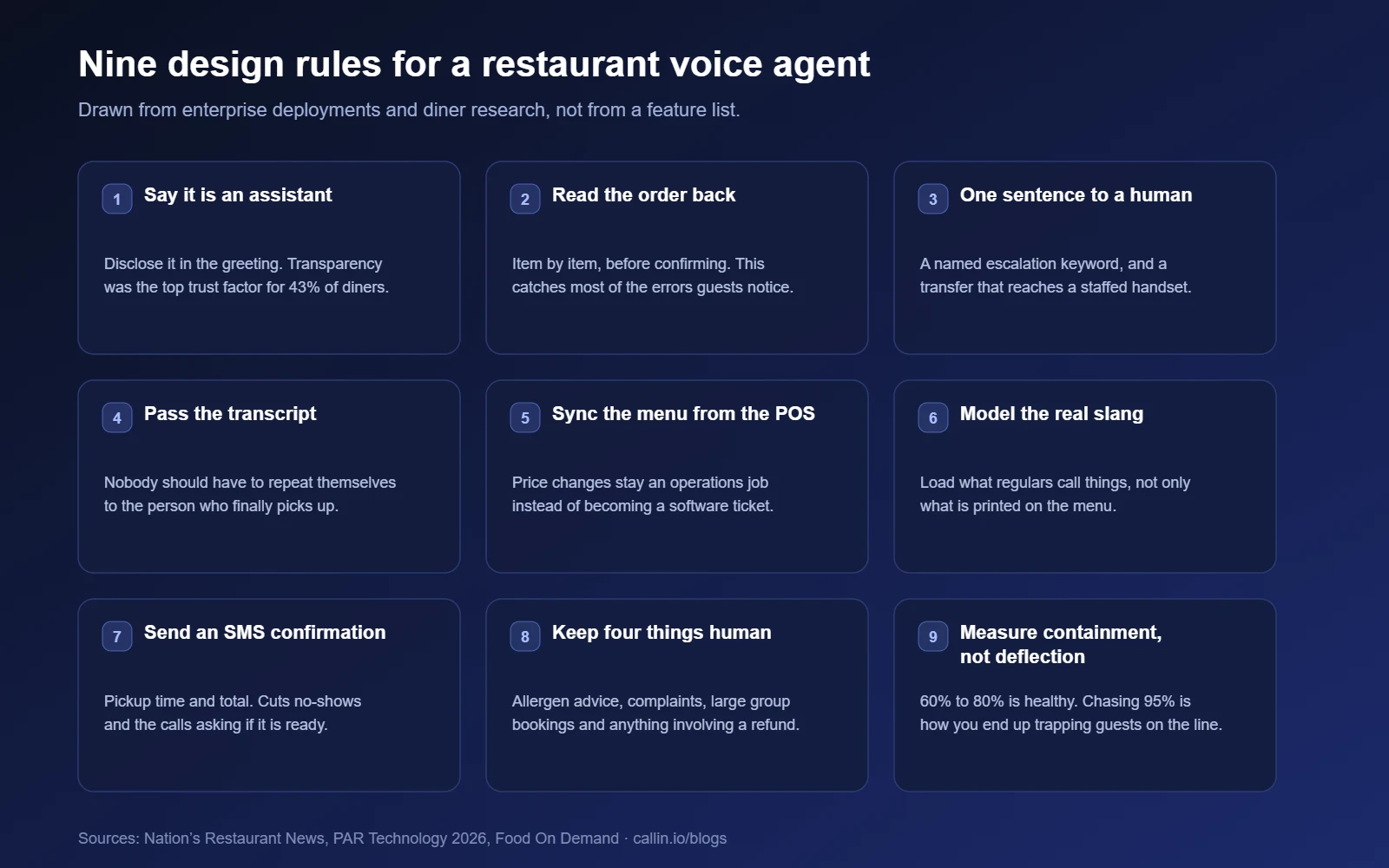
Nine design rules for a restaurant voice agent, drawn from enterprise deployments and diner research. Sources: Nation's Restaurant News, PAR Technology, Food On Demand.
Metrics that tell you it is working
Four numbers, reviewed weekly.
Answer rate. Share of inbound calls connected to something that responds. This should go to 100% in week one and stay there.
Containment. Share of calls completed without a human. Healthy is 60% to 80% for a mixed restaurant line. Chasing 95% is how you end up trapping guests.
Order accuracy. Audit twenty tickets a week against the recording. Anything below 95% means the menu model needs work, not more prompts.
Recovered revenue. Orders and bookings taken outside staffed hours. This is the number that justifies the invoice.
On the productivity side, the strongest academic evidence we have comes from NBER Working Paper 31161, in which Brynjolfsson, Li and Raymond studied around 5,000 customer support agents and found a 13.8% rise in issues resolved per hour, with the largest gains, roughly 35%, going to the least experienced staff. Translated to a restaurant: the agent helps your newest host far more than your best one.
CX Today on how voice ordering changes what restaurant staff spend their shift doing. Source: CX Today, June 2026.
What it costs, and when it pays back
Pricing in this category is usually per minute, sometimes per call, occasionally a flat monthly rate with an included bundle. The honest way to evaluate it is to compare the monthly invoice against the recovered revenue number above, not against a salary.
A rough frame: at 600 inbound calls a month and two to three minutes per call, a per-minute rate in the range published on our pricing page costs less than a single recovered dinner service. The real risk is not the price, it is deploying something guests dislike and losing regulars, which is why the human exit matters more than the rate card.
Gartner's widely cited 2022 forecast, that conversational AI would cut contact centre labour costs by 80 billion dollars by 2026 with one in ten agent interactions automated, is a reminder of how early this still is. One in ten is a first shift, not a replacement.
Frequently asked questions
Can an AI voice agent take a full takeout order with modifiers?
Yes, when the menu is synced from the POS and modifiers are modelled properly. The part that fails is unmodelled slang and off-menu requests, so insist on a read-back before confirmation and keep a human transfer one sentence away.
Will guests know they are talking to a machine?
They should. Transparency was the top trust factor for 43% of diners in PAR's 2026 survey, and in several jurisdictions disclosure is becoming a legal expectation rather than a courtesy. Say it in the greeting and move on.
What happens when the agent cannot understand someone?
A well-configured agent escalates after two failed attempts rather than looping. Set an explicit escalation keyword, make sure the transfer target is a handset that gets answered, and pass the transcript so the guest does not start over.
Is this the same thing as an IVR menu?
No. An IVR asks the caller to navigate your org chart. A voice agent listens to a sentence and acts on it. We compared the two in detail in our guide to conversational IVR.
Can it also call people back?
Yes, and that is often where the extra margin sits: waitlist callbacks, confirming large bookings, following up on catering enquiries. The rules differ from inbound, so read our notes on AI outbound calling before you switch it on.
Does a small single-site restaurant get anything out of this?
Often more than a chain does, because a single site has no call centre to fall back on. Start with hours and bookings only, which is the lightest version of a AI answering service, and expand once you trust it.
The bottom line
Every unanswered call is somebody who had already decided to spend money with you tonight and could not find a way to do it. That is the cheapest demand in the business, and it is sitting on hold.
A voice agent is not a replacement for the person at the host stand. It is cover for the two hours a night when that person cannot be in two places. Start on the overflow line, keep the human exit obvious, listen to your own recordings, and judge it on recovered orders rather than on how clever it sounds.
If you want to see what that looks like on your own number, you can build and test a restaurant agent at callin.io and have it answering your overflow line this week.