Multilingual AI Voice Agent: One Agent, Every Caller
Multilingual AI voice agents answer every caller without a language menu. See how detection, code-switching and per language testing really work.

Most systems sold as a multilingual AI voice agent are monolingual agents wearing a language menu. The caller picks English, the stack loads an English configuration, and everything downstream assumes English until the call ends.
That holds until a caller spells a German surname, reads an account number in their first language, or does what bilingual people do without thinking: switch language halfway through a sentence.
This guide covers what a multilingual voice agent really is, where the languages live in the stack, why short turns break first, and how to test one before it answers a real customer.
Key takeaways
A real multilingual agent needs no declared language and survives mid sentence switching.
Coverage is not one number: understanding a language and speaking it are separate capabilities.
Accuracy collapses on short turns full of names, dates and digits, which is where phone calls live.
Turn taking tuned on English pauses interrupts non native speakers constantly.
Evaluate per language and on mixed language recordings, never on a pooled average.

Four levels of multilingual maturity in voice agents. Source: Callin.io analysis.
What a multilingual AI voice agent actually is
It is a phone system that understands and answers in more than one language without being told which language to expect, and without falling apart when the caller mixes two.
Three properties separate the real thing from a demo.
No language declared up front. No menu, no routing by country prefix, no separate agent per market.
It survives code-switching. A sentence like "il mio codice cliente è four seven two alpha" comes back as one coherent turn, not two broken ones.
Quality holds outside English. Turn taking, entity accuracy and interruption handling work in every language it claims, not only the one the vendor demoed.
That third property is where evaluations stop too early. Teams check transcription accuracy per language, see acceptable numbers, go live, then find the agent talking over Japanese or Finnish speakers because its silence thresholds were tuned on fluent English.
Why a language menu is the wrong starting point
The old answer was the phone tree: press 1 for English, press 2 for Spanish. It hands the work to the caller before anyone has heard them speak, and it fails the people it was built for. Someone who picks Spanish still has to read out an English email address.
Removing that menu is usually the first measurable win of a voice project, which is why it appears in almost every conversational IVR migration.
Which layer of the stack speaks which language
Coverage is never one number, because a voice agent is not one component. It is at least three, and each has its own list.
Speech to text
Recognition turns caller audio into text and decides when a turn ended. It is the most advanced layer today, with wide coverage and real support for mixed language input.
The language model
Reasoning reads the transcript and drafts the reply. Modern models handle dozens of languages, but instruction following and tone degrade in lower resource languages long before grammar does.
Text to speech
Synthesis speaks the reply. This is usually the narrowest list and the one that decides which markets you can promise. A stack can understand a language perfectly and have no acceptable voice to answer in it.
Your real reach is the intersection of all three, in both directions. Recognition is ahead, synthesis is the constraint, which makes coverage a roadmap question rather than an engineering failure. Our AI voice platform page sets out how the layers fit together.

Why language coverage is a commercial decision, not a technical detail. Sources: CSA Research (2020), Gartner (2025), Eurobarometer (2024).
The commercial case, in verified numbers
Language preference is not a soft preference. In a survey of 8,709 consumers across 29 countries, CSA Research found that 76% of online shoppers prefer to buy products with information in their own language, and 40% will never buy from websites in another language.
On the operations side, Gartner predicted in March 2025 that by 2029 agentic AI will autonomously resolve 80% of common customer service issues, with a 30% reduction in operational costs.
In Europe the mix is the normal condition. The 2024 Europeans and their languages Eurobarometer, built on roughly 27,000 interviews across the 27 member states, reported that 47% of Europeans can speak English and that four in five aged 15 to 24 can hold a conversation in a foreign language.
Read those together: callers can often manage in English, and they still buy, book and complain in their own language when given the choice.
Where multilingual calls break: short turns and entities
Phone audio is nothing like the clean read speech used in most benchmarks, and mixing languages widens the gap. Agent turns are short and fragmentary, and the fragments carry the meaning: a date, a surname, a postcode, six digits of an order number.
Consider what the model faces when someone answers "sette". One syllable, no surrounding words, possibly accented, compressed through a phone codec. Is it a quantity, an hour, a digit in a sequence, or a word in another language?
There is no context in the audio because there is barely any audio. There is context in the conversation, because the agent just asked the question. Feeding that expectation back into recognition is what turns "user at example dot com" into a usable address.
This is why word error rate is a poor way to judge a phone agent. It treats "the" and "Nakamura" as equally important, which is backwards for an agent that has to find a customer record. Entity accuracy on names, dates, codes and numbers predicts whether the caller repeats themselves.
Accents and dialects, not just languages
A language list hides the variation that matters. Italian in Naples and Italian in Trento, Spanish in Madrid and Spanish in Buenos Aires, English in Glasgow and English in Mumbai all behave differently through a phone line.
Dialect gaps appear first in numbers and proper nouns, exactly the values a booking depends on. Test with recordings from the regions you serve and treat each major variant as its own test set.
Code-switching is the normal case, not the edge case
Bilingual callers do not finish one language before starting another. They embed English product names in Italian sentences and spell addresses in whichever language they learned to spell in.
A 2026 benchmark from ServiceNow AI Research tested seven frontier recognition systems on code-switched support calls in Spanish, French, Canadian French and German paired with English. Two findings matter for phone support.
First, the number of language switches inside an utterance was the most consistent predictor of an error, more reliable than the overall amount of mixing. Second, errors clustered on the embedded English segments rather than the main language of the call.
The study also found that one widely used open model translated code-switched audio into English instead of transcribing it when no language was pinned. For an agent that then reads a value back to the caller, that is the worst available failure.
Research resources stay thin. The survey A Survey of Code-switched Speech and Language Processing by Sitaram, Chandu, Rallabandi and Black puts it plainly: code-switching data and resources are scarce, which is why coverage tables and real call performance diverge.
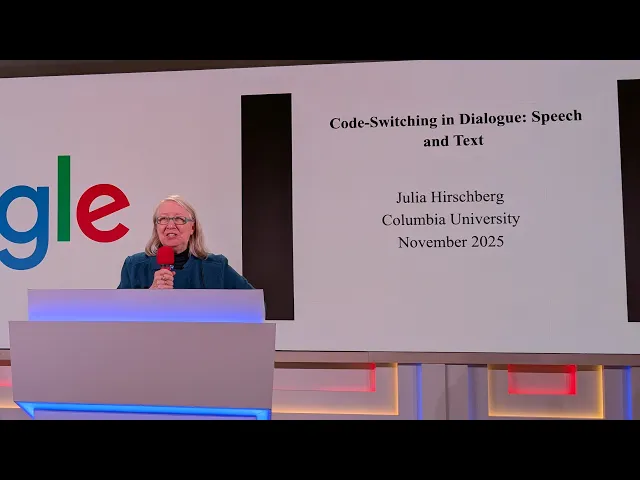
Julia Hirschberg, Professor of Computer Science at Columbia University, on analysing code-switching in speech and text. Source: SANE 2025 workshop, YouTube.
Turn taking is language specific
The hardest problem is not transcribing words. It is knowing when the caller has finished speaking.
Waiting a fixed 700 milliseconds of silence is a monolingual assumption dressed up as a setting. People pause differently across languages and dialects, and above all according to how comfortable they feel in the language. A non native speaker reaching for a word gets cut off by a threshold tuned on fluent speech.
Two fixes help. Judge whether what has been said reads as a complete thought instead of relying on silence alone, and widen the silence window when you expect an entity, such as someone spelling a name, then restore the faster setting.
Noise deserves the same attention. In multilingual environments the noise is often speech in a second language, the failure mode most likely to make an agent answer the wrong person.

Support teams in mixed language markets answer in whatever language the caller opens with. Photo: Arlington Research on Unsplash.
Where a multilingual voice agent pays for itself
Four patterns come up repeatedly, with genuinely different accuracy requirements.
Mixed language markets. Milan, Miami, Toronto, Barcelona, Brussels. The language of a call cannot be predicted from the number dialled, so the win is removing the menu rather than the cost per minute.
Intake and qualification. Appointment booking, order status, delivery windows, insurance intake. Short calls dense with entities, where AI appointment scheduling either works or quietly books the wrong slot.
Tourism, property and field services. Guests, tenants and contractors who rarely share a first language, often calling from noisy places, the case our property management pages describe.
Internal helpdesks. Multinational staff calling one number for password resets and device problems, each in their own language, as covered on our IT support page.
In all four the agent earns its place by resolving the routine call completely and handing over cleanly when it should, the pattern in our guide to voice AI for customer service.
What teams actually ask before buying
Practitioner forums point at the same worries, and vendor pages rarely answer them. Threads on r/AI_Agents and r/SaaS asking how to run one voice agent across several countries keep returning to four themes: detection latency when the language is unknown, agents that answer in the wrong language after a transfer, dialect coverage that looks fine on paper, and per minute pricing that changes by language.
The questions worth putting to any vendor are narrow ones.
Does language detection run continuously, or once at the start of the call?
What happens on the first turn, before the language is known?
Can one agent hold several languages, or does each need its own configuration and number?
Does the price per minute change by language or by voice?
Which dialects are tested, and on what recordings?
What does the agent do when it is not confident, and in which language does it ask?
Pricing deserves one extra look, because synthesis and recognition costs differ by language. Our pricing page shows how that works in practice.
How to evaluate before you go live
A pooled word error rate is the least informative number you can collect about a multilingual agent. It averages across languages, utterance lengths and token types, hiding every failure that matters.

A six point test plan for multilingual voice agents. Source: Callin.io analysis.
Build mixed language test sets. Clean recordings in each language say nothing about calls containing both. Sample real traffic and keep the mixing in.
Score entity accuracy per language. Names, dates, addresses and reference numbers, broken out. Pooled numbers look healthy while one language quietly fails.
Measure turn taking per language. Count false interruptions and the wait after the caller genuinely stops. Callers notice both far more than a misspelled word.
Test one and two word replies. Confirmations, digits and single names, in every language you support. This is where agents fail and averages are blindest.
Test recovery, not only accuracy. When the agent mishears, does it ask a sensible clarifying question in the right language, or proceed with the wrong value?
Test the handover. When the call reaches a person, does the summary arrive in the language that person reads, with the caller's language flagged?
If you resell the capability rather than buy it, the same plan applies before your brand goes on it, as we set out on the white label AI voice agent model.
Data, recording and compliance across languages
Multilingual deployments multiply the compliance surface, and the forgotten detail is the notice itself. A recording disclosure has to be understood to work, so it belongs in the language the caller speaks, not the language of the phone number.
Retention and redaction need the same care. Transcripts in several languages contain the same categories of personal data, and redaction rules written for one language miss date and address formats in another.
Human escalation closes the loop. If nobody on shift reads the language the caller used, a perfect transcript helps no one, so rota planning belongs in the project rather than the appendix. Our AI call center software overview covers the routing side.
Frequently asked questions
How many languages can one AI voice agent handle?
Dozens on the recognition side. The practical limit is synthesis, where available voices decide which languages you can answer in with acceptable quality. Check both directions before promising a market.
Do I need a separate agent for each language?
No, and one per language is the pattern worth avoiding. Separate agents force callers to declare a language first, and anyone who mixes languages breaks the routing. One agent with continuous detection covers every supported language.
How does the agent know which language the caller speaks?
It identifies the language from the first seconds of speech and keeps checking as the call continues. The continuing check matters, because callers often switch when they reach an address or a product name.
What about accents and dialects?
Accent handling is a separate question from language coverage. Test with recordings from the regions you serve, treat major variants as their own test sets, and watch numbers and proper nouns closely.
Does a multilingual agent cost more per minute?
It can, because recognition and synthesis prices differ by language and by voice. Ask for per language pricing rather than one headline rate, and model it against your real call mix.
Can it transfer to a human who speaks the caller's language?
Yes, when routing is configured for it. The agent should pass the detected language with the summary, and your rota has to cover the languages you advertise.
Getting started without a language menu
Start with the call mix you already have. Pull a week of recordings, label the language of each call, and count how many contain more than one. In mixed markets that number surprises people.
Then pick one call type, usually booking or order status, and test an agent on it in your two busiest languages with real recordings. From there the build looks like any other voice project: one agent, continuous detection, clean handover, measured per language. The groundwork is in our guides to the AI receptionist and the AI phone agent.
If you want to hear what your callers would hear, in whichever language they open with, try it on Callin.io and point it at a real call flow.


