AI Call Transcription: What It Gets Right and Wrong
AI call transcription turns calls into searchable text, but phone audio is the hard case. See the real accuracy data, the legal rules and how to test it.

Everyone who has tried to find one sentence inside a forty minute call recording knows the problem. The audio holds the answer, and the audio is useless, because finding the answer costs almost as long as the call did.
AI call transcription fixes that by turning the recording into text you can search, quote and feed to other systems. What it does not do, and what most vendor pages quietly skip, is deliver the accuracy figures they advertise on the kind of audio a phone call actually produces.
This guide covers what the technology does, how accurate it really is on telephone audio, what the evidence says about the time it saves, what the law requires before you record anything, and how to test it on your own calls.
Key takeaways
Phone audio is the hard case. In one published evaluation the same system scored 5.5% word error rate on broadcast news and 20.8% on conversational telephone speech.
Error rates are not evenly distributed. Non-native speakers in that study saw roughly double the error rate of native speakers.
Transcription helps people more than it helps the clock. A multicentre study of ambient AI documentation found burnout fell from 51.9% to 38.8%, while a randomized trial found time savings that were small and differed sharply between vendors.
A perfect transcript still is not an understanding. Summaries invent structure the call did not have.
US federal law allows one-party consent, but around a dozen states require every party to agree. Check before you switch recording on.
Benchmark on your own audio. Vendor accuracy claims are measured on clean recordings, not your phone lines.

Word error rate for one speech recognition system across audio types and speaker groups. Source: Feng, Kudina, Halpern and Scharenborg, Quantifying Bias in Automatic Speech Recognition (arXiv:2103.15122).
What AI call transcription actually is
Four things usually travel under one name, and knowing which you are buying matters.
Automatic speech recognition turns audio into words. Diarization decides who spoke when, so the transcript reads as a dialogue rather than a block. Redaction strips card numbers, health details and other sensitive strings before the text is stored. On top sits a language model that writes a summary, extracts action items, or tags the call by topic and outcome.
The first two are mature engineering with measurable error rates. The fourth is a judgement layer, and judgement is where the surprises live.
Why phone calls are the hard case
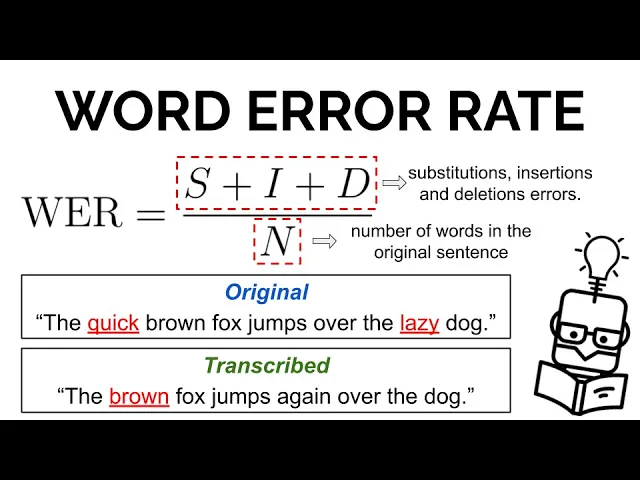
Speech recognition accuracy is quoted as word error rate: the share of words inserted, deleted or substituted against a human reference. Lower is better, and the number only means something alongside the audio it was measured on.
The gap is larger than most buyers expect. In a published evaluation of a Dutch recognition system by Feng and colleagues, the same pipeline scored 5.5% word error rate on broadcast news and 20.8% on conversational telephone speech. Same system, same language, four times the errors.
The reasons are physical and behavioural. Telephony compresses audio into a narrow frequency band and throws away exactly the high-frequency detail that distinguishes consonants. Real conversations have crosstalk, filler words, interruptions and half-finished sentences. Callers are in cars, warehouses and waiting rooms. None of that appears in a studio benchmark.
So when a vendor advertises 95% or 99% accuracy, the first question is not whether the number is true. It is which recording it was measured on.
Where accuracy breaks down, and for whom
Errors are not spread evenly across your callers, and this is the part with real consequences.
In the same study, read speech from native speakers came in at 26.1% word error rate while non-native speakers reached 55.9%. Children and older adults were recognised less well than teenagers. Human-machine speech, meaning the clipped way people talk to a machine, was consistently worse than natural speech: 47.5% against 36.2%.
Three practical consequences follow. A transcript-driven workflow will fail most often on the callers who already have the hardest time being understood. Any automated action triggered by transcript keywords inherits that bias. And quality scores calculated from transcripts will quietly mark down agents who handle the accented or noisy calls.
None of this is a reason to skip transcription. It is a reason to keep audio alongside text, and to never let a transcript be the only record of what happened.
What the evidence says about time saved
The strongest data on transcription at work comes from healthcare, where ambient AI documentation has been studied properly.
A multicentre study across six US health systems, published in JAMA Network Open, followed 263 clinicians through 30 days of ambient AI scribe use. Burnout fell from 51.9% to 38.8%, with an odds ratio of 0.26. Note-related cognitive load dropped from 7.10 to 4.46 on a ten-point scale, and self-reported after-hours documentation fell from 4.95 to 4.05 hours. Attention on the patient rose from 6.51 to 8.56. There was no control group, so read it as a strong before-and-after rather than proof.
A three-arm randomized trial of 238 physicians adds the discipline. Against a control group, one scribe cut time in notes by 9.5%, while the other managed 1.7% and was not statistically significant. Burnout and task-load measures improved for both, with work exhaustion down and well-being scores up.
Put together, the finding is consistent and worth internalising: transcription reliably removes cognitive load, and only sometimes removes minutes. If your business case rests entirely on seconds saved per call, test it before you sign, because the same technology produced a 9.5% gain and a rounding error in the same trial.

Narrowband telephone audio is the hardest input a recognition system gets, and the one most business transcripts are built from. Photo: Julian Hochgesang on Unsplash.
What you actually do with the transcripts
Text is not the deliverable. What the text unlocks is.
Search instead of replay
The direct win. Finding which call mentioned a part number becomes a query rather than an afternoon. For teams handling volume, this alone usually justifies the cost.
Records that write themselves into the CRM
A transcript that stays in the telephony system is a second place to look. A transcript that lands on the contact record, with the outcome and next step attached, removes manual note-taking. This is the same write-back discipline that makes AI lead qualification useful rather than merely interesting.
Coaching with evidence
Transcripts make it possible to review a sample of calls each week instead of the two somebody happened to overhear. Pair the text with the audio: the transcript shows what was said, the recording shows how. Tone does not survive transcription.
Signal for everyone outside the phone team
If the same objection appears in two hundred calls, that is a product and marketing fact, not a sales fact. Transcripts are the only scalable way to find it. The same data also shows where an conversational IVR is misrouting people, by revealing what callers asked for before they reached the wrong team.
A transcript is not an understanding
This is the failure mode that catches careful teams.
A thread in r/speechtech puts it precisely: a transcript can be word-perfect and still lead a model to the wrong answer. Speech carries meaning that text drops. Hesitation, sarcasm, a reluctant yes and an enthusiastic one look identical on the page.
Summaries compound it. A summary is a model deciding what mattered, and it will produce a confident, well-organised paragraph whether or not the call had a conclusion. In the randomized trial above, physicians rated perceived inaccuracies at 2.7 and 2.8 out of 5 for the two systems, which is neither alarming nor negligible: the errors are frequent enough to notice, every single week.
The rule that follows is simple. Transcripts and summaries are drafts. Anything with consequences, a commitment, a diagnosis, a price, a cancellation, gets checked against the audio before anyone acts on it.
How it works, end to end
The call is captured, usually by the telephony platform rather than a separate recorder. Audio is split by channel where possible, because two separate streams diarize far more reliably than one mixed one.
Recognition runs, either in near real time during the call or in batch afterwards. Real time costs more and enables live assistance; batch is cheaper and fine for records. A custom vocabulary of product names, drug names and local place names goes in here, and it is the single cheapest accuracy improvement available.
Redaction removes sensitive strings. Then the language layer produces the summary, the outcome tag and any extracted fields, which are written back to the CRM against the contact. Our AI voice platform page covers which of those connections exist out of the box, and the phone agent page covers how transcripts from inbound and outbound calls land in one place.
One design decision matters more than the rest: retention. Decide up front how long audio and text are kept, and keep them for different periods if that is what your policy needs.

Verified figures from the sources cited in this article. Sources: arXiv:2103.15122, JAMA Network Open 2025;8(10):e2534976, medRxiv 2025.07.10.25331333, Digital Media Law Project.
Consent and recording law
Transcription is recording, and recording is regulated. Getting this wrong is expensive in a way that a few percentage points of word error rate never will be.
In the United States, federal law permits recording with the consent of at least one party, under 18 U.S.C. 2511(2)(d). The Digital Media Law Project guide notes that 38 states and the District of Columbia follow that one-party rule, while a group of states including California, Connecticut, Florida, Illinois, Maryland, Massachusetts, Montana, New Hampshire, Pennsylvania and Washington require every party to agree. That guide is no longer maintained and state law moves, so treat it as a map and confirm the current position for the states you call into.
In the EU and the UK, recording a call is processing personal data, so you need a lawful basis, a retention period, a record in your processing register and a way to honour access and deletion requests. If the transcript or summary contains health data or other special categories, the bar is higher again. Where the recognition or summarisation runs outside the EU, the transfer needs covering too.
Three things to do regardless of jurisdiction: announce the recording at the start of the call in plain language, give people a way to decline that does not cost them the service, and make sure your redaction actually fires before text is stored rather than after.
What practitioners say
Journalists have been living with this longer than most. In r/Journalism, a thread on how reliable AI transcription is for interviews, the highest-voted answer is three words: trust but verify. The surrounding discussion splits between people who find modern tools good enough for a first pass and people who have been burned by confidently wrong names and numbers.
Podcasters in r/Podcasters report the same split, with the quality of the recording doing most of the work. And in r/AIAssisted, the recurring complaint is not the transcript at all but the summary layer on top of it.
The consensus across all three is worth copying: use it for the first pass, verify anything you will act on, and never delete the audio.
How word error rate is calculated, the metric behind every transcription accuracy claim. Source: DataMListic on YouTube.
How to choose, and how to measure
Ignore the headline accuracy number and run your own benchmark. It takes an afternoon.
Pull 30 real calls that look like your actual traffic, including the noisy ones, the accented ones and the ones where people talk over each other. Have a human transcribe them properly. Run each candidate system over the same audio and compute word error rate against the human version. Then compute it separately for the subgroups you care about, because an acceptable average can hide an unacceptable result for one group of callers.
Then check the things word error rate does not capture:
Diarization: does it reliably know who spoke, especially during interruptions.
Proper nouns: your product and place names matter more than the filler words, and error rate weights them equally.
Redaction: feed it a card number and a date of birth and confirm they never reach storage.
Summary faithfulness: read ten summaries against their calls and count the claims that are not in the audio.
Latency and cost per minute at your real volume, not the pricing-page example.
Roll out on one team first, keep the audio, and review a weekly sample for a month before anyone's performance review depends on a transcript. If you are also weighing up the wider stack, our guides to AI call center software and AI call routing cover the parts transcription plugs into.

A practical checklist for putting AI call transcription into production without inheriting its failure modes. Source: Callin.io.
Frequently asked questions
How accurate is AI call transcription?
On clean audio, very. On telephone audio, less than advertised: one published evaluation put the same system at 5.5% word error rate on broadcast news and 20.8% on conversational telephone speech. Accuracy depends on the line, the background noise, the accent and whether people talk over each other, so the only number that matters is the one you measure on your own calls.
Does it work with accents and non-native speakers?
Less well, and the gap is large. In the study above, non-native speakers reached 55.9% word error rate against 26.1% for native speakers reading the same kind of material. Modern systems have improved on those specific numbers, but the direction of the gap is persistent, so test it on your own caller base rather than assuming it away.
Is it legal to record and transcribe calls?
It depends where you and the caller are. US federal law allows recording with one party's consent, but a number of states including California, Florida and Pennsylvania require every party to agree. In the EU and UK, recording is personal data processing and needs a lawful basis, a retention period and a way to handle deletion requests. Announce the recording at the start of the call either way.
Does transcription actually save time?
It saves cognitive effort more reliably than it saves minutes. A randomized trial of 238 physicians found one ambient system cut time in notes by 9.5% and another by a statistically insignificant 1.7%, while both improved burnout and task-load scores.
Can I trust the AI summary of a call?
As a draft, yes. As a record, no. A summary is a model deciding what mattered, and it will read fluently whether or not it is right. Check anything that carries a commitment, a price or a clinical detail against the audio.
Should I keep the audio after transcribing?
Yes, for as long as your retention policy allows. The transcript loses tone, hesitation and emphasis, and those are exactly the things you need when a conversation is disputed.
Where to start
AI call transcription is one of the few pieces of this stack that pays for itself quickly and predictably, as long as you buy it for the right reason. The reason is not a headline accuracy number. It is that conversations stop being locked inside audio files nobody has time to open.
Treat the text as a draft, keep the recording, measure the error rate on your own calls rather than the vendor's, and get the consent question settled before anything else.
If you want transcripts, summaries and outcomes landing on the contact record automatically from every call your agents handle, start at callin.io. Per-minute pricing is on the pricing page, and the voice AI for customer service guide covers what to do with the transcripts once you have them.


