AI Receptionist for Hotels: Answer Every Guest Call
AI receptionist for hotels answers every guest call day and night, takes bookings, routes requests and frees your front desk for in person service.
Key takeaways
An AI receptionist for hotels answers the switchboard day and night, takes and changes reservations, handles the twenty questions that repeat on every shift, and hands anything delicate to a person.
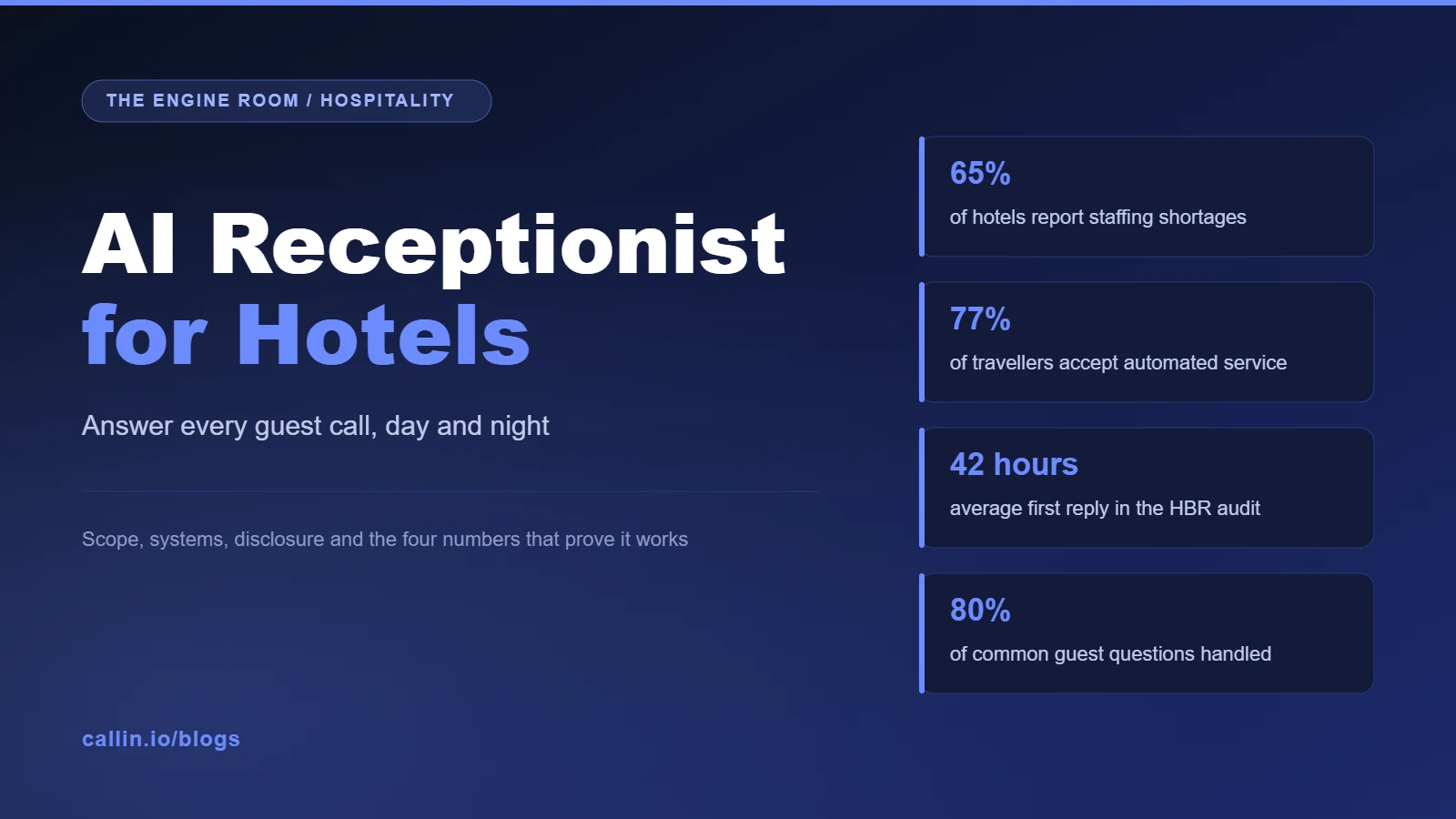
The pressure is structural, not seasonal: 65% of hotels surveyed by the American Hotel & Lodging Association still report staffing shortages, and front desk is the second hardest role to fill.
Guests are more open to this than most owners assume. In Oracle Hospitality research with Skift, 77% said they were open to automated messaging or chatbots for customer service.
The money is in the calls nobody answers: a reservation request that reaches voicemail usually becomes a booking on a travel platform, at a double digit commission.
The setup that works is boring on purpose: a short scope, a clean connection to the property management system, a disclosure line at the start of the call, and a warm transfer to the desk whenever the caller asks.
What an AI receptionist for hotels actually is
An AI receptionist for hotels is a voice agent that picks up your phone line, understands what the caller wants in natural speech, and completes the request inside your own systems.
It is not a kiosk in the lobby, and it is not the touchtone menu guests already resent. The caller talks, the agent answers.
Underneath, three pieces run in sequence on every call. Speech recognition turns the caller's audio into text. A language model decides what the request is and which action it maps to. A speech engine answers out loud, in the caller's language, while the action is written back to your property management system.
How it differs from an IVR
An interactive voice response tree makes the caller do the routing work. The caller has to translate a plain request into your menu structure, and the menu rarely contains the thing they wanted.
A voice agent inverts that. The caller states the request in their own words, and the agent does the translation. If you want the longer version of that distinction, we wrote it up in our guide to conversational IVR.

The four layers of hotel call handling, from a ringing phone to a resolved request. Source: Callin.io.
Why the hotel phone breaks down in the first place
The front desk is the only role in the building that is interrupted by design. It serves the person standing at the counter, the person on the phone, and the person in room 214 at the same time, with one pair of hands.
Hotel front desk staff describe it the same way everywhere. One thread on the r/TalesFromTheFrontDesk community captures it almost perfectly: the phone goes quiet for three hours, then starts ringing the moment a guest walks up to check in, five times in a row.
Another post in the same community is even more revealing. A night auditor describes glancing at the ringing phone while checking a guest in, lifting the handset and putting it straight back down without breaking the conversation. Nobody taught them that. The job taught them that.
The staffing data explains why it keeps happening. In a survey of 282 hoteliers run with Hireology between December 2024 and January 2025, the American Hotel & Lodging Association found that 65% of properties still report staffing shortages and 71% had openings they could not fill, with six to seven vacancies per property on average. Front desk was named as the most needed position by 26% of respondents, second only to housekeeping.
What guests actually call a hotel about
Before you automate anything, pull your call log for the last thirty days and sort by reason. Almost every property finds the same short list.
Availability and rates for specific dates, usually with one follow up question about cancellation.
New reservations, modifications and cancellations.
Arrival logistics: parking, airport transfer, what time reception is staffed, how to get in after midnight.
Breakfast hours, restaurant hours, spa hours, pool hours.
Pets, cots, extra beds, accessibility, luggage storage.
Invoices, receipts and billing questions after checkout.
Housekeeping and maintenance requests from in house guests.
Those seven lines are where a voice agent earns its keep, and they are also the lines that interrupt your staff most often. The pattern mirrors what we see across other sectors in our work on voice AI for customer service: a small number of intents cover the large majority of calls.
The case for answering every call, in numbers
Speed matters more than politeness on a reservation line. The classic study on response speed remains the audit of 2,241 companies published in Harvard Business Review by Oldroyd, McElheran and Elkington: the average first response took 42 hours, 23% of firms never responded at all, and firms that replied within an hour were roughly seven times more likely to qualify the lead than firms that waited one hour longer.
The unanswered caller has a ready alternative: a travel platform. That substitution is expensive. Booking Holdings reported $165.6 billion in gross travel bookings against $23.7 billion in revenues for the 2024 financial year in its fourth quarter results, which works out to roughly 14% of booking value retained by the platform. Every call you answer yourself is a booking that keeps that margin in the building.
On the cost side, Gartner predicted that conversational AI in contact centres would cut agent labour costs by $80 billion in 2026, with one in ten agent interactions automated against an estimated 1.6% at the time of writing. Hotels are not contact centres, but the switchboard half of the front desk behaves like one.

The four numbers worth putting in front of an owner before a pilot. Sources: AHLA and Hireology, Oracle Hospitality with Skift, Gartner, Harvard Business Review.
Do guests mind talking to a machine
Less than owners fear, and more than vendors claim. Both halves of that sentence matter.
In the Oracle Hospitality study Hospitality in 2025, run with Skift across 5,266 consumers and 633 hotel executives, 77% of travellers said they were open to automated messaging or chatbots for customer service and 73% wanted to use their own phone to manage the stay. On the operator side, 54% of hoteliers said they were prioritising front desk automation.
Wyndham gives a sense of the scale this reaches once it works. In its own July 2024 announcement of Wyndham Connect, the group said the platform answered around 80% of common guest enquiries automatically, across nearly 2,000 North American hotels at that point.
The resistance that does exist is specific, and it is worth reading properly. Threads on the r/smallbusiness community about automated answering come back again and again to one complaint, and it is not about synthetic voices. It is phone trees. People hate being routed. A voice agent that routes instead of resolving will inherit that hatred in full.

The guest on the other end of the line decides whether automation worked, not the dashboard. Photo: Vitaly Gariev on Unsplash.
What an AI receptionist should never handle alone
Scope is the whole game. The properties that regret this are the ones that pointed a voice agent at everything on day one.
Keep these off the agent's plate, permanently.
Card numbers read aloud. Take payment through a secure link sent by message, not through the voice channel.
Complaints with any emotional charge. A guest calling about a flooded bathroom at 2am wants a human being, immediately.
Group bookings, events, long stays and corporate rates. These are negotiations, not transactions.
Anything involving a medical issue, a safety concern, a lost child or a dispute between guests.
Any caller who asks for a person. Once, in any wording, and the call transfers.
There is also a security reason to be strict. The same front desk community documents a long running scam in which callers dial guest rooms directly, claim to be reception, and ask for card details. An automated line that asks for card numbers trains your guests to accept exactly that request from a voice they cannot verify.
How to set one up in about thirty days
The order matters more than the tooling. Run it in four blocks.
Week one: scope and content
Take the call log list from earlier and pick the five intents with the highest volume and the lowest risk. Write the answers as your staff actually say them, including the shortcuts. Opening hours, parking instructions and pet policy are usually the fastest wins.
Week two: connect the systems
Read and write access to the property management system is what separates a useful agent from an answering machine with a nicer voice. Availability, rates, reservation lookup and reservation creation need to be live, not pasted into a knowledge base. Our notes on building an AI phone agent cover how to stage this without touching production bookings on day one.
Week three: scripts, disclosure and escalation
Write the opening line, which must state that the caller is speaking to an automated assistant. Write the transfer rule, and the fallback for a request the agent does not recognise, which should be a transfer and never a loop. Then test with messy input: strong accents, background noise, a caller who changes their mind halfway.
Week four: run it narrow, then widen
Start with after hours only, or with overflow when the desk line is already engaged. Listen to every call for the first week. Widen scope one intent at a time, and only after the previous one is boring.
Skift's Suite Success podcast on the AI trends shaping hospitality, with Chris Sanderson of The Future Laboratory on where automation helps the guest experience and where it gets in the way. Source: Skift on YouTube.
Integrations that decide whether it works
A voice agent is only as capable as the systems it can reach. Four connections do most of the work.
Property management system. Availability, rates, reservation create and modify, guest lookup by surname and arrival date.
Channel manager. So a direct booking taken on the phone closes inventory everywhere else in the same minute.
Calendar and task system. For restaurant tables, spa slots and maintenance tickets. The mechanics are the same ones we describe in our piece on AI appointment scheduling.
Messaging. Confirmations, secure payment links and directions belong in a text message the guest can reopen, not in a spoken sentence they will forget.
Groups and management companies have one more requirement, which is running the same agent across many properties with different hours, languages and policies. That is a white label AI voice agent problem, and it is worth solving before the third property rather than after the tenth.
Compliance: disclosure is not optional
Two rules shape how the first ten seconds of the call have to sound.
In the European Union, Article 50 of the AI Act requires that people interacting directly with an AI system are informed of it, clearly and at the start of the interaction, unless that fact is obvious. The European Commission guidance confirms the obligation applies from 2 August 2026 and reads the obvious exception narrowly.
In the United States, the Federal Communications Commission ruled on 8 February 2024 that calls using AI generated voices are artificial under the Telephone Consumer Protection Act. That ruling is aimed at outbound robocalls rather than at answering your own inbound line, but it sets the direction clearly, and it matters the moment you start calling guests back.
Practically, this is one sentence at the start of the call and a logged recording policy. It costs nothing and it removes the complaint before it is made.

A pre launch checklist for a hotel voice agent, grouped by scope, systems, compliance and measurement. Source: Callin.io.
What to measure once it is live
Four numbers tell you whether it is working. Anything else is decoration.
Answer rate. Share of inbound calls answered within three rings, across the full 24 hours. This is the number that should move first.
Containment. Share of calls resolved without a transfer. Expect 50% to 70% on a narrow scope, and treat 95% as a warning sign that transfers are not firing.
Direct booking conversion. Share of availability enquiries that end in a reservation. Compare against the same month last year, not against last week.
Escalation quality. How many transfers reached a human in under twenty seconds. A transfer into a ringing void is worse than no agent at all.
Cost per resolved call is the fifth number, and it is the one owners ask about. Our breakdown of AI voice agent pricing explains why per minute rates and per seat rates produce very different bills at the same call volume, and the pricing page shows where we land.
Multilingual coverage and seasonal peaks
Two situations make the economics obvious even to sceptics.
The first is language. A property in a tourist region takes calls in four or five languages, and the night shift speaks two of them. A voice agent that answers in the caller's language removes a whole category of lost booking without a hiring round.
The second is the peak. Seasonal demand arrives as a spike on a Monday morning after a weekend of searches, and concurrency is where automation beats headcount: forty simultaneous calls cost the same as four.
The same logic applies beyond the guest line, which is why many groups extend the agent to supplier calls, internal IT support requests and the maintenance coordination that sits closer to property management than to hospitality.
Frequently asked questions
Can an AI agent really answer phone calls for a hotel?
Yes, for the defined set of requests you give it. A voice agent connected to your property management system can quote availability, take a reservation, change a date, state your pet policy and send a confirmation by message. It cannot negotiate a wedding block, and it should not try.
Can AI replace a hotel receptionist?
No, and framing it that way leads to bad deployments. It replaces the interruption, not the person. The value is that the receptionist stops abandoning the guest in front of them to answer a question about breakfast hours.
How much does an AI call answering service cost?
Voice agents are usually billed per minute of usage plus a platform fee, so your bill depends on average call length and monthly volume far more than on the headline rate. Model it against your own call log, and check whether setup, language packs and integrations are included.
Will guests know they are talking to an AI?
They should, because you tell them in the first sentence. Under Article 50 of the EU AI Act that disclosure is a legal requirement from August 2026, and in practice it also reduces friction: callers who know they are speaking to an assistant ask shorter, clearer questions.
What happens when the agent cannot handle the call?
It transfers, and the transfer rule is something you design rather than something you hope for. Define the destination for every hour of the day, including the hours when the desk is unstaffed, and verify that the fallback number actually rings. More on how we structure that in our overview of the AI receptionist model.
Does it work for a single independent property, or only for groups?
Single properties often see the clearest gain, because they have no reservations team and no night cover. A twenty room hotel with one receptionist on shift is the case where unanswered calls are pure lost revenue rather than a queue problem.
Where to start
Pick the narrowest version of this that would still change your week. For most properties that is after hours reservation calls, nothing else, for thirty days.
Pull the call log, count what you missed last month, and multiply by your average room rate. That number is the business case, and it is usually larger than the owner expects.
If you want to see how a hotel line sounds when it is handled properly, try our phone agent, look at how the AI voice platform connects to your property management system, and then start at callin.io.