Conversational AI Assistants: How They Work, Where They Fail, and How to Choose One in 2026
Conversational AI assistants explained: how they work, real 2026 data, where they fail, and an 8-point checklist to choose the right one for your business.
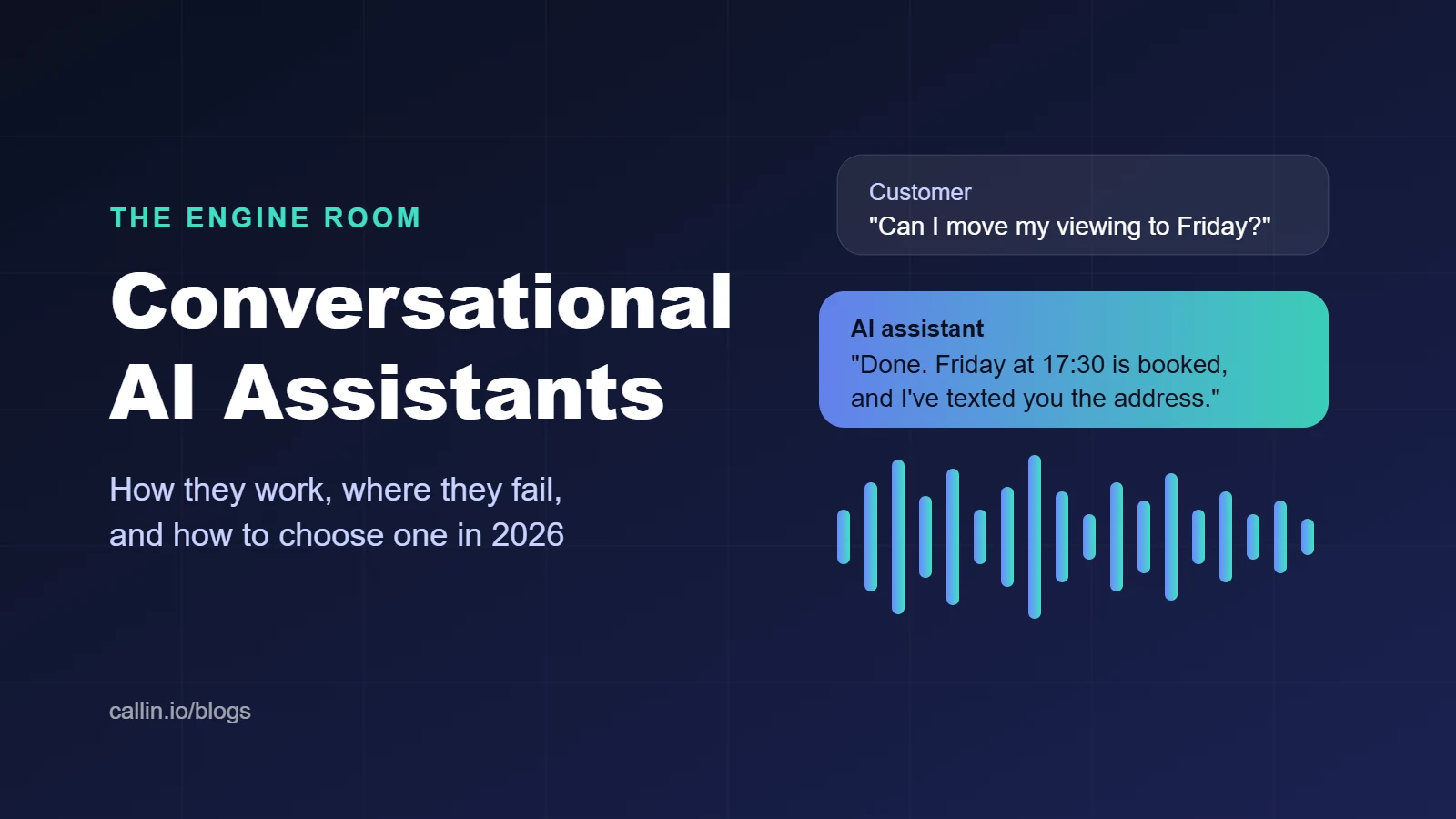
Conversational AI assistants are the software you can talk to or chat with in plain language, and that talks back like a person would. They answer questions, book appointments, update records and pass the conversation to a human when they should. In 2026 they sit on websites, inside WhatsApp and, more and more, on the phone line.
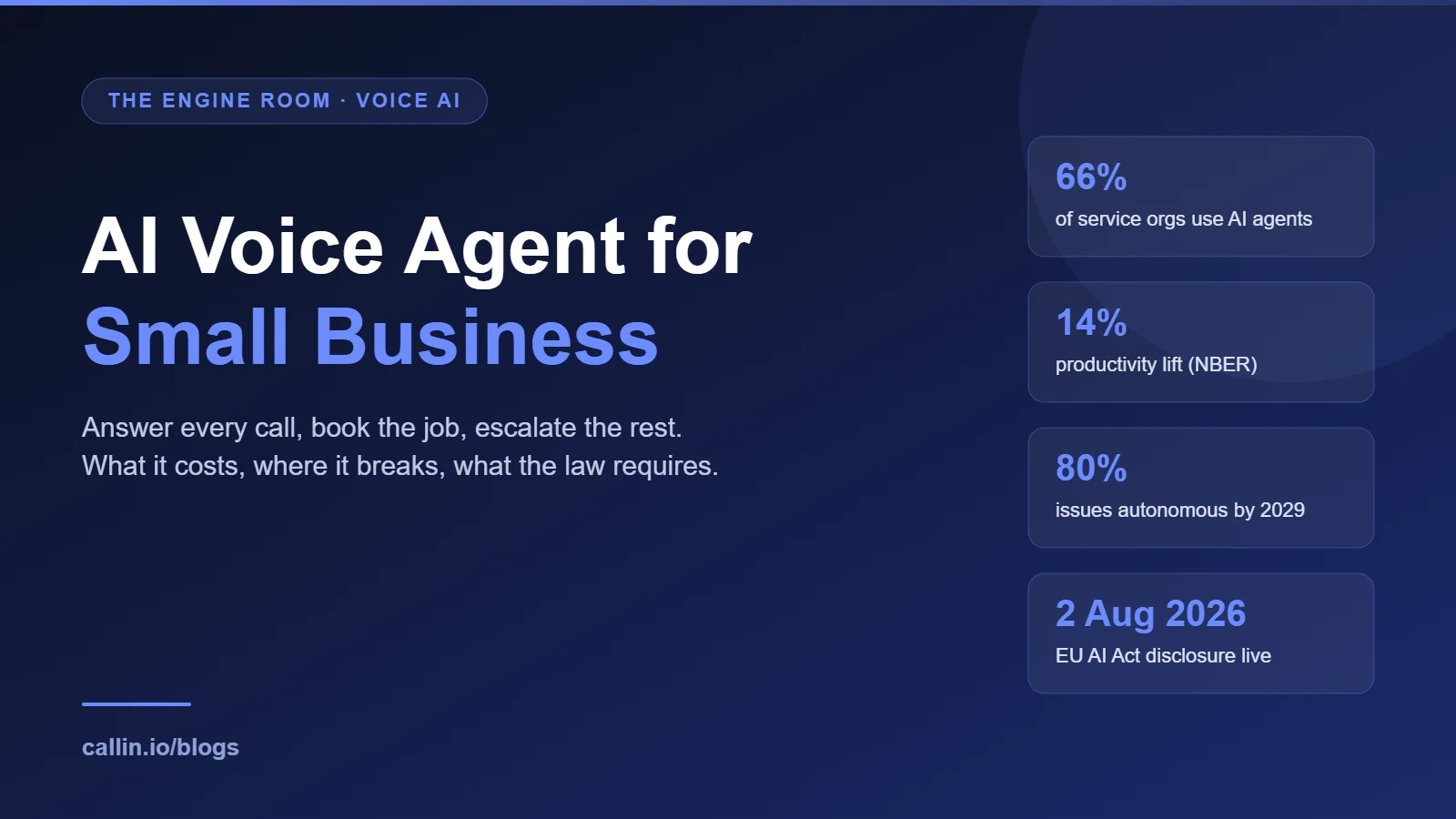
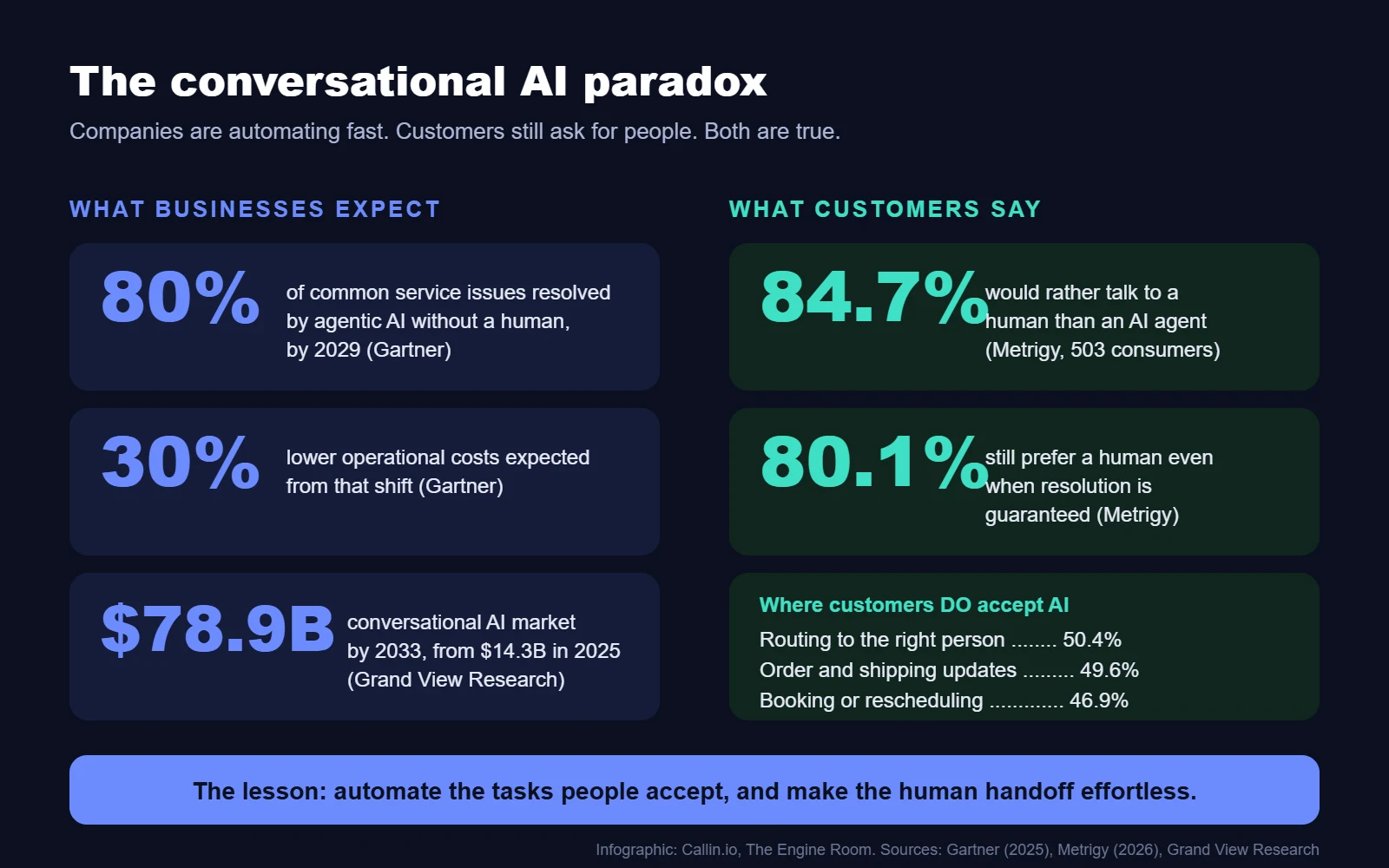
The numbers look like a gold rush. Gartner expects agentic AI to resolve 80% of common customer service issues without a human by 2029. Yet a 2026 Metrigy survey found that 84.7% of consumers would still rather speak to a person. This guide explains how both things can be true, and how to build an assistant your customers will actually want to use.
Key takeaways
A conversational AI assistant understands intent, keeps context and takes actions. A classic chatbot only follows a script.
The best results come from automating the tasks customers already accept: routing, order updates and bookings.
Most failures happen in production, not in the demo. Grounding, observability and a clean human handoff matter more than the model.
Judge vendors on cost per resolved conversation, not on price per seat or per minute alone.
What is a conversational AI assistant?
A conversational AI assistant is a system that uses natural language processing and large language models to hold a real dialogue. You don't need to pick from a menu or use exact keywords. You say what you need, the way you would say it to a colleague, and the assistant works out what you mean.
The key difference from an old chatbot is context and action. A rule-based bot matches keywords to prewritten answers and breaks as soon as you go off script. A conversational assistant remembers what you said three turns ago, asks a follow-up question when something is missing, and can call other systems to get the job done. IBM describes it as the combination of NLP, machine learning and large language models working together in real time.
Chatbot vs conversational AI assistant vs AI voice agent
Rule-based chatbot: buttons and keywords as input, little or no memory, actions limited to links and forms. Main challenge: rigidity.
Conversational AI assistant: free text as input, memory of the full conversation, actions through API calls, CRM updates and bookings. Main challenge: accuracy.
AI voice agent: natural speech on a phone line, memory of the full conversation, the same actions plus call transfer. Main challenge: accuracy plus latency.
There are three families you will hear about. General assistants such as ChatGPT, Claude or Gemini help individuals think and write. Internal assistants help employees find policies or fix IT issues. Customer-facing assistants talk to your clients on chat, email or voice. This article focuses on the third family, because that is where the business case, and the risk, is largest.
How conversational AI assistants work, step by step
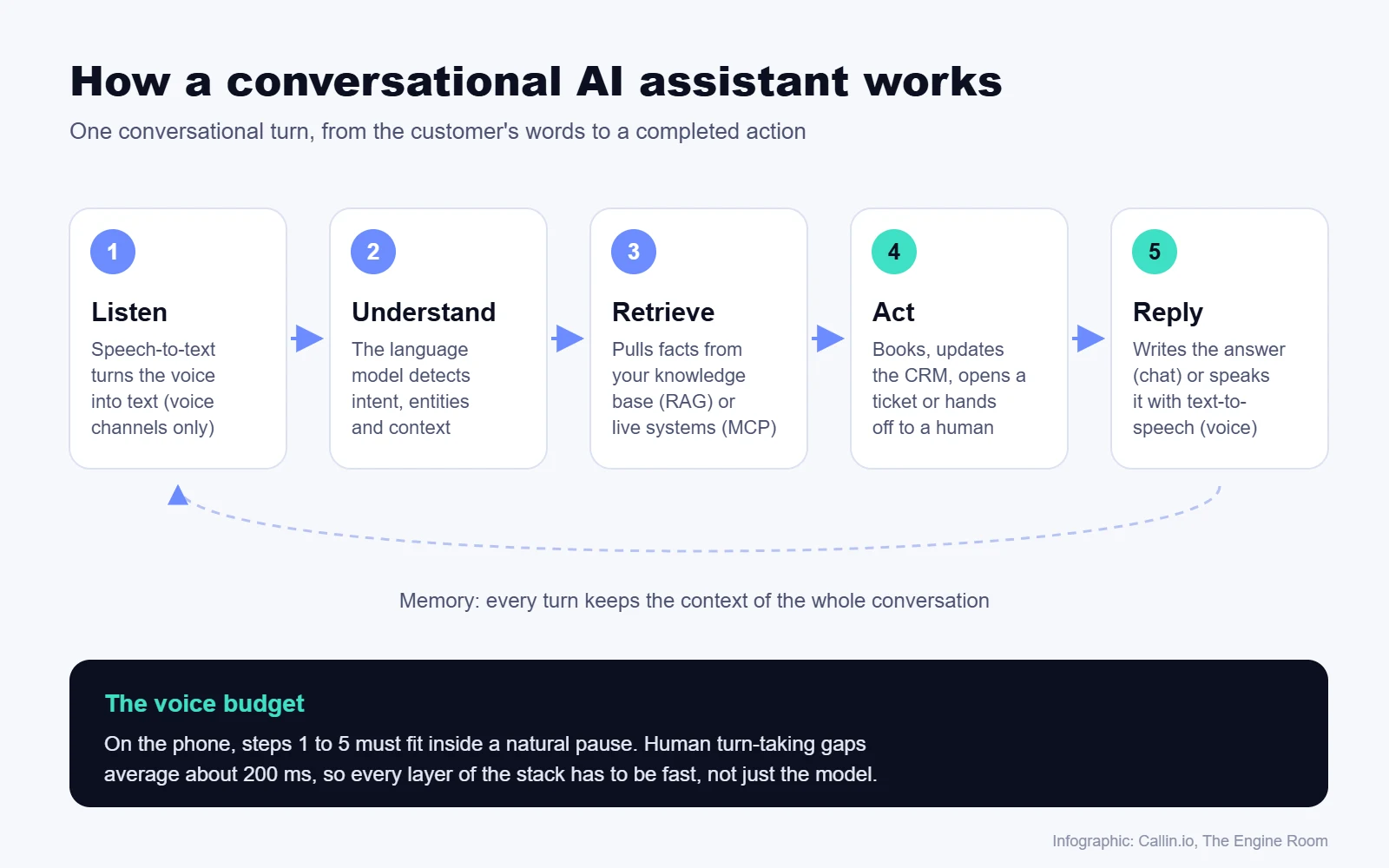
Every conversational turn follows the same loop: listen, understand, retrieve, act and reply. On a chat widget the first and last steps are simple text. On the phone, speech-to-text and text-to-speech add two more models to the chain, and each one adds delay.
Infographic: Callin.io, The Engine Room. Turn-taking data: Stivers et al., PNAS (2009)
Step three is where quality is won or lost. The assistant should not answer from the model's general memory. It should pull facts from your own sources, either through a knowledge base (RAG) or by querying live systems like your booking tool. We compared both approaches in RAG or MCP? How your AI agent retrieves information changes everything.
Speed matters more than most buyers expect. A cross-language study published in PNAS found that the gap between turns in human conversation averages around 200 milliseconds. Anything much slower on a phone call feels awkward, and callers start talking over the assistant. That is why voice platforms now compete on end-to-end response time, and why prompting for voice needs its own rules, as we explain in why a voice isn't a chat.
What the data says in 2026
The market is growing fast. Grand View Research sizes conversational AI at $14.3 billion in 2025 and projects $78.9 billion by 2033, a compound annual growth rate of 23.8%. Back in 2022, Gartner predicted that conversational AI would cut contact center agent labor costs by $80 billion in 2026, noting that labor can be up to 95% of contact center costs.
Infographic: Callin.io, The Engine Room. Sources: Gartner (2025), Metrigy (2026), Grand View Research
Now look at the other side. In Metrigy's study of 503 consumers, 80.1% would still choose a human even if they were told the AI would solve their problem. At the same time, 46% said they would use an AI agent in specific situations. The situations they named are telling: being directed to the right person (50.4%), shipping and order confirmations (49.6%) and scheduling or rescheduling appointments (46.9%).
People don't hate AI assistants. They hate being trapped by them. Automate the simple, repetitive tasks, and make the exit to a human instant.
There is also an internal gap to watch. According to Zendesk's CX Trends research, 72% of CX leaders say they have trained their teams on generative AI tools, but 55% of agents say they have received no training at all. An assistant is only as good as the people who configure, monitor and back it up.
Where conversational AI assistants deliver real value
The strongest use cases share three traits: high volume, repeatable questions and a clear action at the end. Here is where we see them pay off most often.
Real estate and property management
Agencies miss calls during viewings and after hours. An assistant can qualify buyers, book viewings and log maintenance requests straight into the CRM. See how this works in practice for property management teams and real estate lead qualification.
E-commerce and marketplaces
Order status, returns and delivery questions make up a large share of tickets. When Italian Gourmet UK deployed five AI agents across Amazon, eBay and Kaufland, the company saved £66,000 a year on customer support and kept to Amazon's 24-hour reply rule. Sensitive cases, such as refunds and complaints, still go to a person for approval.
IT support and internal help desks
Password resets, access requests and first-level troubleshooting are ideal for automation, as long as the assistant can open and update tickets. Our page on AI voice agents for IT support shows a typical Level 1 and Level 2 setup.
Healthcare and public services
Public bodies are testing assistants too, with strict guardrails. The US Centers for Medicare and Medicaid Services lists conversational AI assistants among the early adopter commitments in its health tech ecosystem, which shows how seriously the sector now takes them.

Photo: Charanjeet Dhiman on Unsplash. The goal is not to replace this team, but to give it back the hours spent on repetitive calls.
Where they fail, and how to prevent it
Demos are easy. Production is hard. Industry research summarised in our article on AI voice agents in production suggests that most funded AI agent projects never reach live customers, and the cause is rarely the model. It is missing governance: no test suite, no monitoring and no way to stop an agent that misbehaves.
Hallucinations are the first risk. A language model can state something false with total confidence, for example a price or an opening time. You cannot remove this risk completely, but you can shrink it with retrieval from verified sources and clear instructions to say "I don't know". We go deeper in LLM hallucinations: the problem nobody has truly solved.
Manipulation is the second. A caller can try to trick the assistant into ignoring its rules, a technique known as prompt injection. If your assistant can issue refunds or change bookings, this is not a theoretical problem. Read what prompt injection is and how to defend against it before you connect any sensitive action.
Regulation is the third. Since 2 August 2026, Article 50 of the EU AI Act requires that people are told when they are interacting with an AI system, unless it is obvious. For European businesses, a clear disclosure at the start of every chat or call is now a legal requirement, not a nice touch.
How to choose a conversational AI assistant: 8 questions
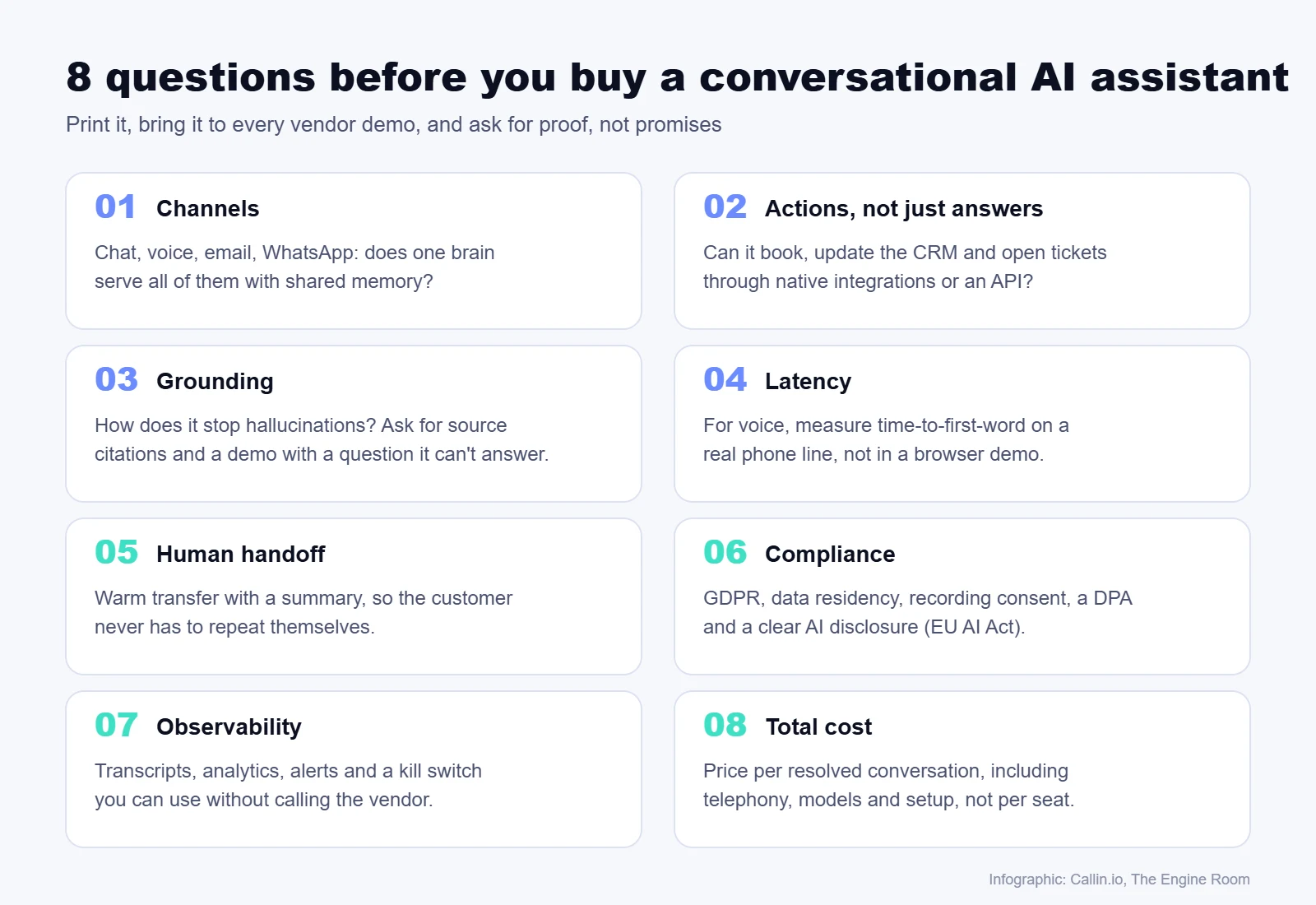
Most comparison lists rank tools by features. That is useful, but it hides what matters once the assistant is live. Bring these eight questions to every vendor demo and ask to see proof, not slides.
Infographic: Callin.io, The Engine Room
Two of these questions deserve extra attention. First, test latency on a real phone line, from a mobile, during business hours. Browser demos run on perfect connections and hide the delay your customers will feel. Second, ask for the cost per resolved conversation. A cheap per-minute rate means little if half the calls end with a transfer. Our guide to what an AI voice agent really costs in 2026 breaks down every layer, from telephony to models.
A 5-step rollout plan that works
Pick one use case. Choose a single, high-volume task, like booking or order status, and define what "resolved" means.
Collect real conversations. Use past calls, emails and chats to write the knowledge base and the test cases.
Launch with a safety net. Start with human approval on sensitive actions, as Italian Gourmet did for refunds.
Monitor every conversation. Read transcripts weekly, track resolution and transfer rates, and fix the top three failure reasons.
Expand gradually. Add a new task or channel only when the first one is stable.
This approach feels slow, but it is the fastest route to results that last. Teams that try to automate everything on day one usually end up switching the assistant off after a bad week.
Watch: conversational AI in five minutes
If you want a quick visual overview of the technology before talking to vendors, this short explainer from IBM Technology is a good place to start.
Frequently asked questions
What is the difference between a chatbot and a conversational AI assistant?
A chatbot follows fixed rules and scripts. A conversational AI assistant understands free language, remembers context across the conversation and can take actions in other systems, like booking an appointment or updating a CRM.
Are conversational AI assistants only for large companies?
No. Small businesses often benefit the most, because a single missed call can mean a lost customer. Pricing is now usage-based on many platforms, so a small team can start with one use case and a limited budget.
Will a conversational AI assistant replace my support team?
In most cases it replaces tasks, not people. It absorbs repetitive questions and after-hours volume, so your team can focus on complex, high-value conversations where customers clearly prefer a human.
Do I have to tell customers they are talking to an AI?
In the European Union, yes. Since August 2026 the AI Act requires that people are informed when they interact with an AI system, unless it is obvious from the context. Being transparent also builds trust.
How long does it take to launch one?
A focused use case with a clean knowledge base can go live in a few weeks. Integrations with your CRM or booking system and a proper testing phase are what take most of the time.
The bottom line
Conversational AI assistants are no longer an experiment. They are becoming the front door of customer service. The winners will not be the companies that automate the most, but the ones that automate the right things, measure every conversation and always leave a clear path to a human.
If you want to see what a production-grade voice assistant sounds like, try Callin.io for free or book a demo with our team.